Cambodia faces slow growth, but core economic strength persists
Cambodia faces slow growth, but core economic strength persists
While growth is expected to moderate between 4 and 5 percent over the next two years, analysts emphasise that the situation represents an adjustment rather than a contraction.

Cambodia’s economy is poised to experience slower growth in 2025 and 2026 as new assessments from international institutions outline a landscape shaped by external tensions, weakening tourism, falling remittances and persistent property-sector pressures. Yet several core indicators show resilience, suggesting the economy maintains a stable foundation if policy responses remain targeted and coordinated.
The International Monetary Fund (IMF), in its Article IV Consultation completed on November 21, 2025, said Cambodia entered the year with solid momentum following a strong rebound in 2024, when growth reached 6 percent on the back of garment and agricultural exports and a revived tourism sector.
Now casting for the first half of 2025 indicated expansion of 6.2 percent year-on-year, but that momentum has been increasingly undermined by a series of shocks. The IMF noted that trade disruptions, geopolitical tensions and subdued credit growth have begun to expose underlying vulnerabilities. The second half of the year shows “clear signs of deceleration”.
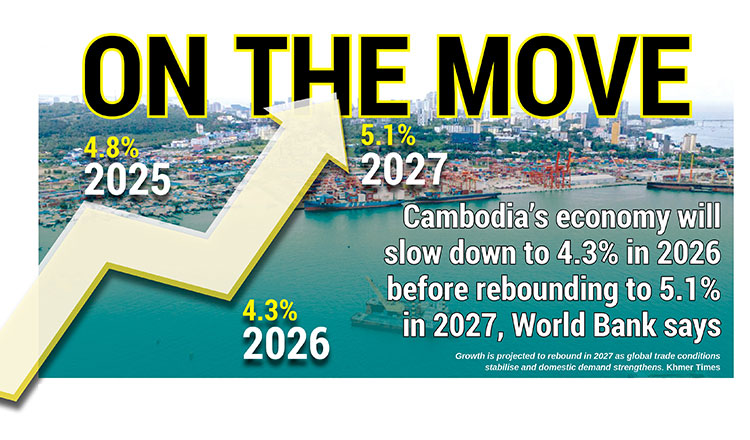
The IMF now projects growth of 4.8 percent in 2025 and around 4 percent in 2026, marking a substantial downward revision from earlier expectations. The slowdown is attributed to a sharp decline in remittances as large numbers of Cambodian migrant workers return from Thailand, weakened tourist inflows and tightening conditions for manufacturers facing tariff pressures in major markets.
The Executive Board stressed that Cambodia’s narrow export base leaves it highly sensitive to global demand fluctuations and regional instability, but also highlighted the country’s strengths, including a young labour force, stable macroeconomic policy and expanding economic partnerships.
To safeguard stability, the IMF recommended maintaining targeted and temporary fiscal support for vulnerable households and returnees, followed by gradual consolidation in the medium term to rebuild buffers. It urged stronger revenue mobilisation and more efficient public spending. The Board encouraged continued steps to restore pre-pandemic reserve requirements and strengthen the transmission of monetary policy in riel.
On financial stability, Directors supported the phase-out of forbearance measures by the end of 2025 to allow proper recognition of distressed assets, calling for improved supervisory capacity, better asset quality assessments and reforms to insolvency frameworks. They also stressed the importance of governance improvements, stronger anti-money-laundering compliance and better oversight of major public projects.
The Asian Development Bank (ADB), in its Asian Development Outlook for September 2025, similarly revised Cambodia’s growth projections downward—from 6.1 percent to 4.9 percent for 2025 and from 6.2 percent to 5.0 percent for 2026. The ADB cited geopolitical tensions with Thailand and uncertainty over US market conditions as key drivers of the softer outlook. Yet the Bank offered cautious optimism, with ADB Country Director Jyotsana Varma noting that the first half of the year demonstrated Cambodia’s capacity to absorb shocks, supported by lower-than-expected food inflation, declining fuel prices and steady industrial output.
Inflation fell sharply from 6 percent in January to 1.6 percent in June, and is expected to stabilise at around 2 percent through 2025-2026. The industrial sector remains the main economic engine.
Garment exports rose more than 22 percent year-on-year in the first half of 2025, partly because US buyers accelerated shipments ahead of possible tariff changes. The ADB expects the sector to retain momentum due to relatively favourable market conditions and ongoing FDI into garment and non-garment industries.
Tourism, however, continues to recover unevenly. Although Chinese arrivals improved early in the year, tensions along the Thai border disrupted regional travel flows and weighed on services. The ADB expects slower services growth, while agriculture is forecast to expand modestly, supported by cashew and rice exports but limited by labour disruptions caused by returning migrant workers.
A perspective from Mekong Strategic Capital’s December 2025 Cambodia Economic Update describes the economy as operating at “two speeds”. On one side, domestic consumption remains strong and exports continue to perform well. On the other, external shocks and structural challenges are slowing overall momentum. The firm estimates that more than 900,000 Cambodians have returned from Thailand since border conflict began. With remittances previously valued at $1.5 billion annually, up to $1.125 billion could be lost, reducing GDP by an estimated 1.8 percent.
Tourism is also under pressure. The firm says Angkor ticket sales fell by around 20 percent in the last six months, while overall East Asian arrivals remain well below pre-pandemic levels. A 15 percent decline in tourism linked to border tensions could reduce GDP by a further 2 percent. The report also notes economic impacts stemming from the government’s crackdown on scam centres. Although these measures are estimated to temporarily shave 1-2 percent off GDP due to the elimination of illegal operations, the firm stresses that they are essential to preventing long-term reputational harm that could deter legitimate investment.
Despite these pressures, domestic economic activity has shown resilience. VAT and excise collections rose 23 percent as of September 2025, reflecting strong consumption. Vehicle imports surged 50 percent, and manufacturing exports expanded by 15.2 percent year-to-date despite uncertainty over US tariff changes. Imports of machinery and electrical equipment jumped 93 percent, signalling continued investment in industrial capacity.
The property market, however, remains the most persistent drag on growth. Cambodia is estimated to hold up to ten years of unsold residential inventory, with the slowdown spilling into the banking system. Mekong Strategic Capital estimates that $10.6 billion in loans—around 17.5 percent of total credit—are in arrears or have been restructured, suggesting the sector will stay subdued for an extended period.
The report also points out that Cambodia retains considerable fiscal space. Public debt stands at a present-value ratio of 18.8 percent of GDP, among the lowest in the region. With long maturities and favourable interest rates, the government has room to deploy more assertive stimulus to support growth.
The country’s demographic dividend remains a major advantage, as the working-age population is projected to expand through 2050, unlike many neighbouring countries. This trend is expected to support long-term growth in manufacturing, consumption and emerging sectors such as care services and specialised tourism.
Academics share the view that Cambodia’s fundamentals remain sound. Thong Mengdavid, a lecturer at the Institute for International Studies and Public Policy, told Khmer Times that Cambodia has so far remained steady due to swift government action and a more diversified network of economic partners.
But he warned that prolonged regional tensions could deepen the economic impact. He said declining remittances would weaken household income and consumption, urging strengthened migration pathways with Japan, South Korea and other destinations. Tourism, he added, remains highly vulnerable to travel advisories and regional instability.
Mengdavid called for continued support for affected workers and acceleration of long-term reforms, including diversifying trade routes, improving tourism safety and promotion, and expanding training programmes for returning workers. Clear communication with investors and sustained social protection, he said, will be critical in maintaining confidence.
While growth is expected to moderate between 4 and 5 percent over the next two years, analysts emphasise that the situation represents an adjustment rather than a contraction. Cambodia continues to benefit from a young population, rising regional integration, steady industrial investment and a demonstrated capacity to absorb shocks. Policymakers now face the task of managing short-term pressures while laying the groundwork for a stronger, more resilient recovery in the years ahead.
- 16:22 01/01/2026