Cambodia navigates trade growth despite imbalances, risks
Cambodia navigates trade growth despite imbalances, risks
Diversifying export markets and upgrading domestic manufacturing will be critical for Cambodia to maintain competitiveness and mitigate future vulnerabilities.
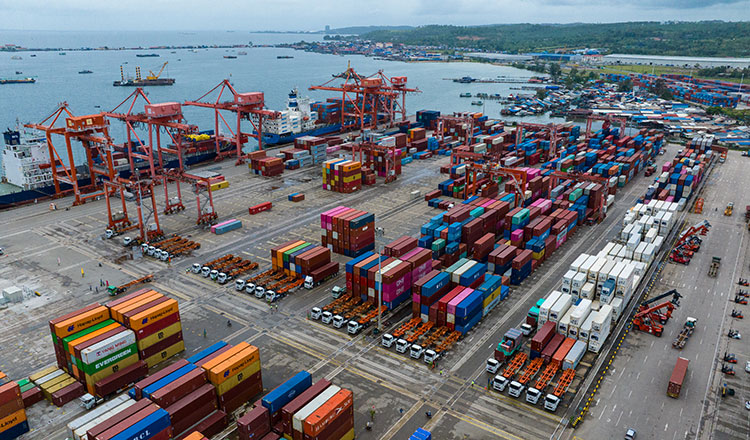
Despite robust gains this year, Cambodia’s trade remains vulnerable to imbalances, overreliance on key partners, and regional uncertainties. As the Kingdom enters 2026, diversification, stronger local industries, and resilient supply chains will be crucial to sustain growth and weather external shocks.
Overall trade volumes in 2025 remained resilient, yet persistent imbalances and exposure to external shocks underscore the urgent need for strategic policy measures and long-term planning.
Cambodia continued to rely heavily on the United States, China, Vietnam, Thailand, and Japan, which together dominate the country’s foreign trade landscape.
According to the General Department of Customs and Excise (GDCE) data covering January to November, China remained the largest trading partner, with bilateral trade exceeding $17.7 billion.
Exports grew 14 percent to $1.5 billion, while imports surged 18.2 percent to $16.2 billion, resulting in a $14.7 billion trade deficit.
This deficit highlights Cambodia’s dependence on Chinese machinery, consumer goods, and industrial products, leaving the economy sensitive to global shocks.
While exports to China increased, potential changes in Chinese trade policy or supply chain disruptions pose significant risks heading into 2026. Strengthening local production and diversifying sourcing will be key to enhancing resilience.
The United States maintained its position as the second-largest trading partner, with total trade reaching $11.8 billion, up 27.7 percent. Exports climbed 27.1 percent to $11.5 billion, while imports increased 50.3 percent to $367 million, generating a strong trade surplus despite a 19 percent tariff introduced in August.
The surplus reflected Cambodia’s export-oriented textile and garment industries, which continue to meet high American demand. However, reliance on a few sectors exposed the Kingdom to policy shifts, trade barriers or US economic downturns.
Diversifying export markets and upgrading domestic manufacturing will be essential for maintaining competitiveness and mitigating future vulnerabilities.
Trade with Vietnam reached $7.13 billion, with exports rising 0.4 percent to $3.39 billion and imports falling 1.4 percent to $3.73 billion. Stagnant export growth signals difficulties in expanding market share, compounded by logistical constraints, tariffs, and competition from other ASEAN exporters.
Boosting trade with Vietnam in 2026 will require targeted infrastructure investments, streamlined cross-border logistics, and proactive export promotion strategies. These measures could strengthen regional commerce, improve supply chain efficiency, and support broader economic development within Southeast Asia.
Trade with Thailand contracted sharply, totalling $3.41 billion, as exports fell 13.8 percent to $679 million and imports declined 12.7 percent to $2.73 billion. Ongoing border conflicts disrupted trade and logistics, threatening supply chains, investor confidence, and regional integration in critical agricultural and manufacturing sectors.
Resolving tensions with Thailand through sustained diplomacy and the establishment of secure and efficient trade corridors is crucial for restoring bilateral commerce, stabilising supply chains and safeguarding economic growth in border regions.
Stabilising cross-border trade would mitigate losses, protect farmers and manufacturers, and strengthen Cambodia’s position within ASEAN, ensuring regional connectivity and economic resilience despite geopolitical uncertainties.
Japan ranked fifth among Cambodia’s partners, with total trade reaching $2.3 billion, up 18 percent. Exports grew 12.6 percent to $1.4 billion, while imports increased 28.1 percent to $564 million. Cambodia supplies garments, agriculture and electronics to Japan while importing machinery and industrial goods.
Strengthening domestic value-added production and deepening industrial collaboration with Japan can support skills transfer, innovation, and sustainable economic growth, while advancing Cambodia’s technological capabilities in 2026 and beyond.
Speaking to Khmer Times, Anthony Galliano, Vice President of the American Chamber of Commerce in Cambodia (AmCham), said the durability and tenacity of the garment sector have been both remarkable and a bright spot for the nation’s economy.
Although tariffs were an unforeseen shock and a potential considerable disruption to the economy, and were initially anticipated to be devastating, this has not been the case. Cambodia can safely claim to have turned challenges into opportunities, said Galliano, also the Group CEO of Cambodian Investment Management Holdings (CIM).
He explained that Cambodia profited from tariff-driven diversion benefit, gaining orders not because tariffs were imposed on it, but because they were imposed on others. “The indirect win was a consequence of the US imposition of punitive tariffs on Chinese apparel, causing diversified sourcing away from China and shifting orders to Cambodia, he said
He continued that the global imposition of tariffs made Cambodia more attractive without changing its own tariff structure, and a safe alternative in global supply chains. Mainly due to low labour costs and a large, export-oriented garment workforce.
“In the absence of any geopolitical conflict with the United States, the bilateral trade relationship should continue to flourish. The Trump administration’s position on Cambodia remains favourable, although this has been strained by recent actions on scam centres and the reemergence of the border conflict.”
The sector’s sustainability and future prosperity will hinge mostly on the relationship of the two governments, the US now 43 percent of Cambodia’s exports, and improvement in customs and policing illicit practices, he added.
When asked about the strategies Cambodia should pursue to reduce its heavy trade deficit with China, he said that the garment sector is quite a simple model, with China being the main supplier of raw materials. “China substantially supplies the inputs, Cambodia reworks them into final products, and the US buys them. There are alternatives to China,” he noted.
He emphasised that Vietnam has a strong textile ecosystem and lower logistics costs due to proximity. Bangladesh is extremely competitive in cotton textiles but has challenges with logistics and capacity as it prioritises the domestic garment industry. Thailand supplies high-quality fabrics, dyes, chemicals and accessories, but that is off the table until relations are reset.
Cambodia does have an opportunity to diversify its supply chain, but must also not disrupt the critical foreign direct investor relationship it has with China, more important than diversifying its export relationship, the AmCham Vice-President noted.
When further asked about how Cambodia can diversify its export markets and reduce dependence on a few major trading partners amid the renewed border conflict with Thailand, he said the concentration of trading partners is alarming, but has been the case for years. The US account for 43 percent of exports as a singular country.
“Rather than diminishing, exports to the US are increasing at a feverish pace. The reality is that the US is the largest economy in the world, has the biggest consumer demand market, and this is unlikely to change in the short to medium term,” Galliano noted.
He underlined that Cambodia is pursuing new markets for its products, but the reality is that a win in a small country may be equivalent to a city in the US. “Perhaps this two-prong strategy of growing the trade relationship with the largest consumer market in the world and concurrently tapping into other markets is the best approach,” he added.
- 16:19 01/01/2026