Cambodia secures $5.1B FDI in 2025, up 16%
Cambodia secures $5.1B FDI in 2025, up 16%
The increase in the FDI indicates that investors, both regional and Western, repose confidence in the Kingdom’s macroeconomic stability, open investment policy and reforms, an expert says.
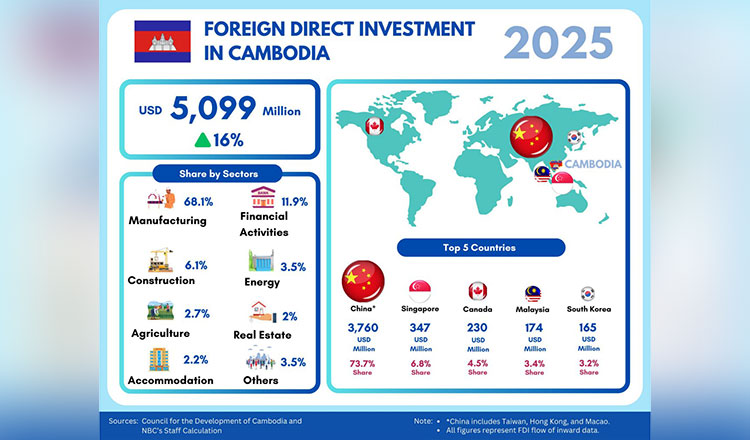
Cambodia attracted $5.1 billion in foreign direct investment (FDI) last year, an increase of 16 per cent from 2024, with China dominating the manufacturing sector, the National Bank of Cambodia (NBC) reported yesterday.
According to the Council for the Development of Cambodia and the NBC’s calculation, China remained the leading source of FDI, contributing approximately $3.76 billion, up 42.3 percent from $2.6 billion in 2024.
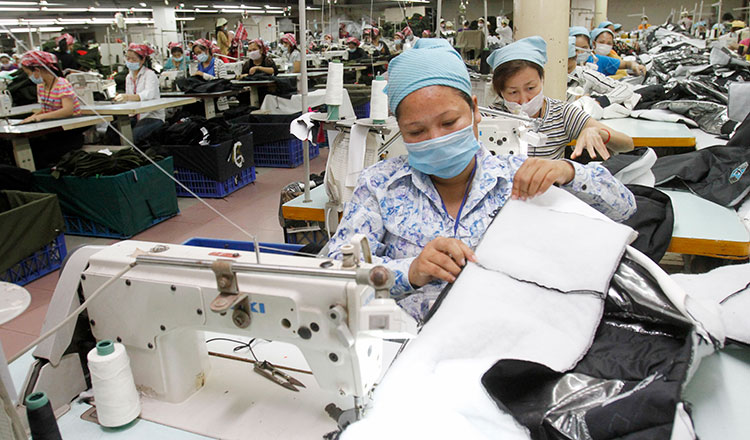
The sharp rise reflected strong momentum from Chinese enterprises in export-oriented manufacturing — including garments, electronics assembly, machinery components, and light industrial production — signalling Cambodia’s expanding role in regional supply chains.
Singapore ranked second with $347 million, accounting for 6.8 percent of total inflows. Canada came third with $230 million, contributing 4.5 percent. Malaysia invested $174 million, representing 3.4 percent of total FDI, while South Korea contributed $165 million, equivalent to 3.2 percent.
Although considerably smaller than China’s dominant share, these figures demonstrated sustained diversification of the investment sources, highlighting ongoing interest and confidence from both regional neighbours and Western investors across various key sectors.
Overall, Cambodia recorded $5.1 billion in FDI in 2025, compared to $4.4 billion in the previous year, marking steady year-on-year growth despite global economic headwinds, geopolitical tensions, and tighter financial conditions in major economies.
Of the total, China accounted for 73.7 percent of total FDI, consolidating its position as Cambodia’s largest foreign investor and a key partner in the Kingdom’s industrial development.
The increase was driven by key sectors, including manufacturing 68.1 percent, financial activities 11.9 percent, construction 6.1 percent, energy 3.5 percent, agriculture 2.7 percent, accommodation 2.2 percent, real estate 2.0 percent and others 3.5 percent.
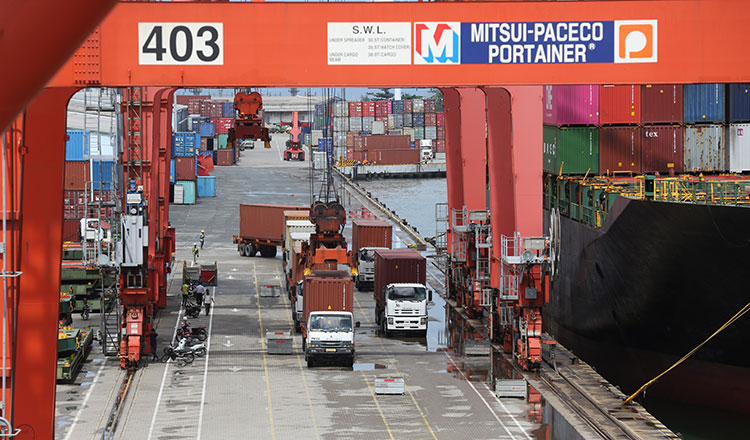
Sectoral data showed that manufacturing attracted the largest share at 68.1 percent, underscoring its central role in the Kingdom’s economic structure and export growth strategy.
Financial activities accounted for 11.9 percent, reflecting expansion in banking, microfinance, and related services to support business activity.
Construction represented 6.1 percent, while the energy sector captured 3.5 percent, highlighting continued investment in power generation and infrastructure to sustain industrial growth.
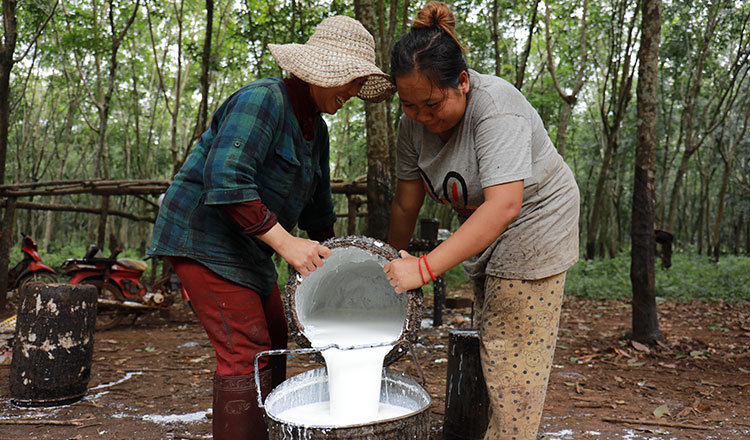
Agriculture received 2.7 percent, accommodation services accounted for 2.2 percent, and real estate 2.0 percent of total inflows. The remaining 3.5 percent was distributed across other sectors, including logistics and services.
The latest figures demonstrated Cambodia’s resilience in attracting foreign capital and its ongoing efforts to strengthen its investment climate, promote economic diversification and enhance competitiveness in priority sectors.
Speaking to Khmer Times, leading economist Duch Darin said, “The 16 percent increase in the FDI to $5.1 billion indicates that investors continue to repose confidence in Cambodia’s macroeconomic stability, open investment policy and reforms.
Darin noted that diverse FDI is economically important because it facilitates industrial upgrading, attracts more financial capital, supports export diversification, promotes technology transfer and creates more jobs.
“Continued FDI inflows will not only further consolidate Cambodia’s industrial base but also lead to a sustainable expansion and improved living conditions,” he added.
- 11:42 17/02/2026