Kingdom’s rubber exports bring $239M, stand next to garments
Kingdom’s rubber exports bring $239M, stand next to garments
Rubber has emerged as one of Cambodia’s key agricultural export earners, contributing alongside garments, footwear, travel goods and agricultural produce to the Kingdom’s expanding export basket.
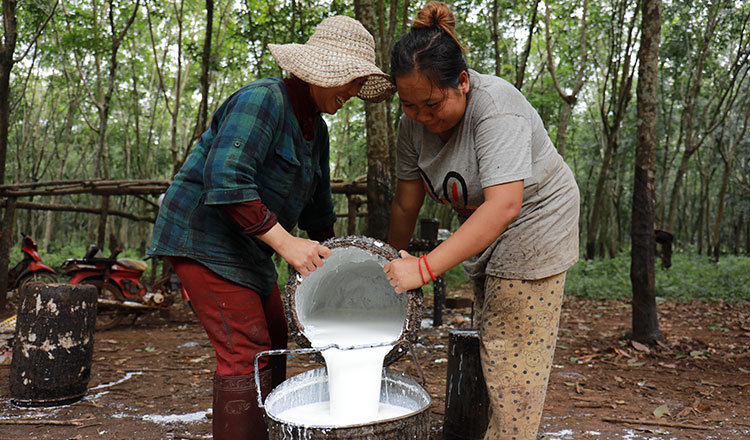
Cambodia’s export sector saw a significant upswing in rubber and rubber article shipments in January 2026, as export revenues surged to $239 million, up 66 percent from $144 million in January 2025, according to trade data from the General Department of Customs and Excise (GDCE), highlighting the Kingdom’s growing position in the global rubber market.
In value terms, Cambodia’s exports of rubber and rubber-based products stand only next to the garments’ exports in January 2026.
This jump reflects not only higher export volumes but also supportive global price trends and expanding value-added processing in the domestic industry. Analysts say that rising international demand — particularly from tyre manufacturers and industrial buyers in Asia — has helped push export earnings higher, even as domestic production continues to grow.
Rubber has emerged as one of Cambodia’s key agricultural export earners, contributing alongside garments, footwear, travel goods and agricultural produce to the Kingdom’s expanding export basket. In 2025, Cambodia posted robust growth in its rubber industry, with annual rubber and rubber-based product exports climbing significantly compared to 2024 levels.
Rubber exports recorded a strong performance in 2025, increasing by 37 percent compared to 2024 to reach $2.06 billion, underlining a broader expansion beyond raw latex into semi-finished and finished products.
Export growth has been underpinned by supportive government policies, improved farming practices, and increased investment in processing facilities and downstream industries such as tyre manufacturing. The presence of multiple tyre factories in provinces like Svay Rieng, Preah Sihanouk and Kratie has boosted domestic demand for locally grown rubber and expanded the industry’s value chain, absorbing larger shares of production and supporting higher export earnings.
Global natural rubber prices have shown fluctuations in recent months, influenced by supply-demand dynamics, production costs, and weather conditions in major producing countries.
Benchmark rubber prices have rebounded modestly in early 2026, rising to around $1.92 per kg — marking a mild uptick over the past month and reflecting renewed buying interest.
The broader natural rubber market has experienced periodic volatility, with prices dipping at times in 2025 due to seasonal supply variations and subdued downstream demand. Still, forecasts point to a generally firm outlook in 2026 as global consumption — particularly from the automotive sector, medical rubber goods, and infrastructure construction — continues to grow and supply constraints persist in some producing regions.
Importantly, Cambodian export prices have themselves reflected these global trends. Official figures from 2025 show the average export price of rubber latex hovered near US $1,756 per tonne, modestly higher than the previous year, which supported export revenue growth despite mixed volume trends.
Despite promising export figures, the Cambodian rubber sector faces challenges that mirror broader global industry patterns. These include weather-related production risks, cost pressures from labour and inputs, and competition from other major Southeast Asian producers.
Moreover, while exports have climbed, rising domestic demand — especially from local manufacturing — has in some periods absorbed larger portions of output, slightly moderating export volume growth.
Industry stakeholders also highlight opportunities in value-added products and diversification into rubber wood and processed goods, which can capture higher margins and drive further export growth. Ongoing discussions with international partners to develop rubberwood industries and end-of-life wood processing reflect this strategic push.
The rubber sector remains one of Cambodia’s important agricultural industries, supporting thousands of smallholder farmers and plantation workers, especially in provinces such as Kampong Cham, Kratie, Mondulkiri and Ratanakiri.
With natural rubber prices expected to remain resilient and demand for rubber-intensive products like tyres and industrial components holding steady, Cambodia’s rubber export sector is well-positioned for continued expansion in 2026.
- 08:24 13/02/2026