What keeps a car brand in Cambodia
What keeps a car brand in Cambodia
Volkswagen is cutting, so is Jaguar Land Rover, and carmakers everywhere are pruning the markets that no longer pay. Cambodia has an unusual number of badges to lose and holds two levers over what happens next
Volkswagen told investors on September 18 that its operating return on sales for 2026 will be 1% or less, against earlier guidance of 4 to 5.5%, after a charge of about €10 billion. Eleven days earlier, Jaguar Land Rover said it would remove about 4,000 jobs and take £1.7 billion out of its costs, resetting its break-even to roughly 300,000 vehicles a year. Nissan has forecast a net loss of about $4.2 billion and its chief executive has declined to rule out a sale of the company.
Companies in that position stop asking which markets they want and start asking which ones they can afford. Distribution agreements get reviewed, regional offices get merged, and small markets get folded into larger neighbours.
Which raises a question worth answering from Phnom Penh rather than from Wolfsburg: What makes a car brand stay in a market, and what makes one stay in this one?
Cambodia has more riding on the answer than a market this size usually would. Chinese, Japanese, American and European brands all hold real positions here, competing against each other in the same city. Very few markets of comparable size carry that range, and buyers here get both the choice and the pricing that comes with it.
New badges are still arriving. The Ministry of Public Works and Transport reported on September 15 that 16,926 electric cars were registered in Cambodia between 2021 and August 2026, and that 6,563 of those arrived in the six months from March, the period covering Sub-Decree 52 and its removal of import duty on battery electric vehicles and plug-in hybrids from April 1. Phan Rim, the ministry spokesman, attributed the acceleration to fuel prices. BYD, GWM, Zeekr, GAC and Dongfeng all sell into that segment.
Cambodia has also demonstrated that it can lose a brand, and the reason had nothing to do with the pressures now reshaping Europe.
Automotive Asia (Cambodia) stopped operating as Audi’s official distributor on December 31, 2022, and the Audi Phnom Penh dealership closed permanently the following day. Owners were told that service and warranty work, including technical recall campaigns, would be handled from Audi Tan Binh in Ho Chi Minh City, and were given a Vietnamese email address and a Vietnamese telephone number to register with. Star Auto (Cambodia) gave up its rights to import, distribute and sell Mercedes-Benz two months later, on February 28, 2023.
Demand was not the problem for either German marque, as the streets of Phnom Penh make obvious. The problem was arithmetic at the border. Cambodia applies import duty, special tax and value-added tax to a vehicle’s declared cost, insurance and freight value. All three run off the same base, so a low declared figure cuts all three at once, and special tax rises with engine size, which compounds the effect at the top of a price list rather than the bottom. Official importers declare full value. Parallel stock clears on docket values set well below what the cars are worth. On a mainstream model the resulting gap runs from a few thousand dollars to $50,000.
Whatever a parent company decides about its global footprint, the question it asks about any individual market is whether the official channel can earn money there, and Cambodia answers with an uneven playing field.
Levelling it requires two instruments this market has for keeping premium and volume brands.
For premium marques, the instrument is the valuation rule, and this time it is being argued before the cars are ordered rather than after a brand has gone. RMA (Cambodia) holds the Mercedes-Benz dealership, with its first new cars due before December, or in the first quarter of 2027 if the paperwork runs long. Before ordering any of them, the company has engaged government authorities on fair and transparent docket pricing.
“There should be a fair playing field for everyone,” says Rith Chanrothanak, general manager for Mercedes-Benz at RMA (Cambodia), who puts the gap at the top of the Mercedes range as high as $100,000. What the company wants is a valuation floor, a minimum figure customs would not go below for a given model whatever invoice is presented. Such a floor raises the landed cost of under-declared grey imports.
For volume brands the instrument is the assembly plant, because a distribution agreement ends with a letter and a factory does not. RMA opened a Ford plant at Pursat in 2022 and built about 3,000 Ranger Wildtrak and Everest models within its first year. In May, the company told the Cambodian Investment Board that it wants to expand beyond assembly into component manufacturing.
The difficulty is that local assembly in Cambodia does not currently do what it does elsewhere. Assembling a battery electric vehicle here costs about $4,000 more per car than importing one fully built, according to the EuroCham Automotive Committee. Sub-Decree 52 made imported electric cars cheaper without doing the same for the kits an assembly plant works from. The policy that filled the road with new badges is the same policy that makes building them here uneconomic.The committee has asked for predictable tax policy, a clear licensing framework for assembly plants, and firmer protection for exclusive distribution rights.
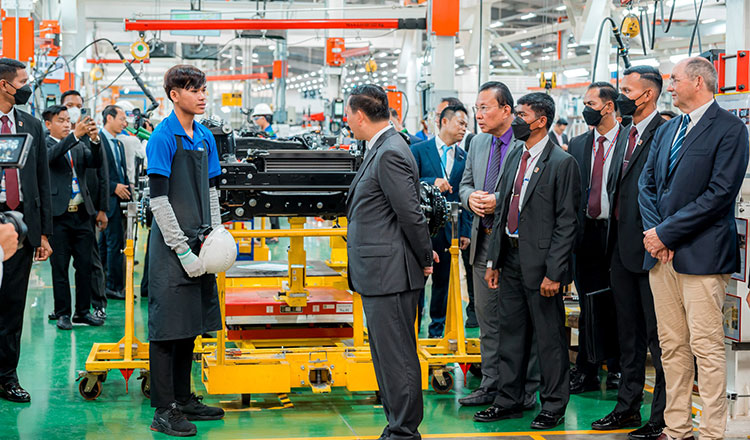
Which is where the Prime Minister comes in. Speaking at the opening of an automotive factory on September 17, Mr Hun Manet asked whether the country should keep adding plants. “Should we accelerate or slow down to maintain the resilience of this sector?” His own answer pointed one way. “The priority must be ensuring our existing investments survive, grow, and remain sustainable before we push for further expansion.” The Council for the Development of Cambodia was told to weigh market demand against existing capacity before approving further automotive projects.
The sector he was addressing runs to fifteen assembly projects carrying close to $248 million of capital, 28% of it domestic and 72% foreign, and supporting 2,774 skilled jobs. Ten plants are operating and together build about 35,000 vehicles a year. Five more are coming.
Both of the things that decide whether a brand stays in Cambodia are therefore being settled here, in the same season. One is what a car is allowed to be worth on paper when it crosses the border.
The other is how many factories get licensed, and on what tax terms the cars they build compete against the cars arriving finished. Both will be read by every carmaker deciding on whether to remain officially in Cambodia.
- 10:24 26/09/2026