Cambodia’s Q4 2025 exports hit $8B as imports rise to over $9B
Cambodia’s Q4 2025 exports hit $8B as imports rise to over $9B
The Kingdom’s trade structure remains highly concentrated with the US absorbing a large share of exports, and China dominating imports. While such concentration might be advantageous in the short term, in the long run, it might be strategically risky.
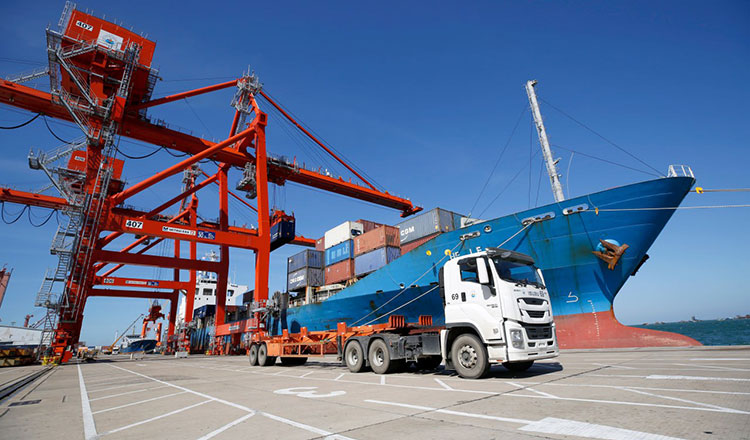
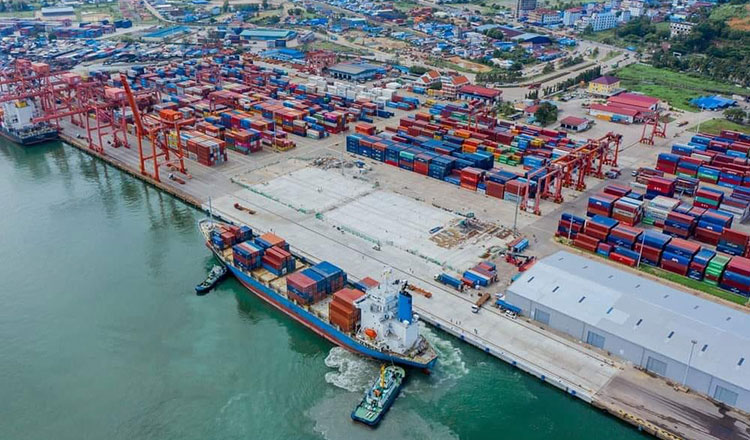
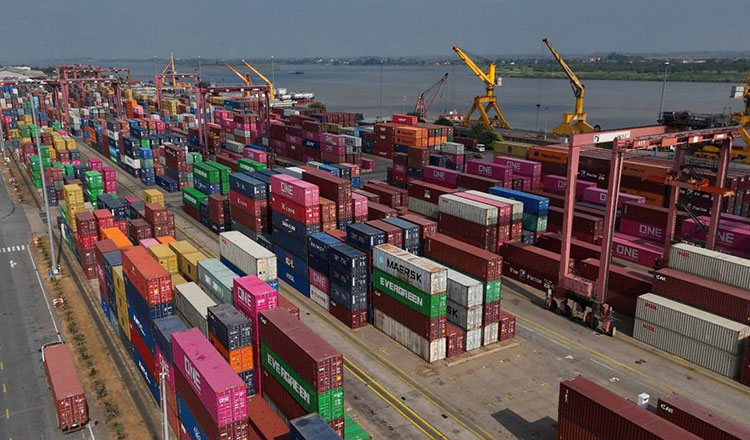
Cambodia’s merchandise trade recorded strong growth in the fourth quarter of 2025, with exports reaching $8 billion and imports climbing to $9.35 billion, reflecting resilient external demand alongside robust domestic consumption and investment.
Figures from the General Department of Customs and Excise of Cambodia, with calculations by the National Bank of Cambodia (NBC) on Thursday, show that exports in Q4 2025 increased 23.2 percent compared with the same period in 2024, supported by continued demand from major markets and steady performance across key manufacturing sectors.
The United States remained Cambodia’s largest export destination, accounting for 43.1 percent of total exports during the quarter, followed by the European Union at 15.7 percent. Vietnam absorbed 9.9 percent of exports, while China (6.3 percent) and Japan (5.1 percent) completed the top five export markets.
Garments continued to dominate Cambodia’s export basket, generating $2.77 billion, up 15.2 percent year-on-year. Exports of other textiles rose to $665 million, while footwear exports increased 18.9 percent to $553 million. Particularly strong growth was recorded in car tyre exports, which surged 55.2 percent to $410 million, reflecting Cambodia’s gradual diversification into higher value-added manufacturing.
On the import side, Cambodia recorded $9.35 billion in imports during Q4 2025, marking a 25.7 percent increase compared with the same quarter last year. The rise in imports was driven largely by higher demand for production inputs, vehicles and construction-related goods, pointing to sustained economic activity and investment momentum.
China remained Cambodia’s largest source of imports, supplying 53.7 percent of total imports. Vietnam followed with 10.1 percent, while Singapore (7.8 percent), Thailand (6.3 percent) and Indonesia (3 percent) were also key import partners, highlighting Cambodia’s strong integration with regional supply chains.
By commodity, garment materials led imports at $1.41 billion, supporting export manufacturing. Petroleum imports stood at $783 million, while imports of vehicles jumped 59.8 percent to $734 million. Imports of construction materials and equipment increased 25.1 percent to $612 million, signalling continued infrastructure development.
Overall, the strong performance of both exports and imports in Q4 2025 underscores Cambodia’s expanding role in regional and global trade, supported by resilient export demand and rising imports linked to production and investment needs.
Thong Mengdavid, lecturer at the Royal University of Phnom Penh, told Khmer Times that the latest trade performance signals an important transition underway in the Cambodian economy.
“For decades, Cambodia’s economy mainly depended on the low-margin and labour-cost garment sector. However, in recent years, more technological investment and improvements in vocational training have boosted Cambodia’s skilled labour force and attracted more high-value and industrialised businesses into the Kingdom,” he said.
According to Mengdavid, Cambodia’s Q4 export growth remains “credible and resilient”, underpinned not only by garments but also by the rapid expansion of car tyre exports linked to new manufacturing investment. Nevertheless, he stressed that sustaining this momentum beyond the near term will require reducing over-reliance on low-value, labour-intensive industries.
“Policy focus should shift toward skills development, supplier upgrading, and incentives that support higher value-added manufacturing and deeper integration into regional supply chains,” he said.
On the import side, the sharp increase largely reflects robust investment activity, particularly in construction materials, transport equipment and industrial inputs. Mengdavid described this trend as positive for Cambodia’s medium-term growth prospects, signalling confidence among foreign and domestic investors.
“That said, imports rising faster than exports could widen the trade deficit if investment does not translate into export capacity, productivity gains or import substitution over time,” he cautioned.
He further noted that Cambodia’s trade structure remains highly concentrated, with the United States absorbing a large share of exports while China dominates imports. While this concentration has delivered efficiency and scale benefits, it also exposes the economy to external shocks.
“High concentration with the US and China is efficient in the short term but strategically risky over time. Cambodia must look beyond these two major powers, such as the EU, Japan, South Korea and India,” Mengdavid said, adding that strengthening resilience will require diversifying export markets and positioning Cambodia as a stable, neutral manufacturing hub within regional value chains.
Similar concerns were echoed by the private sector. Speaking to Khmer Times, Lor Vichet, Vice President of the Cambodia-Chinese Commerce Association (CCCA), said persistent trade deficits point to the need for additional policy measures to rebalance trade.
“Based on trade data, we see that we continue to have a trade deficit, so it requires the introduction of additional policies to balance trade,” Vichet said.
He highlighted the importance of developing domestic raw material manufacturing to reduce import dependence, suggesting flexible public–private partnership models in which the state and private sector share ownership.
“The important thing is that both the public and private sectors consider which formula is good,” he said.
Vichet also warned against excessive reliance on a single export or import market. “A lot of raw materials are imported from China, and a lot is exported to the US market. Relying on one market is fragile, so we need to expand the market and diversify exports,” he said.
To support this shift, he called on the government to provide long-term, low-interest loans to industries producing bulk goods in the garments, footwear and travel goods (GFT) sector, as well as strategic participation by the state in capital-intensive projects. Similar policy tools, he added, could be applied to agriculture to revitalise the sector and strengthen its contribution to trade.
As Cambodia enters 2026, economists say the challenge will be to convert strong trade growth and rising investment into a more diversified, higher value-added export base, one that can withstand global volatility while sustaining long-term economic development.
- 08:31 10/02/2026