Trade persists between Cambodia, Thailand despite border halt
Trade persists between Cambodia, Thailand despite border halt
The General Department of Customs and Excise of Cambodia says bilateral trade between the two countries exceeds $221 million.
Despite official reports from Thailand indicating zero border trade with Cambodia in February, newly released Cambodian data suggest that bilateral commerce between the two neighbours has continued at significant levels through alternative logistics channels.
According to a report published on Tuesday by The Nation Thailand, overall border and transit trade in February 2026 stood at 139.4 billion baht, marking a 9.7 percent decline compared to the same period last year. The data, cited by Arada Fuangtong, Director-General of Thailand’s Department of Foreign Trade, showed that border trade with four neighbouring countries dropped sharply by 28.2 percent. Notably, Thailand-Cambodia land border trade was recorded as having fallen to zero.
In contrast, figures released by the General Department of Customs and Excise (GDCE) of Cambodia painted a different picture of ongoing economic activity. It reported that total bilateral trade between the two countries reached $221.7 million in February alone. This included $52.2 million in Cambodian exports and $167.5 million in imports from Thailand, resulting in a trade deficit of $113.3 million for the Kingdom.
For the first two months of 2026, GDCE data showed total trade volume of approximately $431 million. Of this, Cambodian exports accounted for $112.5 million, while imports stood at $318.5 million. However, the figures still represent a substantial decline of 42.3 percent compared to the same period in 2025, reflecting the broader impact of border tensions and disruptions to traditional overland supply routes.
Analysts suggest that the apparent discrepancy between Thai and Cambodian data lies in differing methodologies. Thailand’s figures primarily measure trade through land border crossings, while Cambodia’s statistics encompass total trade regardless of transportation mode. As a result, while overland trade may have effectively halted, goods have continued to move via maritime and air channels.
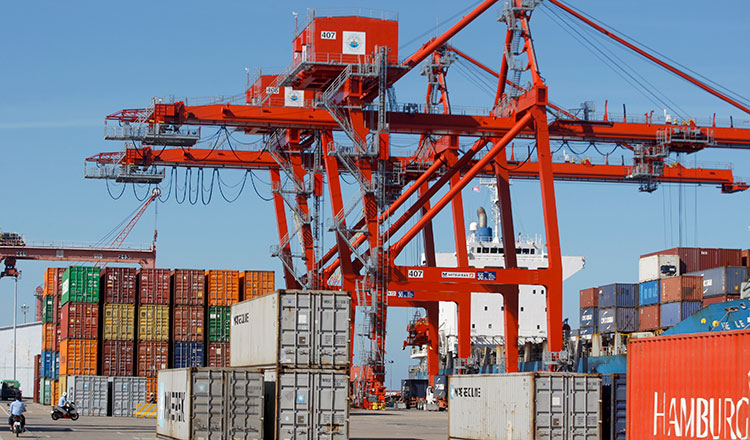
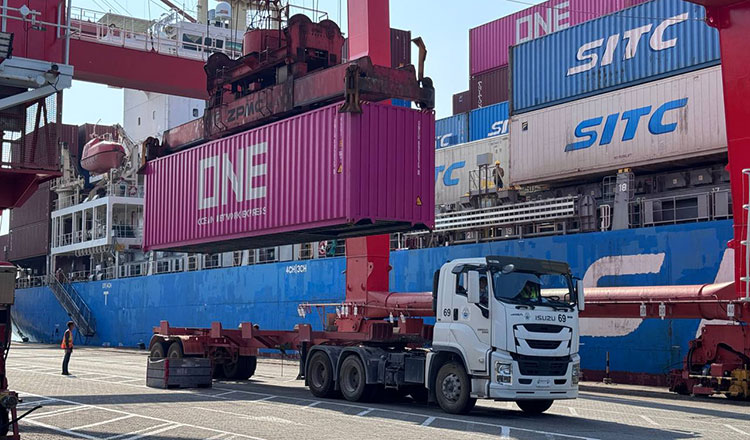
This logistical shift has become increasingly evident in the performance of Sihanoukville Autonomous Port (PAS), the country’s largest maritime gateway. PAS has forecast a 38 percent increase in revenue for the first quarter of 2026, driven by rising cargo volumes following renewed border tensions in late December. The port has reportedly handled around 70 percent of Cambodia’s imports and exports during the disruption, underscoring its critical role in maintaining supply chains.
Lou Kim Chhun, chairman and CEO of PAS, highlighted the importance of maritime infrastructure during periods of uncertainty. He pointed to agricultural commodities such as cassava—traditionally transported overland into Thailand for processing—as being particularly vulnerable to border restrictions. Without access to seaports, he warned, such goods would face severe logistical bottlenecks.
There have also been concerns about the potential rerouting of goods through neighbouring countries, including Laos. However, experts note that goods transiting through Laos are generally recorded as Cambodia-Laos trade, rather than Cambodia-Thailand trade, making it unlikely that such routes fully explain the GDCE’s reported figures.
Air freight remains another alternative, though its higher costs limit usage primarily to high-value goods. Meanwhile, Cambodia’s imports from Thailand—largely consisting of construction materials, consumer goods and cosmetics—are more efficiently transported by sea.
- 08:09 26/03/2026