Border conflict, global issues slow Cambodia’s growth to 5% in 2025
Border conflict, global issues slow Cambodia’s growth to 5% in 2025
Financial Stability Review report says that despite the country maintaining broadly stable macroeconomic fundamentals, a combination of global uncertainties, geopolitical tensions, and structural vulnerabilities tempered the pace of expansion during the year.
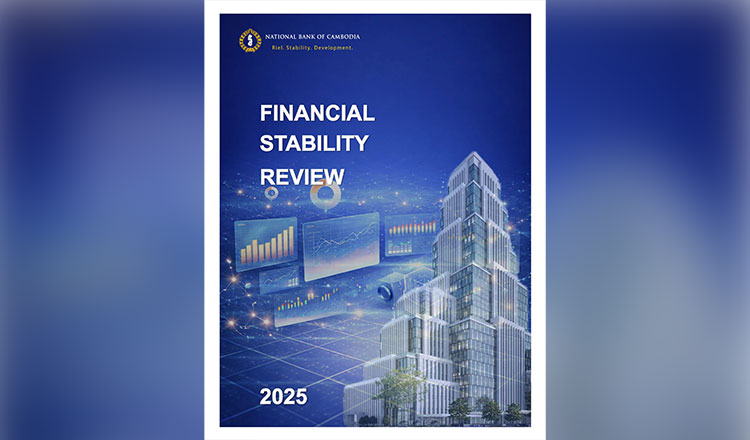
Cambodian economy is estimated to have grown at the rate of five percent in 2025, down from six percent in 2024, according to the Financial Stability Review report released by the National Bank of Cambodia (NBC) on Saturday. While growth accelerated in the first half of 2025, global uncertainties and border conflict with Thailand decelerated the momentum in the second half.
Despite the country maintaining broadly stable macroeconomic fundamentals, a combination of global uncertainties, geopolitical tensions, and structural vulnerabilities tempered the pace of expansion during the year, the report said.
Economic activity in the first half of 2025 remained robust, driven largely by a surge in exports ahead of newly imposed reciprocal tariffs by the United States. This front-loaded export activity, combined with a rebound in tourism-related sectors, provided early momentum. However, growth slowed in the second half of the year as external conditions weakened. Border tensions with Thailand disrupted cross-border trade, tourism flows, and remittances, further dampening economic performance.
The manufacturing sector continued to serve as the primary engine of growth, expanding by 8.5 percent, albeit at a slower pace than the 11.6 percent recorded in 2024. Within the sector, garments, footwear, and travel goods (GFT) manufacturing grew by 7.1 percent, significantly down from 15.8 percent the previous year.
In contrast, non-GFT manufacturing showed stronger momentum, rising by 10.1 percent compared to 6.9 percent in 2024. This shift signals gradual diversification within Cambodia’s industrial base, a development seen as critical for long-term resilience.
Tourism-related industries also contributed positively, though their recovery remains incomplete. The accommodation and food services sector grew by 5.6 percent in 2025, a notable slowdown from the 12.2 percent growth recorded in 2024. Despite improvements, the sector reached only 86.1 percent of its pre-pandemic level performance.
The recovery has been supported by higher-spending international visitors arriving by air and increased domestic tourism, partially offsetting declines in land-border arrivals.
Agriculture, a key source of rural livelihoods, posted modest growth of 0.9 percent, slightly below the 1.1 percent recorded in the previous year. Limited productivity gains and vulnerability to climate and market fluctuations continue to constrain the sector’s expansion.
Meanwhile, construction and real estate—once among Cambodia’s fastest-growing sectors—have yet to fully recover. The construction sector operated at approximately 88 percent of its 2019 level, reflecting a slower-than-expected rebound. Similarly, the real estate sector remained subdued at 84 percent of its pre-pandemic performance, weighed down by cautious investor sentiment and weaker demand.
The report said that a border conflict with Thailand that began in May 2025 and escalated into multiple clashes in July and December 2025 disrupted economic activity in Cambodia’s seven bordering provinces. These developments led to the displacement of local populations and the disruption of their livelihood, in addition to causing a wave of returning migrant workers from Thailand.
While the economy has demonstrated resilience and a capacity for rapid adaptation, these events have inevitably introduced a localised slowdown. Specifically, the influx of returned migrant labour from Thailand led to a sudden oversupply in labour market and a contraction in remittance flows. Furthermore, border closures and product boycotts have reduced cross-border trade and supply chain adjustments. These developments also affected tourist sentiment, as reflected in the decline of visitor numbers.
Despite these sectoral challenges, Cambodia’s macroeconomic fundamentals remained broadly stable throughout 2025. External balances showed resilience, supported by export earnings and steady foreign investment inflows. Investor confidence remained relatively strong, underpinned by prudent fiscal management and a stable monetary environment. Inflation remained low at 2.5 percent in 2025, although it increased from 0.8 percent in 2024.
Total FDI inflow grew by 16 percent, reaching $5.1 billion. This was contributed mainly by a surge in FDI inflow to the manufacturing sector of 53 percent, equivalent to $3.5 billion, and accounting for 68.1 percent of total inflows.
However, several risks continue to cloud the outlook. Cambodia’s reliance on a narrow export base leaves it exposed to fluctuations in global demand and trade disruptions. At the same time, high levels of financial dollarisation limit the central bank’s ability to conduct effective monetary policy. Rising geopolitical tensions and border conflicts pose additional threats, particularly through their impact on remittances and household incomes, which could in turn weaken debt repayment capacity.
The slow recovery in key sectors such as construction, real estate, and parts of tourism also highlights deeper structural weaknesses in the economy. Addressing these challenges will require sustained policy efforts and strategic reforms.
While commenting on the Financial Stability Review report, Thong Mengdavid, Deputy Director at China-ASEAN Studies Centre at CamTech University, told Khmer Times that in addition to regional tensions, the global economic environment has worsened due to the ongoing war involving Iran, Israel, and the United States.
“This conflict has triggered a major oil crisis, with disruptions to supply routes and supply chains like the Strait of Hormuz pushing oil prices above $110 per barrel and reducing global supply significantly. High energy prices are increasing transportation and production costs worldwide, contributing to inflation and slowing global demand, putting further pressure on Cambodia’s export-driven economy,” he said.
“At a structural level, Cambodia remains heavily reliant on a narrow set of sectors—garments, construction, and tourism—making it vulnerable to both global demand shocks and domestic uncertainties. These vulnerabilities are amplified by global energy instability and tighter financial conditions,” Mengdavid said.
He added that Cambodia faces several key challenges in 2026, such as restoring investor confidence amid geopolitical uncertainty, diversifying its economy to reduce dependence on low-cost manufacturing, and maintaining stable international relations. “Domestic risks such as high household debt and real estate weaknesses could also weigh on growth.”
According to Mengdavid, although a five percent growth rate remains relatively strong regionally, sustaining long-term growth will depend on Cambodia’s ability to manage structural and tax reforms while navigating an increasingly complex global environment shaped by both regional tensions and the ongoing energy crisis.
Looking ahead, strengthening the use of the local currency, the riel, is also seen as essential to enhancing monetary policy effectiveness and reinforcing financial stability. As Cambodia navigates an increasingly complex global environment, coordinated policy action and targeted structural reforms will be critical to sustaining growth and unlocking the country’s long-term economic potential.
- 08:04 31/03/2026