Cambodia needs 2% growth to achieve 2050 economic vision, WB says
Cambodia needs 2% growth to achieve 2050 economic vision, WB says
The WB’s findings underscore the scale of reforms required for Cambodia to transition from growth driven by factor accumulation to one anchored in efficiency, innovation and formal sector expansion.
The World Bank (WB) Monday unveiled its analytical findings on Cambodia’s informal economy and competitiveness, revealing that current productivity growth of 0.8 percent is far below the 2 percent annual growth needed for high-income status by 2050.
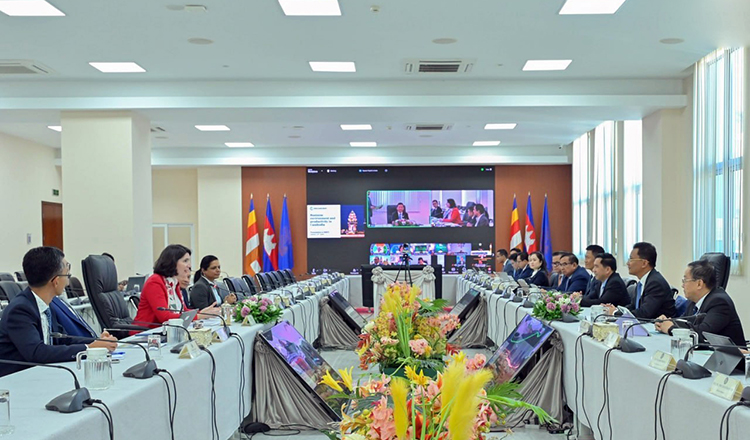
During a meeting with Hem Vanndy, Minister of Industry, Science, Technology, and Innovation (MISTI), the WB delegation led by Tania Meyer, WB Country Director for Cambodia, presented its latest analytical findings on the informal economy and business competitiveness in the Kingdom, as part of its efforts to support the Royal Government’s ongoing reform agenda.
The WB analysis highlighted structural constraints that continue to weigh on productivity, a key driver of sustainable economic growth and income convergence.
According to a MISTI announcement, the research revealed a significant gap in Cambodia’s current productivity growth, estimated at around 0.8 percent.
To achieve the 2050 vision of becoming a high-income country, productivity growth would need to exceed 2 percent per year for the next 25 years—a performance benchmark that has only been achieved by South Korea, the analysis showed.
The finding underscored the scale of reforms required for Cambodia to transition from growth driven by factor accumulation to one anchored in efficiency, innovation and formal sector expansion.
Vanndy said, “The analysis comes as a timely diagnosis as the Royal Government advances key reforms and MISTI will relate this analysis with the national policy portfolio, including the draft micro, small and medium enterprises (MSMEs) development strategy.”
Meyer reiterated WB’s continued support for the Royal Government, emphasising the importance of enhancing the business climate and fostering the informal economy. “For Cambodia, WB has focused specifically on the informal economy in the analysis,” she said.
Faya Hayati, WB senior economist, said that the role of WB is to support the reform agenda that the government is pushing through evidence-based analysis, emphasising that productivity growth is critical for Cambodia to achieve its 2050 vision of becoming a high-income country.
The meeting also reviewed the results of the WB’s survey on the informal economy, which categorises informal enterprises into three groups: subsistence enterprises accounting for 41 percent, potential enterprises at 44 percent and high-performing enterprises making up 15 percent.
The survey highlighted carefully targeted reforms, including social protection for vulnerable groups, incentives to formalise, improved business registration processes and broader improvements to the business environment.
The MISTI Minister urged WB to prepare detailed policy recommendations and practical guidance to support in-depth discussions with relevant ministries and agencies, aiming to identify and implement feasible economic reforms.
Speaking to Khmer Times, leading economist Duch Darin said, “I believe the approach to labour productivity should be a balance, and that it should be pragmatic.”
He said, “First, Cambodia should enhance skills by aligning education and technical training more closely with labour market needs, particularly in manufacturing, agri-processing, digital services, and technology-driven sectors. Productivity rises when workers possess the right skills and firms adopt more efficient technologies.”
“Second, Cambodia should continue to formalise the informal economy. This can be achieved by making formalisation more appealing through simplified process incorporation and access to finance, and the use of digital tools.”
- 09:00 14/01/2026