Hun Manet directs ministry to map regional potential for industrial hubs
Hun Manet directs ministry to map regional potential for industrial hubs
Clear zoning unlocks provincial land resources, maximises economic value, and fosters sustainable development.
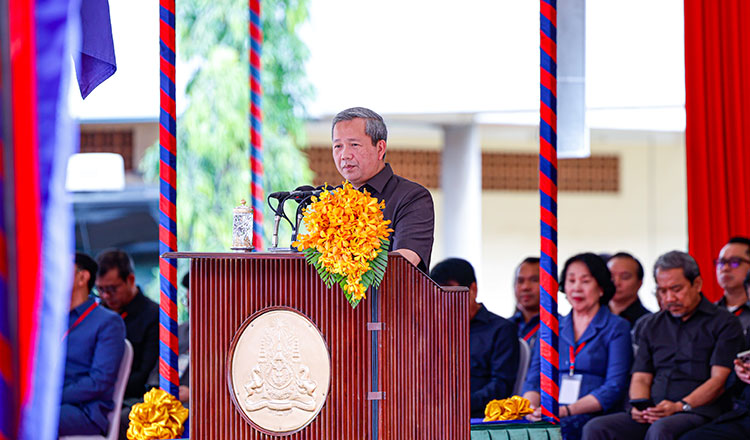
To unlock regional economic potential, Prime Minister Hun Manet Wednesday directed the Ministry of Land Management, Urban Planning and Construction to coordinate with municipal and provincial administrations to draw precise zoning plans for industrial hubs, logistics corridors, supply chains and residential areas that reflect each region’s geographic potential.
Mr Hun Manet issued the directive during a ceremony to distribute land title certificates to residents in Ksach Kandal district, Kandal province.
Using Kandal province as an example, he highlighted the province’s strategic location in the Mekong lowland around Phnom Penh and its connectivity through major national roads.
“Clear zoning plans and land‑use mapping are essential to unlocking each province’s natural land resources, maximising economic value, and fostering sustainable community development,” the Prime Minister said.
He added that land‑use planning based on actual geographic potential can prevent disputes, attract investment, improve livelihoods and promote sustainable, equitable economic growth.
The announcement comes as the government pushes an industry‑driven growth model.
The Ministry of Economy and Finance earlier this week reviewed the 10‑year Industrial Development Policy (2015-2025), saying the policy has transformed Cambodia from a country heavily reliant on agriculture to a country with a strong economy led by industry, penetrating deeper into regional and global value chains.
In the next move, the ministry is leading the inter-ministrial committee to draft the next-generation IDP 2026-2035 towards modernisation based on skills and high technology to adapt to rapid changes in domestic and global industrial structures.
The blueprint aims to modernise the Kingdom’s industrial engine, steering it away from traditional, labour-intensive manufacturing toward a high-tech, skill-driven economy capable of navigating rapid domestic and global disruptions.
Mr Hun Manet’s directive received praise from the business community, with leaders from the Cambodia Chamber of Commerce (CCC) highlighting the positive long-term impact on national economic growth and investment certainty.
“Clear zoning plans for industrial hubs, logistics routes, and residential zones provide much-needed clarity and confidence for both domestic and foreign investors,” CCC Vice-President Lim Heng told Khmer Times.
Heng emphasised that strategic spatial planning around key economic corridors will accelerate the development of industrial clusters and warehousing hubs, ultimately positioning Cambodia as a more competitive trade and manufacturing hub in the region while ensuring orderly urban housing growth for the workforce.
“When land-use policies align with infrastructure and geographical advantages, it drastically reduces operational costs and streamlines supply chains,” Heng said.
The government continues to promote and monitor special economic zones (SEZs).
Over the past 20 years, SEZs have made significant contributions to the diversification of industries and sources of investment in Cambodia.
According to the CDC, Cambodia now has 65 SEZs, 39 of which are actively operating. SEZs have helped diversify the industrial base and brought new clusters, including tyre manufacturing, vehicle and bicycle assembly, electronics and furniture production, creating jobs and better wages for local communities.
Chea Vuthy, Secretary‑General of the CDC’s Cambodia Investment Board, said the country is emerging as a regional production base for automotive and supporting industries thanks to ongoing investment in car assembly plants, tyre factories and component manufacturers.
“The success of SEZ development has been important in diversifying the industrial base and attracting high‑quality, high- value‑added investment capital to Cambodia,” Vuthy said.
The development of the new policy follows a massive surge in industrial diversification, and with Foreign Direct Investment inflows now directed at non-garment sectors such as electronics, tyres, furniture, and parts.
In 2025, the Council for the Development of Cambodia registered 630 projects with total capital of $10 billion, and in the first half of 2026 some 276 projects worth about $4.7 billion were licensed.
- 09:11 30/07/2026