Cambodia revises growth forecast to 4.2%, unveils MTFF 2027-29
Cambodia revises growth forecast to 4.2%, unveils MTFF 2027-29
The correction comes in the wake of overlapping global shocks, reflecting vulnerabilities in trade, energy and climate systems that continue to pressure economic resilience and domestic policy adjustments.
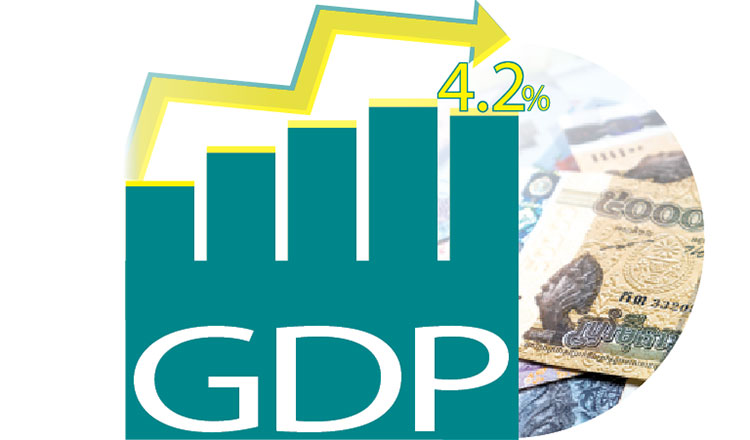
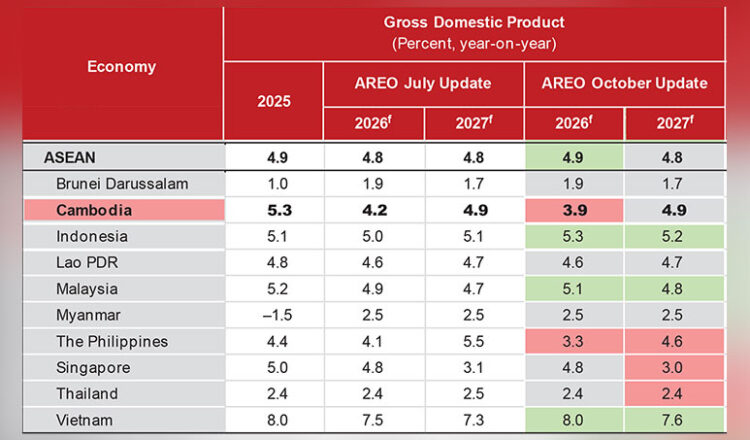
The Royal Government revised its economic growth forecast for 2026 to 4.2 percent, down from 5.0 percent projected last week, and unveiled the Medium Term Fiscal Framework (MTFF) 2027-2029 to guide fiscal policy, amid heightened global uncertainty and rising domestic spending pressures.
Approved by Prime Minister Hun Manet on April 28, the MTFF 2027-2029 was announced to the public on Monday. It aims to safeguard sovereignty and territorial integrity while maintaining livelihoods and promoting medium-term growth under global and regional uncertainty.
Mr Hun Manet said the framework provides a medium-term vision for macroeconomic and public finance management, outlining government policy priorities and principles for the efficient and effective use of national resources, besides strengthening long-term fiscal sustainability.
It also strengthens the linkage between policies, strategic plans and annual budgeting, ensuring resources are allocated in line with national development priorities and enhancing the government’s ability to respond to emerging challenges in a timely and effective manner.
The Prime Minister explained that Cambodia, like others across the world and in the region, is in a multi-crisis transition period marked by high uncertainty due to rising protectionism, trade tensions, geopolitical competition and worsening climate change impacts.
He highlighted that Cambodia has, in recent years, been undergoing a transition amid overlapping global shocks, reflecting vulnerabilities in trade, energy and climate systems that continue to pressure economic resilience and domestic policy adjustments.
Mr Hun Manet noted that in the past two years, Cambodia has faced three major shocks, including US retaliatory tariffs, Cambodia-Thailand border tensions and the Middle East war, which triggered an energy crisis with broad economic spillovers.
He said that the ongoing Middle East conflict has driven sharp increases in oil and gas prices, creating inflationary pressures and affecting the country’s economic growth trajectory and overall stability in both the short and medium term.
“In this new context, Cambodia’s economic growth outlook has been revised to 4.2 percent for 2026 and 5.0 percent for 2027, with an average of 5.5 percent for 2028 and 2029 respectively,” the Prime Minister said.
He added that public finances face medium-term shocks, as the revenue base is affected by successive fiscal measures on fuel products and incentives encouraging electricity use instead of fossil fuels across multiple sectors of the economy.
On the expenditure side, requirements are rising for protecting national sovereignty, improving livelihood, ensuring crisis-resilient growth and infrastructure development and preparing for upcoming commune council elections, he noted.
Mr Hun Manet highlighted that the framework outlines seven key policy priorities guiding fiscal management and development planning in the medium term, including national security, social welfare, diversification, private sector growth, human capital, digital transformation and institutional reform.
Among these, the government emphasises protection of national sovereignty and territorial integrity along with political and macroeconomic stability and efforts to improve people’s well-being and livelihoods across all provinces and sectors as top priorities.
Other priorities include promoting economic diversification and new sources of growth, strengthening the business environment, supporting the private sector and continuing efforts to combat technological fraud and related financial crimes across emerging digital platforms.
The government also aims to focus on developing human and social capital, advancing digital transformation and green development, and strengthening governance and institutional capacity to enhance efficiency, transparency and long-term resilience in public administration.
Similar to previous frameworks, the MTFF 2027-2029 is prepared in a three-year rolling format with four main objectives: ensuring macroeconomic stability, aligning budgets with government priorities, improving revenue collection efficiency and enhancing public finance transparency.
According to the MTFF 2027-2029, the framework is based on a neutral fiscal stance and it serves as a key tool for aligning fiscal policy implementation with development priorities, while maintaining discipline in public spending and ensuring medium-term sustainability of national finances.
Under the projections, revenue collection is expected to grow at an average of 7.3 percent annually from 2027 to 2029, including 7.2 percent growth in 2027, equivalent to 14.72 percent of GDP, according to the framework.
Total public expenditure is projected to grow by an average of 3.1 percent annually, with current expenditure in 2027 rising by 7.9 percent compared to the 2026 budget, while the budget deficit is projected at around 1.53 percent of GDP.
- 08:20 07/05/2026