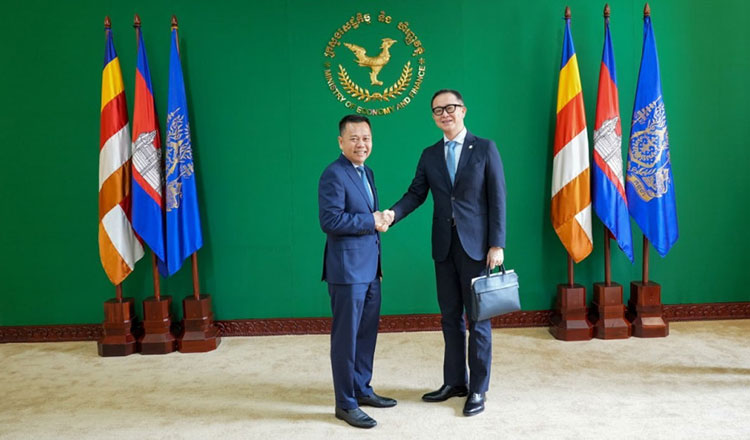
Cambodia backs ADB’s $70 billion regional integration initiative
Cambodia backs ADB’s $70 billion regional integration initiative
The Kingdom stands committed to strengthening regional connectivity through integrated power grids, expanded cross-border electricity trade, and improved broadband access across Asia and the Pacific.
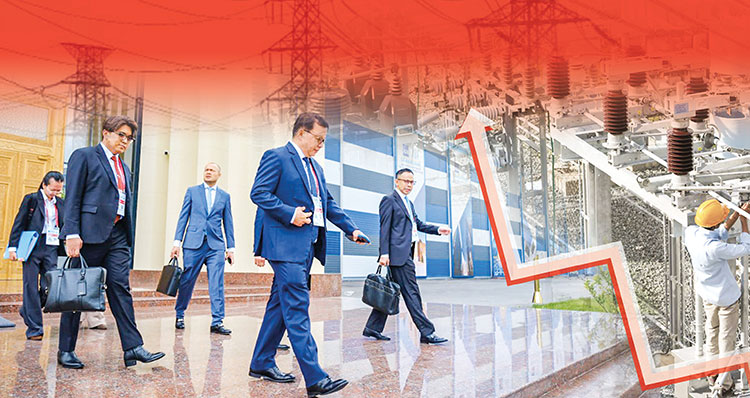
The Royal Government of Cambodia on Monday reaffirmed support for regional integration and connectivity enhancement, welcoming the Asian Development Bank’s (ADB) $70 billion initiative on energy infrastructure and digital transformation at the 59th annual meeting in Samarkand, Uzbekistan.
The statement was made by Ros Seilava, Secretary of State of the Ministry of Economy and Finance (MEF), during the Business Session of the Board of Governors, chaired by Masato Kanda, President of ADB, and Jamshid Khodjaev, Deputy Prime Minister for Investments and Foreign Economic Relations of Uzbekistan.
During his remarks, Seilava, also ADB Alternate Governor for Cambodia, said that this year’s meeting, themed ‘Crossroads of Progress: Advancing the Region’s Connected Future’, reflected a broader understanding of connectivity beyond physical infrastructure.
He said, “The meaning of crossroads goes far beyond the meaning of road and exchange of goods. It speaks to a future shaped by deeper development connectivity, particularly through power grid integration, strong digital links, unlocking private capital and shaping mobilisation for development that drives greater opportunity for shared prosperity throughout Asia and the Pacific.”
The MEF Secretary expressed appreciation to the ADB President for announcing the new budget. “I would like to take this opportunity to express our thanks to President Kanda for his leadership and for the announcement of the $70 billion commitment by ADB to support energy infrastructure and digital transformation in Asia.”
“As Cambodia looks ahead, our ambition is clearly set out in our Vision 2050 to become a high-income country,” Seilava said, adding that the Royal Government continues to play an active role in supporting regional development progress.
He pointed out that ADB supports Cambodia in improving diversification and strengthening competitiveness, accelerating private sector-led growth, advancing human capital development, strengthening climate resilience and enhancing regional connectivity.
However, he also highlighted emerging global challenges, particularly energy and economic pressures linked to geopolitical tensions. “In light of global energy pressures arising from the ongoing Middle East conflict, Cambodia is facing an energy price shock and broader economic consequences, including renewed trade uncertainty that may compound the economic impact of the conflict.”
He warned that these risks could affect the Kingdom’s macroeconomic stability. “Together, this potentially increases downside risks to Cambodia’s growth outlook and fiscal position, particularly as we are preparing for least developed country (LDC) graduation in 2029,” he added.
The MEF Secretary added that such support is crucial in maintaining social and economic stability during periods of uncertainty. “During a period of heightened uncertainty, ADB’s Countercyclical Support Facility (CSF) support on top of country allocation is instrumental to protecting our most vulnerable households and affected sectors, strengthening our resilience and sustaining Cambodia’s development progress,” he said.
In closing, Seilava reaffirmed the Royal Government’s commitment to continued cooperation with ADB and development partners to advance shared regional goals.
“Cambodia remains committed to working closely with ADB and all development partners to build a more connected, resilient and prosperous region,” he said. “At this crossroads of progress, let us work together to turn our shared aspirations into concrete results for the people across Asia and the Pacific.”
It may be noted that during a press conference on May 3, the ADB President announced a $70 billion commitment in new energy and digital infrastructure initiatives by 2035, aimed at strengthening regional connectivity through integrated power grids, expanded cross-border electricity trade, and improved broadband access across Asia and the Pacific.
The package included a $50 billion initiative to develop a Pan-Asia Power Grid, designed to integrate renewable energy across borders, enhance energy security, and reduce emissions, as well as a $20 billion initiative to expand cross-border digital connectivity and help close the region’s digital divide.
President Kanda said, “Energy and digital access will define the region’s future. These two initiatives build the systems Asia and the Pacific need to grow, compete, and connect. By linking power grids and digital networks across borders, we can lower costs, expand opportunity, and bring reliable power and digital access to hundreds of millions of people.”
Speaking to Khmer Times, leading economist Duch Darin said that the ADB initiative is sound because investing in energy connectivity and digital tools lowers production costs and promotes cross-border commerce.
“This aligns with a strategy to move up the value chain, which improves economic resilience against external challenges. Ultimately, by leveraging such regional platforms, Cambodia can position itself competitively in both regional and global markets,” he added.
- 08:15 06/05/2026