Vietnam and UK cooperation backs finance talent for IFCs
Vietnam and UK cooperation backs finance talent for IFCs
Vietnam’s ambition to develop international financial centres is entering a decisive phase, with policymakers and international partners turning their attention from infrastructure to the quality of finance and accounting talent needed to meet global expectations.
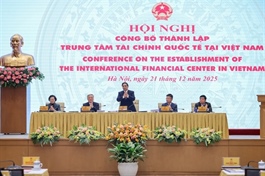
The strategic intent surrounding international financial centres (IFCs) was underlined at a conference held at the Government Office on December 21 on the issue. Discussions focused on completing the legal and institutional framework for the IFC, reaffirming the government’s commitment to a stable, safe, and investor-friendly financial environment, and sending a clear message to the international community on Vietnam’s readiness to share development opportunities.
Speaking at the conference, Prime Minister Pham Minh Chinh said the IFC would be implemented through coordination between Ho Chi Minh City and the central city of Danang on a complementary basis rather than local competition. “The success of the two cities would provide momentum for the centre to move forward and gradually establish its position on the global financial map,” he said.

Coordination between Danang and Ho Chi Minh City will be carried out on a complementary basis, Photo: Hoang Thuy |
As Vietnam moves from announcement to implementation, attention is shifting from infrastructure and incentives towards execution and capability. For policymakers and international partners, the central question is whether Vietnam can build the human capital, governance and professional standards required for an IFC to operate credibly from the outset.
Cooperation between Vietnam and the United Kingdom in finance and professional services is becoming more prominent as part of this transition. Recent policy signals have created momentum for deeper engagement with international institutions and firms experienced in established financial centres.
A case in point is the MoU signed between the Association of Chartered Certified Accountants (ACCA) and KPMG in October in London. Beyond a bilateral agreement, the MoU reflects a broader effort to align Vietnam’s financial ecosystem with international standards, with human capital as a pillar of IFC development.
Ren Varma, ACCA’s regional head for mainland Southeast Asia, told VIR that Vietnam is entering a pivotal phase in its economic and financial development, combining strong growth momentum with a clear policy drive towards deeper international integration.
“Vietnam is at a very exciting point in its journey,” Varma said. “Compared to other markets in the region, it combines strong growth fundamentals with a clear policy push for international integration.”
Beyond policy frameworks, Varma highlighted structural advantages, particularly a young and adaptable talent pool and a strong track record in adopting global standards. “ACCA has been in Vietnam for more than two decades, and we have seen how quickly the profession responds to change,” he said. “Combined with Vietnam’s growing role in green finance and digital innovation, this creates a compelling proposition for investors looking at ASEAN.”
Varma noted that Vietnam’s differentiation will hinge on clear strategic choices. While the dual-location model provides a solid foundation, a sharper focus on green finance and fintech could help position the country as a destination for sustainable investment and digital solutions. These ambitions, however, must rest on firm foundations, including adoption of International Financial Reporting Standards (IFRS), high-quality assurance and a talent pipeline aligned with global expectations.
“Vietnam remains central to ACCA’s regional strategy,” Varma said. “When Vietnam succeeds with its IFC, it sets a precedent for other emerging markets in the region.”
This emphasis on standards and credibility is shared by international audit and advisory firms involved in Vietnam’s IFC preparations. Warrick Cleine MBE, chairman and CEO of KPMG in Vietnam and Cambodia said the UK’s financial ecosystem offers relevant experience as Vietnam builds internationally credible financial infrastructure. “Partnerships like this provide Vietnam with proven foundations that can be adapted to its own context and growth ambitions,” he said.
Investor confidence remains central to cross-border capital flows, underpinned by the quality and consistency of financial reporting, audit, risk management, tax and legal frameworks, as well as the availability of internationally trained talent. For institutional investors, Cleine added, governance and compliance have become baseline requirements, with expectations around transparent, comparable and consistently enforced financial statements continuing to rise.
From the UK business community, the ACCA-KPMG MoU is widely viewed as a signal of policy direction rather than a purely technical arrangement. For Matt Ryland, executive director of the British Chamber of Commerce in Vietnam (BritCham), its importance lies in what it indicates about Vietnam’s long-term approach to financial and professional services reform.
“The significance is the signal it sends to international investors,” Ryland said. “It reflects a clear commitment to aligning the ecosystem with global standards.”
The development of an IFC is understood as a structural shift. British firms are therefore assessing opportunities that go beyond capital deployment, with interest in contributing early to the design of legal and regulatory frameworks, the development of financial products and the building of talent pipelines.
Progress is evident, but gaps remain. Vietnam’s finance workforce is young and motivated, yet capabilities in advanced IFRS application, sustainability reporting, data analytics and professional English still need strengthening, while compliance and assurance practices remain uneven.
“This has elevated the role of business chambers and professional networks in narrowing the gap between policy ambition and market execution,” Ryland said. “BritCham positions itself as an enabler and connector, convening businesses, government agencies, academia and professional bodies to identify gaps, share best practices, and pilot solutions that respond to both reform priorities and investor needs. Our focus is on helping ideas move from policy intent to practical implementation.”
As Vietnam moves from policy intent to implementation of its IFC plans, ACCA’s long-standing role in training and accrediting finance professionals, including through partnerships such as the ACCA-KPMG MoU, addresses one of the core human capital requirements identified in the IFC development process.
|
Warrick Cleine, chairman and CEO, KPMG in Vietnam and Cambodia
UK firms and professional bodies can support Vietnam’s authorities through regulatory sandboxes, joint working groups and pilot programmes, including initiatives on IFRS transition and environmental, social, and governance (ESG) disclosure for financial institutions and listed companies. These mechanisms allow policies to be tested under real market conditions, helping to shorten the learning curve while managing implementation risks. At the core of any IFC is the quality of its people. Ensuring that finance, risk and compliance functions operate to shared international standards is essential to building investor confidence, particularly for cross-border capital flows that depend on consistent financial information, internal controls and governance. Progress will increasingly be assessed through practical milestones. Training and certification across finance, audit, risk and compliance will be an early indicator of whether operations can be conducted safely and consistently. Pilot cross-border transactions, including green and sustainability-linked instruments and sandboxed financial products under the IFC framework, would provide tangible evidence of implementation. Clear roadmaps for IFRS adoption, ESG reporting and assurance, alongside supervisory alignment with international standards, will also be closely monitored by investors. Robust safeguards around anti-money laundering and counter-terrorist financing, know-your-customer requirements, audit quality and risk supervision remain non-negotiable. When designed effectively, these controls can underpin innovation by providing the confidence needed for new products and cross-border activity to develop. Kenneth Atkinson, former chairman, BritCham
Vietnam has set out an ambition to build a modern financial ecosystem with advanced legal frameworks, infrastructure, skilled workforce, and access to international capital. Although it shares some similarities with the July 2000 stock exchange launch, particularly in aiming to enhance capital flows into Vietnam, this initiative marks a more historic milestone in the country’s financial integration journey. The UK government has supported the effort, funding advisory work by TheCityUK to provide guidance on potential IFC models and regulatory frameworks, drawing on the UK’s long-standing expertise in financial services. Developing human capital is central to the IFC’s success. BritCham and UK corporates are well-positioned to contribute by sharing expertise in finance, governance, and professional standards. Five years ago, BritCham established the British Corporate Advocacy Committee, which brings together major British investors to provide structured feedback to Vietnamese authorities on regulatory and operational matters, supporting both reform objectives and investor confidence. Professional bodies in the UK are already active in Vietnam, providing training and certification in IFRS, ESG reporting, risk management, and financial compliance. Other associations can support talent development further, ensuring the workforce is aligned with global standards. |

- 16:31 27/12/2025