Security, risk control critical for crypto asset market: experts
Security, risk control critical for crypto asset market: experts
Statistics from blockchain analytics firm Chainalysis showed that Việt Nam ranked third in the Asia-Pacific region for crypto asset inflows in 2025, with a total transaction value of around US$220-230 billion, up 55 per cent over 2024. About 17-18 million Vietnamese, nearly 20 per cent of the population, are holding or using crypto assets.

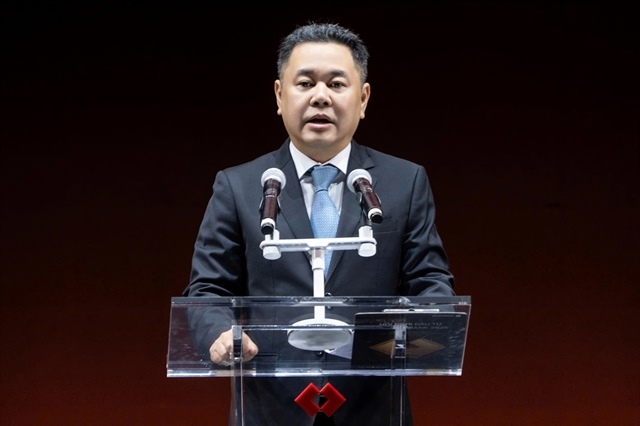
It is critical for Việt Nam to build a transparent, well-controlled crypto asset market to protect legitimate rights of related parties. — REUTERS/VNA Photo |
Network security and effective risk control are critical factors for the successful pilot implementation of the domestic crypto asset market in the context of robust capital inflow and high risks of fraud and money laundering, experts have said.
Statistics from blockchain analytics firm Chainalysis showed that Việt Nam ranked third in the Asia-Pacific region for crypto asset inflows in 2025, with a total transaction value of around US$225 billion, up 55 per cent over 2024. About 17-18 million Vietnamese, nearly 20 per cent of the population, are holding or using crypto assets.
Director of the National Innovation Centre Vũ Quốc Huy said that despite rapid growth, crypto asset trading is mainly taking place on overseas platforms, leading to tax loss and posing challenges for anti-money laundering and counter-terrorism financing efforts.
It is critical for Việt Nam to build a transparent, well-controlled crypto asset market to protect the legitimate rights of related parties, he said.
Figures from the Ministry of Public Security show that nearly 20,000 crypto-related fraud cases were detected between December 15, 2019 and May 14, 2024, involving more than 17,000 people and causing losses exceeding VNĐ12 trillion (US$456 million).
According to Vũ Duy Hiền, Deputy Secretary General of the National Cybersecurity Association, piloting a crypto asset market is an inevitable step for Việt Nam to keep pace with emerging trends in the digital economy.
However, without a sufficiently strong cybersecurity foundation, the market would be highly vulnerable to cross-border cyberattacks, high-tech fraud and money laundering activities.
Resolution 05/2025/NQ-CP introduces a five-year regulatory sandbox for the crypto asset market, he said, adding that it also sets out specific requirements on cybersecurity, information security, personal data protection, anti-money laundering measures, technical supervision and transparency.
Hiền urged an effort to ensure end-to-end cybersecurity, develop a transparent monitoring mechanism and promote international cooperation to successfully implement the crypto asset market.
Digital trust is the key to unlocking the potential of the crypto asset market, said co-founder of PILA Group Nguyễn Phú Dũng, adding that digital trust must be built on transparency with verifiable and real-time data and a reliable infrastructure system.
He also stressed the importance of comprehensive digital identification.
Lê Vũ Hương Quỳnh, Asia-Pacific regional director at Tether, said Việt Nam should take a cautious, phased approach anchored in a clear legal framework, stronger capacity among intermediaries like exchanges and financial institutions, and improved financial literacy for investors.
According to head of Business Development at OKX APAC Huỳnh Quốc Nam, the crypto market has characteristics that differ fundamentally from traditional stock markets.
While stock exchanges operate within fixed trading hours, digital asset markets run 24/7, without holidays and on a global scale, which requires highly stable and secure technological infrastructure capable of continuous operation with minimal downtime, he said.
He pointed out that liquidity is also a critical factor, adding that during periods of sharp market volatility, exchanges must ensure efficient liquidity for investors to be able to withdraw their assets at any time.
Bùi Hoàng Hải, Deputy Chairman of the State Securities Commission under the Ministry of Finance, said that the pilot digital asset market must be put under close supervision.
The Government will control the scale of the market during the testing phase and set standards to protect investors, he said, adding that a proper sandbox would not only foster a more transparent market, but also lay the groundwork for a comprehensive legal framework.
- 07:41 23/12/2025