AMRO trims Cambodia’s growth to 3.9%, citing El Niño risks
AMRO trims Cambodia’s growth to 3.9%, citing El Niño risks
The report warns that a severe El Niño poses a significant threat to the country because its economy relies heavily on farming for jobs, and families still allocate a large share of their budget to food.
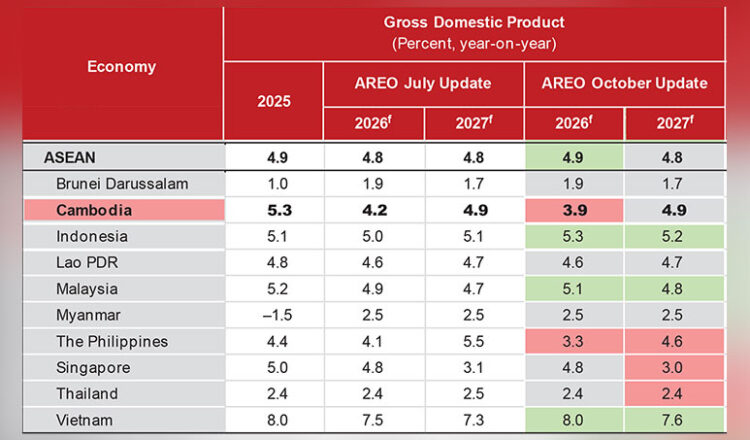
The ASEAN+3 Macroeconomic Research Office (AMRO) yesterday reduced Cambodia’s economic growth forecast to 3.9% this year, down 0.3 percentage point from the 4.2% projected in July, warning that agricultural production could be hit by a potential El Niño shock.
The downgrade was included in the ‘ASEAN+3 Regional Economic Outlook Update for October 2026’, which projected regional growth at 4.1% in both 2026 and 2027, with inflation at 1.6% and 1.7%, respectively.
The report noted that the unchanged regional growth forecast for this year concealed mixed revisions among individual economies, with Cambodia and the Philippines downgraded while Korea and Malaysia received upgrades.
For Cambodia, AMRO maintained its 2027 growth forecast at 4.9%, unchanged from its July projection, while its inflation forecast for the Kingdom this year was lowered to 4.9% from 5.1%. However, it raised the 2027 inflation forecast to 3.0% from 2.8%.
Against this backdrop, the report highlighted Cambodia’s vulnerability to a potential severe El Niño event because of the continued importance of agriculture to the economy and employment, and the large share of food in household consumption.
According to the regional body, agriculture accounts for 16.1% of the country’s gross domestic product (GDP) and 33.4% of employment. Food accounts for 43.3% of the consumer price index (CPI) basket, with rice alone representing 8.3%.
AMRO grouped Cambodia with Laos and Myanmar as economies where agriculture accounts for relatively high shares of both GDP and employment, while food makes up over 40% of the CPI basket.
This exposure means a severe El Niño event could disrupt agricultural production, affect economic output and rural incomes, while also increase household living costs through higher food prices, the report said.
However, AMRO noted that the actual impact would depend on local weather conditions and the availability of buffers, including irrigation coverage, water reserves, food stocks and import arrangements. Data on these buffers remain limited and uneven across the region.
Cambodia has rice stock coverage equivalent to about 3.1 months, while net food imports are roughly balanced at around 0.2% of GDP. AMRO noted that production exposure is concentrated in economies where agriculture retains a relatively large role in output and employment.
The report said El Niño is firmly established and likely to become very strong toward the end of 2026, with its macroeconomic effects likely to extend into 2027.
The impacts could be transmitted through agricultural output and rural incomes, food prices and trade, as well as water availability, power generation, fire and haze.
The potential for water shortages has also prompted the Royal Government of Cambodia to focus on retaining water from the current heavy rainfall for use during future dry periods.
During the inauguration of National Road 10 in Pursat province, Prime Minister Hun Manet instructed relevant ministries and provincial administrations to address the impacts of recent flooding and explore ways to capture and store excess water for use during future droughts.
He noted that forecasts from a US-based institute indicate that the world could soon face an El Niño phenomenon, bringing higher temperatures and reduced rainfall that could lead to prolonged drought.
He urged authorities to view the current heavy rainfall as an opportunity to replenish reservoirs, capture excess water and strengthen national water reserves ahead of potential drought and shortages.
Mr Hun Manet said, “Over the next six months, forecasters predict the El Niño phenomenon, prolonged droughts and rising temperatures, which could potentially result in 45 million deaths worldwide.”
“Therefore, we may face water shortages. So, rainfall of 50 million cubic metres daily right now is replenishing our reservoirs, while we simultaneously seek ways to mitigate the heat,” he added.
The Premier noted that the recent flooding, which has filled some reservoirs and prompted water releases in certain areas, should also serve as an opportunity to assess the country’s capacity to manage water resources and strengthen preparedness for future climate-related challenges.
- 08:08 06/10/2026