Stronger suppy chain control needed to tap Halal market potential
Stronger suppy chain control needed to tap Halal market potential
Việt Nam needs to develop a stable supply system for Halal-compliant inputs and stronger controls across the entire chain from production areas through processing, certification, logistics and distribution.
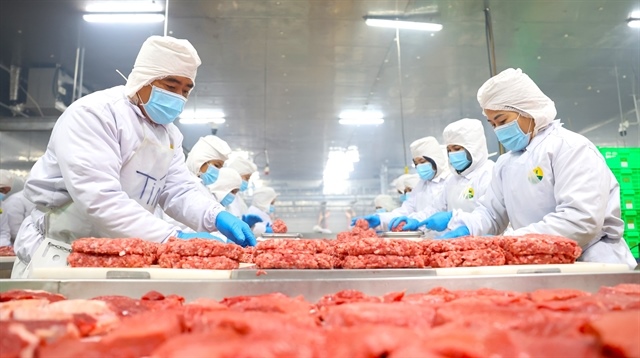
Beef produced at Pacos International is certified Halal compliant. Stronger controls across the entire chain are critical to expand exports to Halal markets. — VNA/VNS Photo Thanh Tân |
Strengthening control across Halal supply chains will be critical for Việt Nam to turn its advantages in agriculture, seafood and food processing into sustainable export capacity, officials and industry experts said at a conference held by the Ministry of Industry and Trade on September 23.
The monthly trade promotion conference with Việt Nam’s overseas trade office focused on identifying domestic supply capacity, market demand and mechanisms to boost Halal exports.
Director of the Vietnam Trade Promotion Agency Vũ Bá Phú said Việt Nam has strengths in agricultural products, seafood and processed foods, while the Halal market is expanding beyond food into cosmetics, tourism, logistics, finance and related services.
Halal-certified products are also drawing growing interest from consumers outside Muslim communities, partly because Halal standards are associated with transparency, safety and tighter controls throughout the supply chain, he said.
"Halal markets are expected to become a new driver for Việt Nam’s exports," Phú said, adding that the global Muslim population is estimated at about two billion people across 112 countries, accounting for about 25 per cent of the world's population.
However, exporters are facing significant barriers, including differences in standards and certification systems, limited supplies of Halal-compliant inputs, fragmented supply chains and a lack of detailed market information, experts said.
Bá Thị Nguyệt Thu, director of the HalalViet Promotion and Experience Centre, said that Việt Nam’s exports to Halal markets are still concentrated largely in raw agricultural and seafood products, while supplies of deeply processed goods that meet specific requirements remain limited.
Lê Anh Ngọc from the National Authority for Quality, Processing and Market Development said differences among Halal standards and certification systems were a major obstacle, as access to one Halal market does not automatically guarantee access to another.
A certificate accepted in Indonesia may not necessarily be accepted in Malaysia, while certification for Malaysia may not be sufficient for Gulf Cooperation Council markets or the United Arab Emirates, he said.
Differences between certification systems can increase compliance costs and make it important for exporters to identify their target markets before choosing a certification system, Ngọc said.
He said further development of national standards and greater mutual recognition between international certification systems will help reduce compliance costs and facilitate exports.
Government agencies and overseas trade offices also need to provide businesses with more detailed information on individual markets, certification requirements and potential partners, he added.
Supply chain control
For deeply processed goods, Halal requirements can extend throughout the supply chain, covering raw materials, additives, flavourings, processing facilities, storage and logistics. A single non-compliant input can affect the eligibility of the final product.
Việt Nam therefore needs to develop a stable supply system for Halal-compliant inputs and stronger controls across the entire chain from production areas through processing, certification, logistics and distribution, according to Thu.
“Building a coordinated ecosystem can make a significant difference,” Thu said, adding that the focus would also be placed on stepping up international trade promotion.
Halal product development is not only about exports, but can also support Việt Nam’s domestic market. Hotels, restaurants and tourism operators serving international Muslim visitors are creating demand for Halal-compliant products and services, she said.
Phạm Thế Cường, Vietnamese trade counsellor to Indonesia, said Vietnamese companies should strengthen partnerships with businesses in countries with developed Halal industries. Such partnerships could help companies better understand Halal standards while building supply chains linking raw-material production, processing, distribution and exports.
Việt Nam’s export of Halal products doubled to around US$900 million from 2021 to 2025, representing a modest rise. The global Halal market was estimated at around $2.7 trillion in 2025 and is projected to reach $3.6 trillion by 2029. Halal food alone accounted for about $1.5 trillion.
- 16:05 23/09/2026