Cutting logistics costs key to boosting exports
Cutting logistics costs key to boosting exports
Import-export activities has remained a bright spot for the economy in recent years, playing an important role and helping drive macroeconomic growth
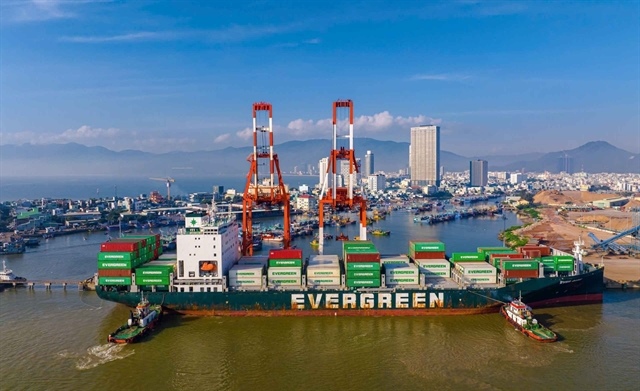
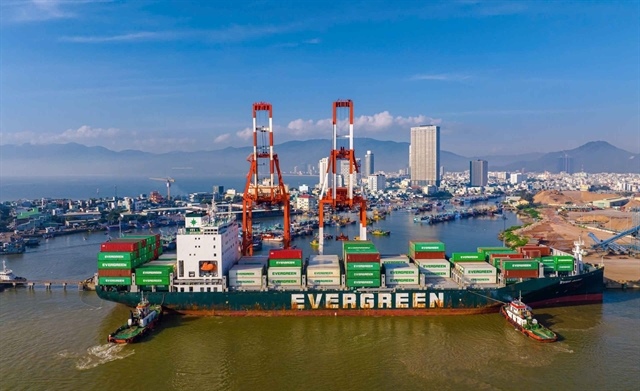
A cargo vessel at Quy Nhơn Port. Cutting logistics costs is vital to boosting the country's import-export trade. — VNA/VNS Photos |
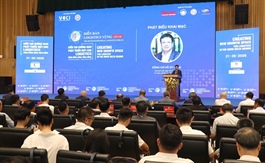
Reducing costs has become an increasingly urgent priority for import-export activities, particularly logistics costs, a conference in Hà Nội was told on Tuesday.
According to Deputy General Director of the Ministry of Industry and Trade's Agency for Foreign Trade, Trần Thanh Hải, import-export activities has remained a bright spot for the economy in recent years, playing an important role and helping drive macroeconomic growth.
However, he said the sector still faced a number of issues that needed to be addressed, with cutting logistics costs a top priority.
"Through this conference, we hope to have a frank and direct understanding of the bottlenecks impacting import and export costs," Hải said, adding that the meeting aimed to identify issues and appropriate solutions.
The conference followed a Government push to address difficulties facing import-export businesses. The ministry said it was responding to a directive issued following a meeting between Deputy Prime Minister Phạm Gia Túc and businesses in the sector.
Trade growth raises logistics pressures
The country's total trade turnover reached US$930.1 billion in 2025, up 18 per cent from the previous year, with a trade surplus of $20.05 billion.
In the first eight months of 2026, trade turnover saw a yearly growth of 29 per cent to $770.14 billion. Exports rose 22 per cent to $374.84 billion, while imports increased 35 per cent to $395.30 billion, resulting in a trade deficit of about $20.46 billion, the ministry said.
Processed and manufactured industrial goods accounted for 90.17 per cent of exports during the period, while production materials represented 94.11 per cent of imports.
Bùi Bá Nghiêm, a senior specialist at the agency, said the increase in imports was largely linked to machinery, components and raw materials used in production.
The trend points to an expansion of production capacity but also highlights Vietnamese manufacturers' reliance on imported inputs, he said. Higher transportation, warehousing and financing costs for those inputs can ultimately add to the cost of exported products.
The foreign-invested sector accounted for 80.1 per cent of export turnover in the first eight months of 2026, while the domestic economic sector recorded a trade deficit of about $30.60 billion, he said.
Nghiêm said efforts to reduce logistics costs should therefore also focus on increasing the ability of domestic companies to participate in supply chains, rather than simply facilitating higher volumes of goods moving through the economy.
Cost-cutting measures
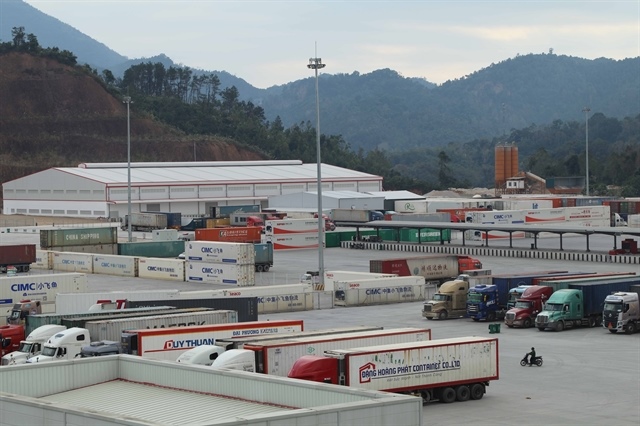
A cargo vessel at Quy Nhơn Port. Cutting logistics costs is vital to boosting the country's import-export trade. — VNA/VNS Photos |
According to Nghiêm, his agency has proposed a group of measures to reduce logistics costs and improve the efficiency of the country's import-export sector.
The proposals focus on establishing a national system to measure logistics costs, tracking expenses by industry, transport corridor and type of business, alongside an economy-wide indicator relative to GDP. Key indicators would include costs per tonne, container or shipment, transit and waiting times, on-time delivery rates, inventory days, empty-run rates, storage costs and the use of electronic documents.
Reorganising transport along major corridors, improving connections between different modes of transport and reducing time and costs at ports, airports, border crossings and warehouses would also be necessary, the agency said.
It also called on authorities to review procedures for major export product groups to identify duplicate documentation and stages that add costs.
The principle of providing data once, processing information before cargo arrives, applying risk-based management, conducting post-clearance audits where appropriate and sharing inspection results should be strengthened, it said.
The agency also proposed developing a shared logistics coordination database and platform linked to existing systems. The platform could be used to monitor cargo flows, port and warehouse capacity, transport schedules, congestion and cargo tracing.
The Government should focus on data standards, connectivity, access rights and security, while artificial intelligence could be used for forecasting, route optimisation and document verification. Management decisions based on such systems, however, should have a clear legal basis and accountability, it said.
Strengthening the capacity of import-export and logistics companies should also be part of the effort, the agency said, urging exporters to manage costs across the supply chain, improve order and demand forecasting, optimise packaging and inventory, and consider alternative routes and delivery terms.
Domestic logistics companies should meanwhile cooperate to provide integrated services, invest in transport and warehouse management systems, expand overseas agency networks and develop multimodal and cold-chain services.
The agency also called for logistics cost reductions to be linked to green transformation and supply-chain resilience. Warehouses should improve energy efficiency and temperature management, while exporters should prepare emissions and traceability data required by individual markets.
Green investments should be assessed based on lifecycle costs and their ability to support reliable order fulfilment, rather than adopted solely in response to market trends, it said.
Việt Nam is striving to reducing logistics costs to 12-15 per cent of GDP and entering the global top 40 in the World Bank's Logistics Performance Index (LPI) by 2035, following the logistics services development strategy for the 2025-35 period, with a vision to 2050.
- 14:55 22/09/2026