Việt Nam’s electronics industry faces trade deficit despite strong export growth
Việt Nam’s electronics industry faces trade deficit despite strong export growth
Deputy Minister of Industry and Trade Lương Hoàng Thái highlighted the electronics industry’s significant contribution to national exports, calling on businesses and experts to analyse its import-export structure, identify challenges and propose solutions to improve its development prospects.
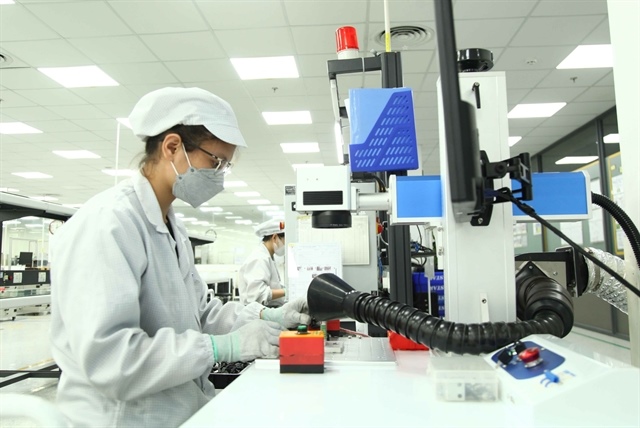
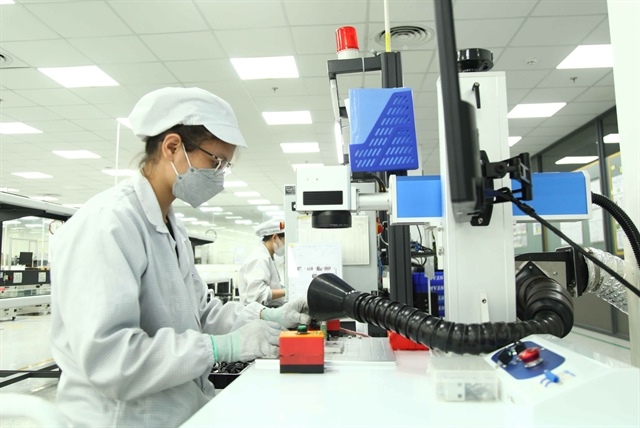
Producing electronic components at Star Engineers Vietnam Co., Ltd. in Bình Xuyên I Industrial Park, Phú Thọ province. — VNA/VNS Photo |
The Ministry of Industry and Trade held a meeting with major electronics enterprises in Hà Nội on October 30 to assess the sector’s production and trade performance, examine the cause of its trade deficit and discuss development prospects.
In his remarks, Deputy Minister of Industry and Trade Lương Hoàng Thái highlighted the electronics industry’s significant contribution to national exports, calling on businesses and experts to analyse its import-export structure, identify challenges and propose solutions to improve its development prospects.
According to the ministry’s Agency of Foreign Trade, the total trade turnover was estimated at US$1.010 trillion in the first 10 months of 2026, up 32.3 per cent year on year, surpassing the $1-trillion mark. October alone saw an estimated $122.2 billion in trade, up 47.6 per cent.
Exports reached an estimated $499 billion during January-October period, rising 27.4 per cent. The performance is expected to help the country meet or exceed its full-year export growth target of 15-16 per cent.
Electronics remained one of Việt Nam’s key export sectors. Data from the Department of Customs under the Ministry of Finance showed that by October 15, exports of computers, electronic products and components, as well as telephones and components, had reached $189.65 billion, accounting for around 40 per cent of the country's total export value.
Computers, electronic products and components generated $135.3 billion, up 65 per cent year on year, driven partly by rising global demand for artificial intelligence (AI) equipment and data centres.
However, imports of the two product groups totalled $209.7 billion, including approximately $201 billion worth of computers, electronic products and components.
Although telephones and components posted a surplus of more than $45.67 billion, the combined trade balance of the two groups remained in deficit by around $20 billion.
The country's trade balance shifted to a deficit in 2026 after maintaining surpluses for 10 consecutive years, highlighting the need to examine the country's import-export structure, particularly in the electronics sector.
At the meeting, Trần Thanh Hải, deputy director of the Agency of Foreign Trade, said Việt Nam has become an important electronics manufacturing destination in global supply chains, hosting major corporations such as Samsung, LG, Intel, Foxconn and Canon.
However, the production structure remained uneven, with foreign-invested enterprises dominating manufacturing, assembly and exports, while domestic businesses were mainly involved in component production, supporting industries and technical services.
A major cause of the trade deficit was the sharp increase in imports of raw materials and components. Prices of certain types of chips surged 300-500 per cent, pushing up import values even without a proportionate increase in import volumes.
Businesses also increased stockpiling to meet production requirements while expanding factories, production lines and export capacity, driving up demand for imported machinery, equipment and inputs.
The industry's heavy reliance on imported components and materials, coupled with limited domestic content and locally generated added value, remained another major challenge.
To address these shortcomings, the Agency of Foreign Trade proposed attracting investment in strategic electronics segments, developing the semiconductor industry, strengthening research and development, upgrading supporting industries and fostering closer links between foreign-invested and domestic enterprises.
Other priorities include diversifying export markets and supply sources, improving workforce quality and logistics capacity, and helping Việt Nam move beyond manufacturing and assembly towards higher-value activities in global electronics supply chains.
- 10:21 31/10/2026