Technology will give mountain specialties a route to wider markets
Technology will give mountain specialties a route to wider markets
Linking technology investment to product standards and market demand would give producers a stronger incentive to adopt new methods and give businesses greater confidence to invest, he said.
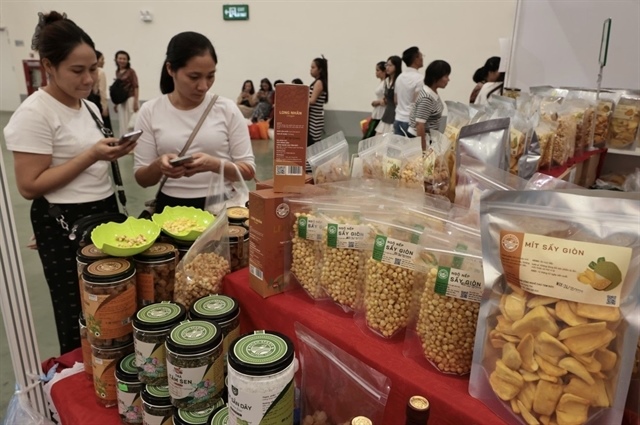
A pavilion displays processed agricultural specialties from different localities at an exhibition. VNA/VNS Photo |
Technology is expected to help producers in mountainous regions move beyond selling raw agricultural products, with deeper processing, digital traceability and e-commerce offering new ways to raise value and reach wider markets.
But limited access to capital, skilled workers and digital know-how remains a hurdle for cooperatives and small businesses seeking to scale up, industry experts said at a forum in Hà Nội on September 21.
The forum, organised by the Industry and Trade Magazine, focused on the use of science, technology and innovation in producing, distributing and developing specialty products from mountainous areas and ethnic minority communities.
The discussions centred on implementing Politburo Resolution 57-NQ/TW, which calls for breakthroughs in science and technology, innovation and national digital transformation.
Phạm Quyết Tiến, deputy director of the Institute for Agricultural Support Technology Research, said the biggest challenge was not simply a lack of machinery but the absence of technology systems suited to the scale and conditions of local producers.
Production remains fragmented in many areas, with farming practices and varieties yet to be standardised. Weaknesses in quality control, processing, storage and traceability also mean many products are still sold as raw materials, limiting their value.
“Technology choices should not be driven by the pursuit of expensive equipment, but by what producers actually need,” Tiến said.
He identified four areas where technology could make the biggest difference: standardising varieties and production processes; mechanisation and quality control; post-harvest storage and processing; and digitalising production areas and traceability systems.
Linking technology investment to product standards and market demand would give producers a stronger incentive to adopt new methods and give businesses greater confidence to invest, he said.
The aim is to turn locally produced specialties into more consistent, higher-value goods that can compete beyond their home markets.
For cooperatives, deeper processing is already showing potential to increase returns and extend the shelf life of agricultural products.
Trần Thị Thúy, director of Lộc Thúy Quỳnh Farm Cooperative, said technology had allowed the cooperative to process dragon fruit into higher-value products with longer shelf lives, opening opportunities to join distribution chains and eventually export.
The cooperative, however, faces challenges in raising investment, finding skilled workers and improving digital capabilities.
Older farmers can struggle with digital production records and traceability requirements, while industrial processing lines require workers with technical skills, Thúy said.
The cooperative must also match production with demand, develop online sales and meet requirements from overseas buyers.
It plans to invest further in processed products, starting with an instant dragon-fruit beef-stew noodle product, and eventually build an instant-noodle production line to support exports.
Financial support, technology transfer, worker training and stronger links to buyers would help cooperatives improve their production capacity and enter higher-standard markets, Thúy said.

A pavilion displays processed agricultural specialties from different localities at an exhibition. VNA/VNS Photo |
E-commerce opens a wider market
Bùi Quang Cường, head of the human resources development committee at the Vietnam E-commerce Association, said the challenge for many mountain products was no longer simply product quality, but the ability to compete in digital marketplaces.
Producers need to improve packaging and labelling, build recognisable brands and identify the customers they want to reach, he said.
E-commerce can remove much of the geographic barrier that has traditionally limited sales of products from remote areas. But selling online requires more than putting products on a platform.
Businesses need to manage pricing, digital content, sales, payments, logistics and customer service, while adapting to increasingly competitive online markets.
Improving digital skills will therefore be critical if cooperatives and small businesses are to use e-commerce to expand beyond local and regional markets, Cường said.
Traceability and transparent product information are also becoming increasingly important as consumers buy more goods online.
Consumers want to know not only what they are buying but where it comes from, how it was produced and what story lies behind it, Cường said.
That means cooperatives and businesses need to tailor their products, packaging and marketing to specific customer groups rather than trying to sell to everyone.
Tiến said technology transfer should begin with the needs of producers and the market, rather than with the technology itself.
Solutions need to take into account local conditions, the size of raw-material areas, farming practices, investment capacity and the ability of local workers to operate and maintain equipment.
The economics of operating the technology also need to be considered, including maintenance costs, spare parts, break-even production volumes and, crucially, whether there is a reliable market for the resulting products.
Under Resolution 57, the Institute for Agricultural Support Technology Research plans to develop technology packages covering the full value chain, from raw-material production and processing to storage, quality standards and market access.
Cooperatives and businesses would serve as the core of pilot models in production areas, with results measured through indicators including productivity, quality, costs, waste, selling prices and incomes.
Cường said, for producers in remote areas, technology and e-commerce are increasingly becoming two sides of the same market strategy: technology can raise quality, extend shelf life and improve traceability, while digital channels can put those products in front of consumers far beyond their place of origin.
The challenge now is to build a value chain that connects production, processing, standards, distribution and market access. If those links can be strengthened, Việt Nam's mountain specialties could move further from small-scale raw-material sales towards higher-value products with access to domestic and overseas markets.
- 09:37 22/09/2026