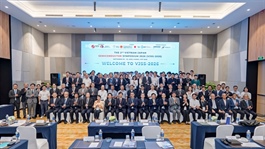
Fund industry needs broader investor base to reach growth goals
Fund industry needs broader investor base to reach growth goals
Vietnam’s fund industry faces the need to significantly expand its investor base, diversify products, and upgrade technology infrastructure to raise total net asset value (NAV) from around 0.7 per cent of GDP currently to 5 per cent by 2030, according to Nguyen Huu Hieu, CEO of FiinGroup.
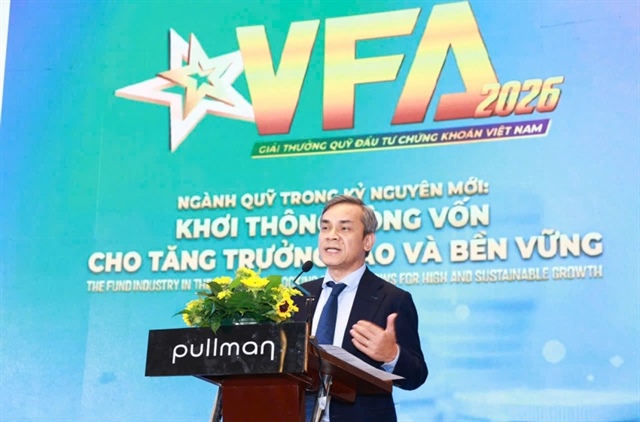
Nguyen Huu Hieu, CEO of FiinGroup. Photo: Chi Cuong |
Speaking at the Vietnam Fund Awards 2026 on September 22, Hieu said the Vietnamese fund industry had recorded significant growth over the past five to seven years, with NAV expanding at an average annual rate of around 16 per cent.
The industry currently has more than 40 fund management companies, over 100 securities investment funds, and more than 700,000 investors holding fund certificates. However, the gap towards the 2030 target remains substantial.
"Including entrusted investment portfolios, total assets under management currently amount to around 6 per cent of GDP. This remains modest compared with markets such as Malaysia and India, where the corresponding ratios are approximately three to four times higher than Vietnam’s," Hieu said.
The industry also remains highly concentrated, with a large share of assets managed by a small number of major companies. Entrusted portfolios are primarily invested in defensive assets such as government bonds, corporate bonds, and certificates of deposit.
Equities account for around 72 per cent of fund assets, while open-ended funds and exchange-traded funds account for approximately 71 per cent of total fund assets, reflecting a market that remains largely concentrated in traditional products.
Against this backdrop, Hieu identified three major trends likely to shape Vietnam’s fund industry in the coming years, starting with product innovation and diversification.
"This should go beyond simply establishing more funds, with products needing to become more accessible, understandable, and comparable to attract a broader base of retail investors," Hieu explained.
The second trend is the potential inflow of international capital following Vietnam’s transition to secondary emerging market status under FTSE Russell’s classification.
“Experience from countries that have previously been upgraded shows that the sustainability of foreign capital inflows depends significantly on the underlying strength of the market, including the pace of reforms and its ability to provide products that meet investors’ needs,” Hieu said.
The third trend is diversification of the investor base, extending beyond professional institutions to a much broader segment of the population.
Hieu cited India’s experience, where investors can make regular investments with relatively small amounts, equivalent to around VND80,000-150,000 ($3-6) per month.
“If similar products could reach around 50 million working-age people with incomes in Vietnam, the market would have an opportunity to build a much larger investor base while fostering long-term investment and saving habits,” he said.
Photo: Chi Cuong |
Achieving a NAV-to-GDP ratio of 5 per cent by 2030 would require a major expansion of the industry. The number of funds would need to increase from more than 100 currently to around 500, while the number of investors would need to rise from over 700,000 to approximately 2.5 million, or four to five times the current level.
Based on the estimates presented at the event, achieving these targets would require average annual growth of around 70-80 per cent, along with a new approach to market development beyond traditional distribution channels.
Such rapid expansion would also require significant changes to the industry’s operating model. Hieu identified four major bottlenecks, including the lack of integrated end-to-end investment processes and the continued use of fragmented, manual systems.
Investment position, asset value, NAV, and performance data also remain fragmented and insufficiently interconnected, while customer onboarding and know-your-customer procedures can be time-consuming, limiting the ability to scale and launch new products.
AI adoption is also increasing among fund management companies, but most applications remain focused on individual productivity or specific tasks rather than being integrated across the entire operating workflow.
“With appropriate implementation, AI can potentially multiply productivity in data processing, analysis, and decision support, rather than delivering improvements measured only in percentage points,” Hieu said. "Fund managers therefore need to standardise processes and databases, integrate AI into core workflows, and shift from local optimisation towards end-to-end optimisation."
Hieu said the fund industry needs to strengthen three core capabilities to support its expansion. The first is reliable data and risk assessment, improving research, portfolio valuation, and investment risk management through solutions including FiinPro-X, Bond Pricing, and independent credit rating services provided by FiinRatings in cooperation with S&P Global Ratings.
The second is an integrated fund management and operating system connecting portfolio management, trading, NAV calculation, compliance reporting, and regulatory reporting, with links to the Vietnam Securities Depository and Clearing Corporation, and the stock exchanges. Solutions highlighted include FiinFund, Core Fund, and BI reporting systems.
The third is technology infrastructure that enables seamless decision-making, connecting “reliable data, well-founded decisions, controlled execution, and verifiable results”.
"To achieve the target of raising the fund industry’s NAV to 5 per cent of GDP by 2030, Vietnam needs to advance institutional and policy reforms while upgrading its soft infrastructure, including data, system connectivity, information standardisation, and the practical application of AI. These will provide the foundation for the fund industry to expand its scale and improve operational efficiency,” he said.
- 15:30 22/09/2026