Cambodia-Thailand conflict narrows trade deficit
Cambodia-Thailand conflict narrows trade deficit
While two-way trade has shrunk sharply, Phnom Penh’s purchases from Bangkok took a much harder hit than its exports to the country.
For decades, Cambodia has run a multibillion-dollar trade deficit with Thailand. But since the border conflict began last year, the deficit narrowed to $849 million in the first eight months, down 46.6 per cent from $1.59 billion a year earlier.
According to the latest data from the General Department of Customs and Excise, the Kingdoms’ bilateral trade reached $1.81 billion by August, down 32 percent from $2.66 billion during the same period last year.
The decline was largely driven by a sharp drop in imports from Thailand, which fell 37.5 percent to $1.33 billion from $2.13 billion a year earlier. Meanwhile, Cambodia exports to Thailand declined by a much smaller 10.3 percent to $479.9 million from $534.9 million.
The figures indicated that Cambodia’s trade deficit with Thailand narrowed to about $849 million during January-August, compared with approximately $1.59 billion in the same period last year.
The scale of the longstanding trade imbalance was more pronounced in 2025, when total bilateral trade reached $3.6 billion, with Cambodia recording a trade deficit of about $2.2 billion with Thailand, equivalent to roughly 60 percent of total trade.
As imports declined faster than exports, Cambodia’s export-to-import coverage ratio also improved to 36.1 percent from 25.2 percent a year earlier, highlighting the uneven impact of the prolonged border disruption on bilateral trade.
While overall commerce between the two kingdoms has contracted substantially, the decline in Cambodian purchases from Thailand has been considerably sharper than the reduction in exports to the Thai market.
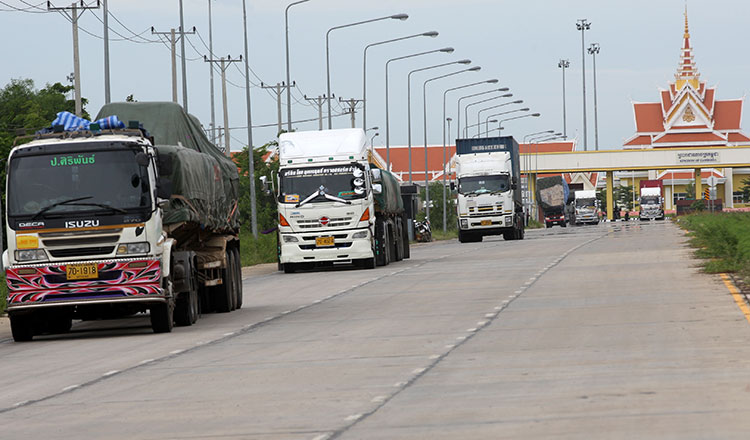
The trade disruption followed the closure of land border crossings amid escalating tensions between the two neighbouring countries. The restrictions disrupted the movement of goods that traditionally depended on land transportation, prompting businesses to seek alternative routes and adjust their supply chains.
The impact has been particularly significant for Thai goods entering Cambodia, as authorities and businesses have taken steps to reduce or restrict imports of Thai strategic products, while the consumer boycott of Thai goods further weakened demand for some products.
Earlier data showed that bilateral trade remained under pressure during the first half of the year. However, the pace of decline gradually moderated as businesses adapted to the prolonged disruption.
During the first seven months, Cambodia-Thailand trade stood at about $1.61 billion, down 32.7 percent from $2.4 billion in the same period last year. Cambodian exports declined 14 percent to about $420 million, while imports dropped 37.5 percent to around $1.19 billion.
The August-inclusive figures showed that the overall trade contraction remains significant, but the trade imbalance has continued to narrow in Cambodia’s favour.
For Cambodia, Thailand remained an important source of consumer goods, agricultural inputs, machinery, construction-related products and other supplies, while Thailand remained an important destination for Cambodian agricultural and industrial exports.
The narrower deficit, therefore, does not necessarily indicate stronger bilateral trade. Rather, it reflected a much sharper contraction in Cambodian imports than exports.
If the current trend continues, with Cambodian exports to Thailand declining by around 10 percent annually while imports from Thailand fall by about 30 percent, the trade gap could potentially close within a few years, bringing bilateral trade closer to balance.
- 10:52 14/09/2026