DPM unveils 3 core investment pillars at high-level China forum
DPM unveils 3 core investment pillars at high-level China forum
Chanthol says investors need to understand their markets, choose the right partners, respect local laws and cultures, and build solid ties with host governments and communities.
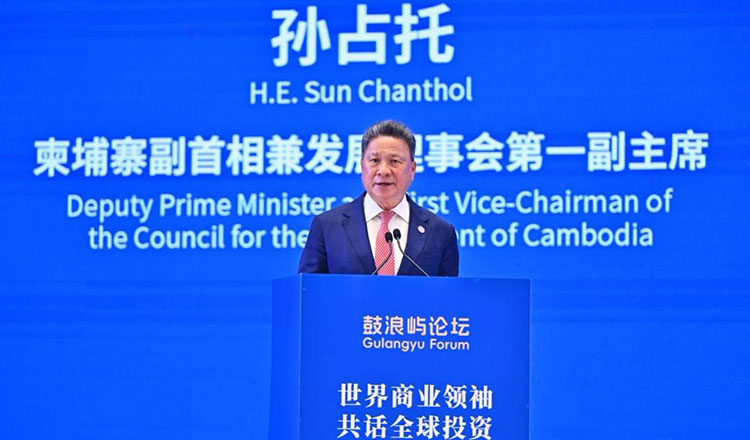
Deputy Prime Minister and First Vice-Chairman of the Council for the Development of Cambodia (CDC) Sun Chanthol outlined three fundamental principles for fostering a sustainable investment environment at the “2026 Gulangyu Forum – World Business Leaders Roundtable for Global Investment”, held on the sidelines of the 26th China International Fair for Investment and Trade (CIFIT) in Xiamen, China, from yesterday to Friday.
Speaking at the forum on Monday, Deputy Prime Minister Sun Chanthol said that globalising businesses face growing non-commercial hurdles alongside traditional financial risks. He highlighted geopolitical tensions, regulatory shifts, differing legal frameworks, supply chain disruptions, and communication gaps between investors and local governments as critical obstacles.
Chanthol urged investors to proactively prepare for uncertainties, invoking the Chinese proverb “Wei Yu Chou Mou” — meaning to prepare before the rain falls.
He said this requires investors to understand their markets, select appropriate partners, respect local laws and cultures, and build strong relationships with host governments and communities.
Drawing from Cambodia’s experience, Chanthol identified predictability, partnership, and diversification and connectivity as three key principles for creating a sustainable investment environment.
“On predictability, investors need clear and consistent rules, while governments have a responsibility to provide transparent laws, stable policies and reliable institutions,” said Chanthol.
“For the CDC, our duty does not end with project approval; rather, that is where our responsibility begins,” he said, emphasising the need to accompany investors throughout project implementation, operations and expansion.
DPM Chanthol pointed to Cambodia’s direct dialogue mechanisms, including the Government-Private Sector Forum (G-PSF), Public-Private Sector Dialogues (P-PSD) and the recently introduced “Open Day with DPM” programme, as platforms for addressing challenges faced by investors in a timely manner.
On partnership, Chanthol said successful overseas investment requires more than capital and must be built on trust.
He encouraged foreign companies to view themselves as development partners of their host countries by creating jobs, developing local skills, transferring technology, protecting the environment and respecting local cultures.
“Companies investing abroad should view themselves as ‘development partners’ of the host country,” he said.
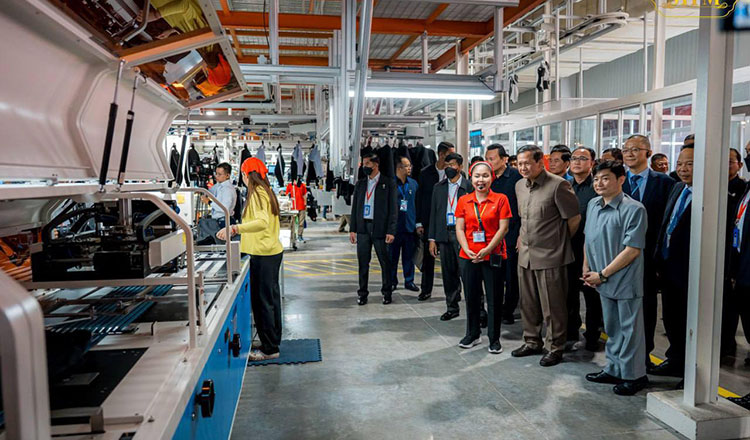
He highlighted Chinese investment in Cambodia’s manufacturing, infrastructure, energy and technology sectors as examples of cooperation based on mutual benefit and mutual respect.
“The third principle, diversification and connectivity, is particularly important in an increasingly uncertain global economy as businesses need more options to strengthen resilience,” Chanthol emphasised.
He encouraged diversification of markets, suppliers, production bases, logistics and supply chains, while noting that Cambodia continues to strengthen economic relations with China, ASEAN and other global partners without having to choose between them.
“Greater connectivity creates more opportunities and mitigates risks,” he said.
Chanthol offered a message to Chinese companies and international investors considering Cambodia: “Come and talk to us before you invest, talk to us while you invest, and continue talking to us after you invest.”
He said that the Royal Government is fully committed to risk mitigation and long-term collaboration. He concluded that open communication channels foster the mutual trust necessary to safeguard investments against commercial and geopolitical risks.
Later in the day, Chanthol led a high-level delegation in courtesy calls and bilateral discussions with Chinese and Fujian provincial leaders, including Vice-President Han Zheng and Secretary of the Communist Party of China Fujian Provincial Committee Zhou Zuyi.
Chanthol described Cambodia-China relations as an “ironclad friendship” and said ties had reached a new level through the Comprehensive Strategic Partnership of Cooperation and the joint effort to build an “All-Weather Cambodia-China Community with a Shared Future in the New Era”.
He expressed Cambodia’s appreciation for China’s long-standing support for socio-economic development and major infrastructure projects, while updating Chinese officials on the Funan Techo Canal project. Discussions also covered tourism promotion, investment aftercare, the Cambodia-Thailand border situation and efforts to combat online technology scams.
Chinese and Fujian officials reaffirmed their support for Cambodia’s socio-economic development and key strategic projects, while Fujian authorities pledged to encourage more enterprises and investors to explore opportunities in Cambodia.
Chanthol also led the delegation in business and study activities in Xiamen. A business luncheon hosted by Xiamen Hongda Taxation Service focused on strengthening private-sector networks and attracting Fujian investors to Cambodia.
The delegation later visited SDIC Intelligent Information Technology to learn about digital forensics, cybersecurity and digital government technologies. In the evening, Chanthol attended an Investment and Trade Dinner Reception hosted by UN Trade and Development.
More than 1,200 government agencies, as well as business delegations from 129 countries and regions, and 30 international organisations have registered to attend the 26th CIFIT at the Xiamen International Expo Center in China’s Fujian province.
- 04:16 09/09/2026