Kingdom’s trade reaches $44B in 7 months
Kingdom’s trade reaches $44B in 7 months
Data from the first seven months of 2026 reveals strong growth in both import and export volumes, alongside an increasing national trade deficit.
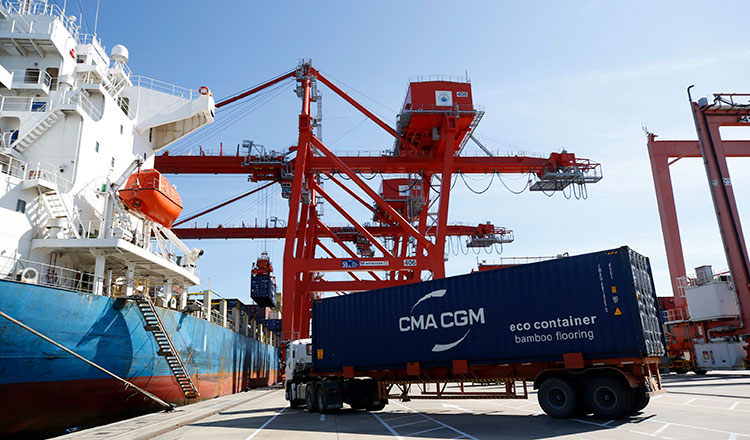
The General Department of Customs and Excise (GDCE) yesterday reported that Cambodia’s total merchandise trade reached $44 billion in the first seven months, up 21.3 percent year-on-year, while the trade deficit stood at $2.4 billion.
According to the GDCE’s Trade Balance Statistics, total trade volume rose from $36.32 billion in the same period of 2025 to $44.07 billion in 2026. Exports increased 21.3 percent to $20.81 billion, and imports grew 21.4 percent to $23.26 billion.
The resulting trade deficit widened from $1.99 billion a year earlier to $2.44 billion. At the same time, the export coverage ratio remained virtually unchanged at 89.5 percent, reflecting almost equal growth rates in both exports and imports.
Trade with China, the Kingdom’s largest partner by volume, expanded 23.9 percent to $13.63 billion. Exports to China rose 24.2 percent to $1.10 billion, reflecting continued overseas demand for Cambodian goods.
Imports from China, however, climbed almost as quickly, increasing 23.8 percent to $12.52 billion. Export coverage of Chinese imports stayed low at 8.8 percent, confirming the persistent structural imbalance.
China alone accounted for roughly 31 percent of the total trade volume during the period and remained the primary driver of the national deficit, generating a bilateral shortfall of $11.42 billion that far exceeded the overall gap.
The United States continued to serve as the most important surplus market as trade with the US surged 32.2 percent to $9.42 billion. Exports jumped 30.6 percent to $9.05 billion, supported by strong shipments of garments, footwear and other manufactured products.
Imports from the US more than doubled, rising 87 percent to $377 million, indicating growing two-way commercial links, yet they remained relatively modest in absolute terms compared with the much larger volume of Cambodian exports.
The bilateral surplus therefore expanded to $8.67 billion. Although the coverage ratio declined from an exceptionally high 3,436 percent to 2,400 percent, the US still delivered Cambodia’s largest single-country trade surplus and a vital source of foreign exchange.
Trade with Vietnam rose 8.2 percent to $5.35 billion and showed a clear improvement in balance. Cambodian exports to Vietnam increased 12.4 percent to $2.73 billion, while imports grew more moderately by 4.2 percent to $2.62 billion.
As a result, Cambodia recorded a surplus of $112 million with Vietnam, reversing a deficit of $84 million in the corresponding period of 2025. Export coverage improved from 96.6 percent to 104.3 percent, pointing to a more balanced and increasingly favourable relationship with the neighbouring country.
The overall picture that emerged from the first seven months of 2026 is one of robust expansion in both exports and imports, accompanied by a wider national deficit.
The heavy imbalance with China continued to weigh on the trade account, while the substantial surplus with the US and the newly positive balance with Vietnam provided partial offsets.
With these three markets accounting for more than half of Cambodia’s total trade, shifts in demand or policy in any of them are likely to continue exerting significant influence on the kingdom’s external performance for the remainder of the year.
Speaking to Khmer Times, President of the Logistics Supply Chain and Brokers Business Association in Cambodia (LOSCBA) Chea Chandara said that bilateral relations between Cambodia and the US have improved significantly under the second term of President Donald Trump, contributing to stronger economic ties.
He noted that the United States Trade Representative (USTR) recently imposed a 10 percent tariff on Cambodian goods entering the US market under Section 301. “This rate is more competitive than the 12.5 percent applied to neighbouring countries such as Thailand and Vietnam.”
At the same time, the Royal Government has reduced import duties on a range of US goods, with some commodities now subject to zero tariffs. These measures have encouraged traders to import more American products, resulting in a 60 to 80 percent increase in imports from the US since the beginning of the year, he added.
Chandara observed that in the past, Cambodia’s imports from the US were limited to only a few categories, particularly vehicles. Recently, a wider variety of American commodities has appeared in the local market.
The LOSCBA President also highlighted the close connection between Cambodia-US trade and Chinese investment. “Chinese investors dominate the country’s investment landscape, with the majority of projects concentrated in the industrial sector.”
Given Cambodia’s relatively small domestic market, the primary purpose of these investments is to process goods for export to the US and European markets, where higher returns can be achieved, he noted.
Furthermore, Chandara pointed out that the ongoing land border closure with Thailand has created additional opportunities. “With Thai products, which long dominated the Cambodian market, less available, both US and Chinese goods have gained greater access to local consumers, further supporting the rise in two-way trade,” he said.
- 08:36 11/08/2026