GDCE intensifies efforts to combat tax evasion
GDCE intensifies efforts to combat tax evasion
The move shall prevent all forms of tax evasion, strengthen customs and excise compliance, increase national revenue and promote businesses operating across the country.
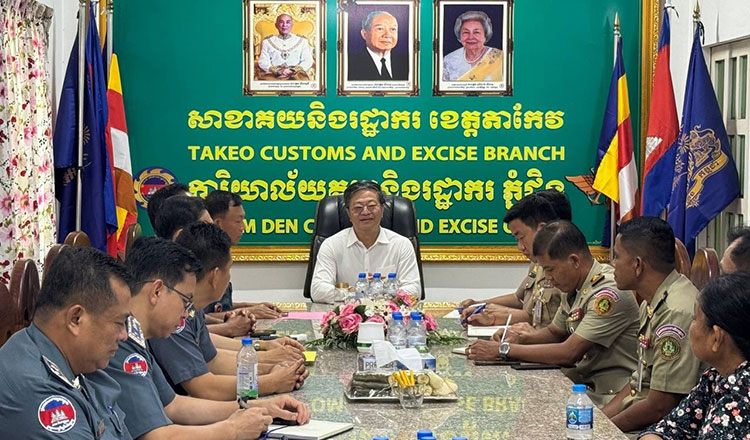
The General Department of Customs and Excise (GDCE) has intensified efforts to combat tax evasion and strengthen customs governance through nationwide enforcement and awareness campaigns. The measures are expected to boost state revenue and facilitate legitimate trade.
Under the ‘Sharp Measures to Prevent and Suppress Tax Evasion and Strengthen the Governance of GDCE’ initiative, Se Sokhorn, Deputy Director General of GDCE, led a delegation to inspect the border corridors in Koh Andaet and Kiri Vong districts of Takeo province on May 30.
During the mission, Sokhorn met representatives from the provincial administration, immigration police office, customs, and import-export traders at the Phnom Den international border checkpoint to review the implementation of the measures and discuss closer cooperation to combat tax evasion.
He stressed that all stakeholders, including customs units, local authorities, relevant agencies, customs brokers and traders, must actively participate in enforcing the measures to ensure effective import-export management, strengthen compliance and prevent customs-related offences at border crossings.
According to Sokhorn, one important component of the reform programme is the dismantling of unnecessary checkpoints operated by provincial customs and excise branches, a move that has contributed to enhancing transparency while facilitating trade and improving the efficiency of customs administration.
The GDCE Deputy Director instructed the Takeo Customs and Excise Branch, Phnom Den Customs and Excise Office, brokers and traders to focus on the priorities and support the effective implementation of the government’s anti-tax evasion campaign.
First, he instructed officers to provide public services with professionalism, transparency and strict compliance with official service fees to strengthen public trust and improve the accountability of customs services nationwide.
Second, he ordered officers to strengthen the prevention and suppression of tax evasion. In particular, the Takeo Customs and Excise Branch must deploy personnel to prevent tax evasion along the Prey Yuthka, Kamnob and Prey Tamao checkpoints.
Third, he urged customs brokers and traders to pay import duty and meet tax obligations accurately based on the correct type and quantity of imported goods, emphasising that compliance is essential to maintaining fair competition in the market.
Fourth, provincial customs departments and checkpoint offices were instructed to continue disseminating information on the strict measures more widely among businesses and local communities to ensure a better understanding of regulatory requirements and enforcement priorities.
Sokhorn also called for stronger cooperation from provincial authorities and relevant institutions to support officers in carrying out their responsibilities and combating customs crimes more effectively to ensure a fair, transparent and competitive trading environment.
Separately, Kam Chankosal, Deputy Director General of GDCE, organised a workshop from May 27 to 28 in Svay Rieng province to disseminate the strict measures to officials, importers, transport operators and customs brokers operating at various import ports.
According to a GDCE announcement, the package of measures was introduced under the instruction of Prime Minister Hun Manet, who called for effective and efficient implementation of the reforms aimed at strengthening customs administration and improving revenue collection.
The package consisted of three major components: measures to prevent tax evasion and fraud while facilitating trade, initiatives to strengthen governance within customs administration, and mechanisms to monitor implementation. In total, the package contains 31 detailed activities.
The measures are designed to prevent and suppress all forms of tax evasion, strengthen customs and excise compliance, increase national revenue and promote businesses operating across Cambodia’s trading sector, the statement added.
Alongside enforcement efforts, the package also aimed to enhance trade facilitation through the removal of duplicate checkpoints, elimination of scanner inspection fees, wider application of risk-based inspections, expansion of trusted trader programmes and further automation of customs procedures.
During the meeting, Chankosal highlighted that delays or obstruction in implementing the measures could result in disciplinary penalties without exception and, where necessary, legal proceedings. He noted that the same reform package had already been introduced in Tbong Khmum and Kratie provinces earlier in May.
It may be noted that the anti-tax evasion campaign follows an earlier dissemination programme organised by GDCE on April 28 under the chairmanship of Kun Nhem, Director General of GDCE, which attracted approximately 510 participants from business associations, customs agencies, transport operators and the private sector.
While speaking to Khmer Times, Sam Seun, policy analyst at the Royal Academy of Cambodia (RAC), welcomed the government’s efforts to strengthen tax compliance and combat tax evasion.
However, he stressed that the success of the measures would depend largely on their implementation at border checkpoints, where informal payments remain a concern.
Sam recommended accelerating the adoption of a digital invoicing system to improve transparency in customs procedures. “Such a system would provide traders with clear information on imported goods, applicable duties and taxes, and the exact amount required for payment,” he said.
He explained that digital invoices should be linked directly to the central database of the GDCE headquarters in Phnom Penh, enabling traders to verify transactions and maintain accurate payment records while reducing opportunities for informal charges.
He also suggested installing surveillance cameras at border checkpoints and strengthening ethics training for customs officials to enhance accountability and ensure revenue collection.
- 11:08 02/06/2026