Govt puts off capital gains tax until 2027
Govt puts off capital gains tax until 2027
The move extends the current grace period for real estate transactions, providing additional time for market participants to prepare for the tax’s full enforcement.
The Royal Government has postponed a decision to implement capital gains tax on real estate for a further year, pushing the start date to January 1, 2027, according to a notice issued by the General Department of Taxation (GDT) on January 5.
The GDT, under the Ministry of Economy and Finance, said the decision was made in line with the “high agreement” of Prime Minister Hun Manet, following a request outlined in an official letter dated December 24, 2025. The move extends the current grace period for real estate transactions, providing additional time for market participants to prepare for the tax’s full enforcement.
Under the revised timeline, capital gains tax on profits realised from the sale or transfer of real estate will only apply to gains arising from January 1, 2027, onwards. This marks another delay to a policy that has been closely watched by property developers, investors and individual property owners amid ongoing adjustments in Cambodia’s real estate sector.
However, the GDT clarified that the postponement applies exclusively to real estate. Capital gains tax on other asset categories remains on schedule. Specifically, gains arising from the sale or transfer of leases, investment properties, goodwill, businesses, intellectual property and foreign currencies will be subject to capital gains tax from January 1, 2026 onwards.
The government has previously said the phased approach is intended to balance revenue collection with economic stability, particularly as Cambodia continues to recover from recent global and regional economic pressures. By delaying the real estate component, authorities aim to avoid placing additional strain on the property market while maintaining progress in broadening the tax base.
The capital gains tax framework forms part of wider tax reforms designed to strengthen public finances, improve compliance and enhance transparency. The GDT has encouraged taxpayers, developers and investors to familiarise themselves with the applicable rules for non-real-estate assets, while using the additional year to prepare for the real estate tax coming into force in 2027.
Officials have reiterated that further guidance will be issued as needed to ensure a smooth and consistent implementation across sectors.
Noun Rithy, Chairman of the Board of KFA Group, told Khmer Times that the decision to defer the capital gains tax was a positive move, particularly given the current economic climate.
“The deferral of capital gains tax is a good thing because implementing it at a time when the economy is facing difficulties from multiple external factors would constrain the flow of real estate transactions,” he said.
He added that the postponement would help maintain activity in the property market and allow all stakeholders to benefit. “The deferral will encourage the real estate sector to remain active and enable investors, buyers, sellers and developers to take full advantage of the policy,” Rithy noted.
According to him, the sector has been under pressure for several years. “The real estate market has faced challenges since 2019 and has yet to experience a strong recovery. Construction activity for residential housing, condominiums and shopping malls remains subdued and is not comparable to the levels seen in 2018,” he said.
However, Rithy pointed out that certain segments continue to show growth. “There has been some expansion in industrial zones, tourism-related developments and utility buildings,” he said.
He stressed that the government’s decision reflects its support for the private sector. “The Royal Government’s deferral of capital gains tax is a timely response to help the real estate sector move forward without stagnation and demonstrates encouragement for private sector participation,” he added.
When asked about the implementation of the capital gains tax, he said, “We are waiting for an appropriate time when our economy is stronger.” He added that, while the private sector naturally seeks tax exemptions to enhance profitability, it is important not to overlook the responsibility to pay taxes, which contribute to national development.
Kinkesa Kim, Managing Director of CBRE Cambodia, said the delay in implementing the capital gains tax was unlikely to have a significant impact on real estate investors’ buying and selling decisions.
“For real estate investors, the delay of the capital gains tax may not have a significant impact on buying and selling decisions. Price is still the most important factor in investors’ decisions,” she said.
However, she noted that the postponement could help to maintain market stability and provide a degree of certainty in the near term. “This delay could help maintain stability and provide certainty in the short term in 2026, while being crucial in maintaining Cambodia’s economic stability,” she added.
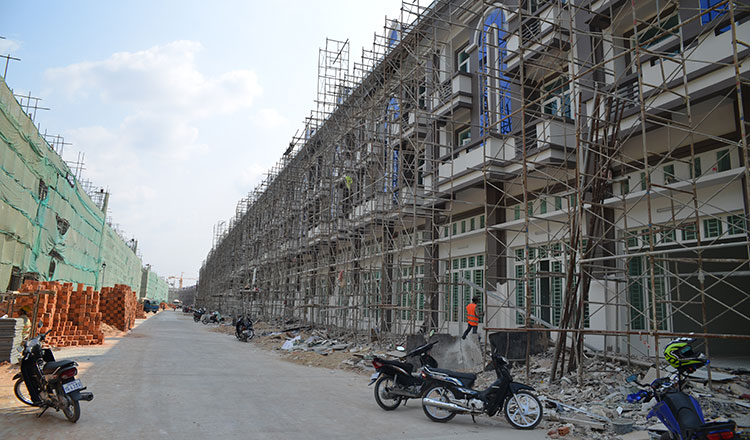
However, Cambodia approved 3,503 construction projects in 2025, covering a combined floor area of more than 18 million square metres and representing a total investment of $7.32 billion — an increase of 68.89 per cent compared with 2024, according to figures released by the Ministry of Land Management, Urban Planning and Construction (MLMUPC).
The ministry noted that, notwithstanding global inflationary pressures, tighter financial conditions and ongoing geopolitical tensions, Cambodia’s construction sector has shown resilience. Growth has been underpinned by improving investor confidence and steady domestic demand, allowing the sector to maintain its upward trend.
- 08:27 07/01/2026