Financial sector charts next steps as Party Congress convenes
Financial sector charts next steps as Party Congress convenes
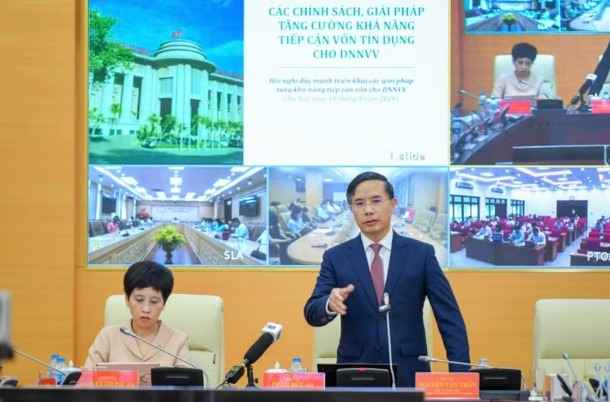
Amid the 14th National Party Congress taking place in Hanoi, Nguyen Van Thang, member of the Party Central Committee, Secretary of the Ministry of Finance Party Committee, and Minister of Finance, spoke to VIR’s Phuong Nguyen about the financial sector’s recent achievements and priorities for the period ahead.
|

How do you assess the Ministry of Finance’s performance in implementing financial and state budget tasks, as well as its progress in improving mechanisms, policies, and legal frameworks across the financial, investment, and state treasury sectors in recent years?
Over the past five years, the financial and budget duties have been carried out amid unfathomable developments domestically and internationally, which have posed numerous challenges.
However, thanks to great efforts by the entire political system under the sound leadership of the Party, National Assembly, and government; by concerted actions from ministries, agencies, sectors, and localities; along with proactive, flexible, and timely direction of the financial sector, the task of financial and budget management has been effectively carried out with several noteworthy outcomes, with the accomplishment of all key targets for the 2021-2025 period.
Financial and budget sources have been mobilised, managed, and used in a more increasingly effective manner, making an important contribution to the implementation of national socioeconomic goals.
Firstly, the financial sector has provided timely consultancy and deployed plans, mechanisms, policies, and solutions for socioeconomic development; boosting economic growth in association with macroeconomic stability. The state budget overspending in the 2021 – 2025 period occupied about 3.1 – 3.2 per cent of GDP; public debt is estimated at 35 – 36 per cent of GDP - meaning they were effectively controlled, contributing to strengthening the national credibility ranking.
Secondly, the national law system on finance and state coffers have improved in a concentrated manner. In the 2021 – 2025 period, the MoF enacted 32 laws and resolutions of the National Assembly and the National Assembly Standing Committee, and 168 decrees. It also enacted within its jurisdiction 436 circulars, focusing on removing obstructions, and boosting decentralisation and empowerment, cutting and reducing administrative procedures, meeting new development requirements in the new period.
Thirdly, management of state budget revenues has been strengthened, with revenue structure focused in a more sustainable manner. The ratio of state budget mobilisation averaged over the past five year has hit 18.3 per cent of GDP. At the same time, exemption, reduction, and extension of assorted taxes and fees were worth about VND1.1 quadrillion ($44 billion) used for supporting individuals and enterprises during the pandemic, and for them to recover and promote production and business activities post-pandemic.
Fourthly, the financial sector has also increased revenues and save expenditures valued at about VND1.5 quadrillion ($60 billion) which have been earmarked for development investment, national defence and security, science and technology, salary reform, social security, removal of dilapidated houses, and construction of schools in border areas.
Fifthly, the country’s development investment has increased by 32 per cent of all state budget spending. It has used with focuses, ensuring sufficient funding for strategic infrastructure projects with high spillover effects.
Sixthly, the country’s investment and business climate has continued to be ameliorated, with all economic sectors encouraged for development. At present, more than one million enterprises are operating in Vietnam, up 46 per cent over 2020. Total development investment in the 2021–2025 period accounted for 32.2 per cent of GDP – in which the private sector and state-owned enterprises held more than 65 per cent.
Seventhly, Vietnam has continued to stand out as a bright spot in attracting foreign direct investment (FDI), ranking among the world’s group of 15 largest developing countries with wooed FDI. Foreign capital accounts for approximately 16 per cent of total development investment.
Eighthly, capital markets in Vietnam have developed in a safer, more sustainable and more integrated direction, gradually becoming an important channel for capital mobilisation for the economy. By the end of 2025, the bond market is estimated to have reached a size of around VND3.93 quadrillion ($157.2 billion), tantamount to 30.7 per cent of GDP. Stock market capitalisation is projected to have hit nearly VND10 quadrillion ($400 billion), or 77.9 per cent of GDP. In 2025, Vietnam’s stock market fully met the required criteria and was upgraded from a frontier market status to an emerging market status.
Finally, the MoF has actively promoted regional economic development, sectoral development, and new economic sectors and models. It has also participated in the establishment of international financial centres and free trade zones. Moreover, it has also effectively coordinated with relevant agencies in ensuring social security, ensuring that economic growth goes well hand in hand with social progress and equity.
What key tasks and solutions will the financial sector prioritise to maintain macroeconomic stability and promote rapid, sustainable growth in the period ahead?
In the coming time, the MoF will centre on the synchronous implementation of key tasks and solutions.
First and foremost is deploying a reasonably expansionary proactive fiscal policy, focused, and targeted. It is also to strengthen the leading role of the central budget, while also encouraging proactivity and creativity from ministries, sectors, and localities.
Fiscal policy will be closely coordinated with monetary policy to maintain macroeconomic stability, contribute to achieving double-digit growth, and transforming the national development model.
In addition, a focus will also be placed on enhancing the effectiveness and efficiency of state budget revenue and expenditure management; ensuring correct, sufficient, and timely collection, linked with nurturing and developing sustainable revenue sources.
We will strive to maintain the average state budget mobilisation rate in the 2026-2030 period at about 18 per cent of GDP, and increase development investment expenditure to around 40 per cent of total state budget expenditure. Furthermore, we will also strictly control the budget deficit and public debt in line with the economy’s borrowing and repayment capacity, thereby contributing to improvements in the national credit rating.
Simultaneously, we will also continue institutional and law system improvement in finance and state budget. We will also utilise digital transformation and administrative procedure reform, enhancing capacity and effectiveness in management and supervision.
What solutions are being prioritised to develop different economic sectors, as well as the capital and stock markets?
The MoF will concentrate on bettering the effectiveness of the state-owned economic sector, enabling it to truly play a leading and pioneering role in key, essential, and strategic sectors.
What is more, the private sector will also be further developed in line with the spirit of the Politburo’s Resolution No.68-NQ/TW issued last May on private sector development. Efforts are to be made to have around two million operational enterprises by 2030, with technological capability, innovation and digital transformation ranking among the leading groups in ASEAN and Asia.
The MoF will also develop capital markets and the stock market into important channels for medium- and long-term capital mobilisation, with opportunities tapped into effectively from the stock market upgrade. We will also complete the legal framework for new trends such as digital assets, green transition, and digital transformation.
In addition, we will also centre on selectively luring in FDI, with priority placed on large-scale, high-technology and environmentally friendly projects. It is also necessary to strengthen linkages between domestic enterprises and foreign-invested enterprises, so that Vietnamese businesses can deeper participate in global value chains and supply chains.
|
To achieve the highest possible outcomes in celebration of the 14th National Party Congress, the Ministry of Finance has launched an emulation drive to accelerate and make breakthroughs in successfully fulfilling the goals and tasks set out in the Resolution of the 13th National Party Congress within the financial sector. This initiative is being carried out widely, synchronously, and consistently throughout the whole financial sector, closely linked with emulation movements aimed to excellently accomplishing assigned political tasks. The initiative features diverse content and forms closely associated with the implementation of central resolutions on administrative reform and the MoF’s schemes on administrative reform. Important attention would be paid to human resource development and the promotion of digital transformation in the financial field. |
- 09:58 21/01/2026