Vietnamese banks pull in record deposits as credit growth surges in 2025
Vietnamese banks pull in record deposits as credit growth surges in 2025
State-owned lenders Vietcombank, VietinBank, BIDV and Agribank, which together dominate Việt Nam’s financial system, all posted sharp increases in assets, deposits and loans, reflecting strong confidence from households and businesses as borrowing demand rebounded.

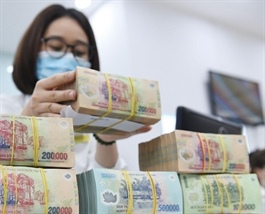
People walk past a private bank branch in HCM City, as banks reported record deposit inflows and strong credit growth in 2025. — VNS Photo Bồ Xuân Hiệp |
Việt Nam’s largest banks reported record deposit inflows and double-digit credit growth in 2025, strengthening their funding base and giving them room to expand lending as the economy moves into a recovery phase, bank executives said last week.
State-owned lenders Vietcombank, VietinBank, BIDV and Agribank, which together dominate Việt Nam’s financial system, all posted sharp increases in assets, deposits and loans, reflecting strong confidence from households and businesses as borrowing demand rebounded.
At Vietcombank’s annual business review last Thursday, chairman Nguyễn Thanh Tùng said the bank’s total assets had reached VNĐ2.48 quadrillion (US$98 billion) by the end of 2025, up nearly 20 per cent from a year earlier.
Outstanding credit to the economy rose by more than 15 per cent to VNĐ1.66 quadrillion, while customer deposits reached VNĐ1.68 quadrillion, up over 10 per cent, ensuring what the bank described as a safe balance between funding and lending.
VietinBank also reported strong growth. Chairman Trần Minh Bình said the lender’s total assets increased by about 18 per cent in 2025, while credit expanded roughly 16 per cent and deposits climbed 12 per cent compared with the end of 2024.
BIDV, Việt Nam’s largest bank by assets, said its total balance sheet exceeded VNĐ3.25 quadrillion, up 20 per cent year on year. Customer deposits rose by nearly 14 per cent to more than VNĐ2.4 quadrillion, while credit outstanding grew more than 15 per cent to over VNĐ2.3 quadrillion.
Agribank, which has the country’s largest rural lending network, reported total assets of more than VNĐ2.6 quadrillion, up 20.3 per cent, with deposits climbing 17.6 per cent to VNĐ2.38 quadrillion. Its loan book approached VNĐ2 quadrillion, up 14.7 per cent.
The strong deposit growth, described by bankers as the highest in several years, has given lenders greater capacity to extend credit without relying heavily on more expensive wholesale funding.
“This is creating room for banks to support production, trade and consumption as the economy continues to recover,” one senior banker said.
Profit outlook brightens
The surge in deposits and lending is translating into stronger profits for much of the banking sector, analysts say.
MB Securities (MBS) said in a research note that industry earnings were on track for another strong year, though gains were becoming increasingly uneven.
MBS forecast that several large private lenders would post sharp profit growth in the fourth quarter of 2025, driven by aggressive credit expansion as borrowing demand rebounded.
Techcombank’s profit was expected to jump 81 per cent year on year in the final quarter, HDBank 41 per cent, VPBank 37 per cent and TPBank 31 per cent, MBS said.
“These banks share strong capital positions and the ability to grow their loan books quickly, allowing them to capture the surge in demand from businesses and households,” the report said.
The fourth quarter is traditionally the busiest period for banks, as companies borrow to finance production, exports, trade and consumption. This seasonal effect was even more pronounced in 2025 as economic conditions stabilised and interest rates remained relatively low.
If rates stay near current levels, banking sector profits for the full year could rise by more than 20 per cent, MBS added.
Growing gap within the sector
Despite the strong headline numbers, analysts warn that the recovery is uneven.
Large banks with cheap funding, extensive branch networks and diversified customer bases are widening their lead, benefiting from rising net interest margins and strong deposit inflows.
Smaller lenders and foreign-owned banks, by contrast, are facing higher funding costs, narrower margins and heavier provisioning for credit risks.
“This cycle is increasingly rewarding scale and balance-sheet strength,” one banking analyst said. “Banks that can mobilise deposits at low cost and deploy them efficiently are pulling ahead.”
The divergence highlights how Việt Nam’s banking recovery is no longer just about growing credit, but about how well each institution manages funding, risk and capital structure.
With deposits flooding in and credit demand rebounding, policymakers are closely watching to ensure lending flows into productive sectors rather than speculative activities, as Việt Nam seeks to sustain economic growth without reigniting financial instability.
- 10:07 19/01/2026