China accounts for 54% of Cambodia’s total investment
China accounts for 54% of Cambodia’s total investment
Kingdom’s open trade and investment policies are instrumental in boosting investor confidence and drawing new entrants from China.
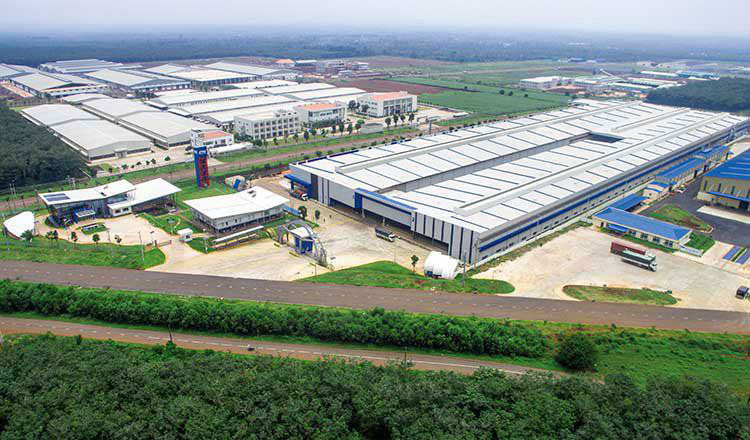
China emerged as the largest source of foreign investment in Cambodia in 2025, accounting for more than half of the Kingdom’s total approved investment capital, according to a report by the Council for the Development of Cambodia (CDC) on Monday.
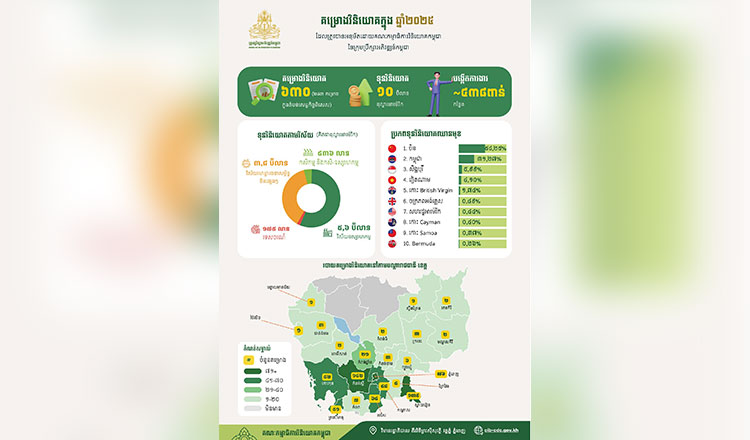
The report shows that Chinese investors committed a total of $5.42 billion last year, representing 54.25 percent of Cambodia’s total investment capital of $10 billion. The figure underlines China’s continued position as Cambodia’s most significant investment partner amid a broader rebound in approved projects.
Domestic investors ranked second, contributing $3.12 billion, or 31.27 percent, of total investment capital. Singapore followed in third place with $599 million, accounting for 5.99 percent, while the remaining investment originated from a range of other countries.
According to the CDC, the Cambodia Investment Committee (CIC) registered 630 investment projects in 2025 with a combined capital of $10 billion. These projects are expected to generate around 438,000 jobs, reinforcing the sector’s role as a key driver of employment and economic activity.
The figures represent a marked increase compared to 2024. The number of registered projects rose by 216, equivalent to an increase of around 52 percent, while total investment capital grew by approximately $3 billion, or 45 percent, year on year. Officials said the growth reflects improved investor confidence and the impact of ongoing government efforts to enhance the business environment.
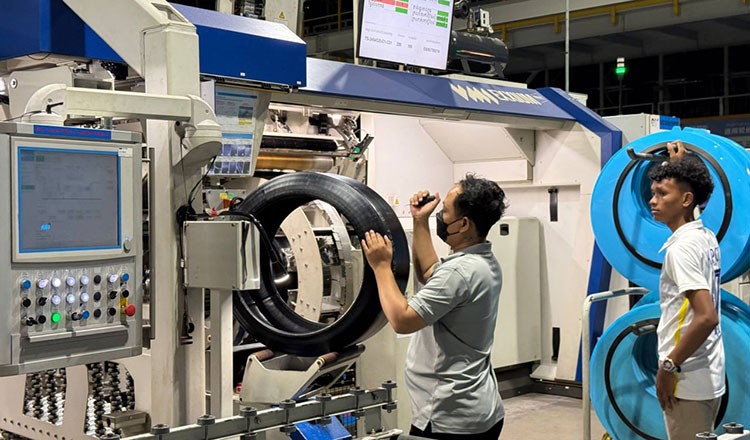
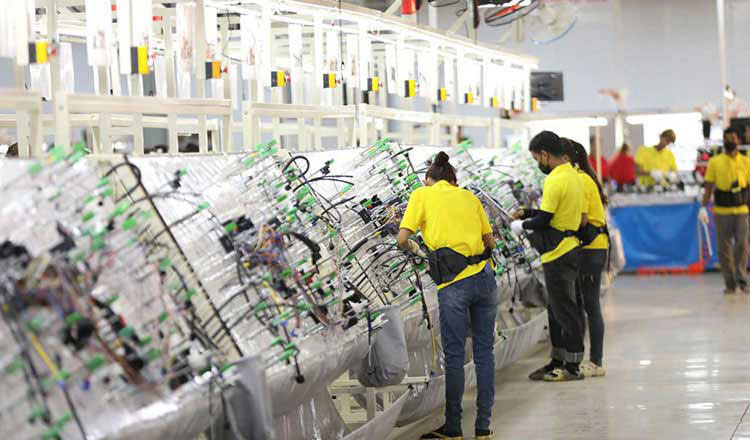
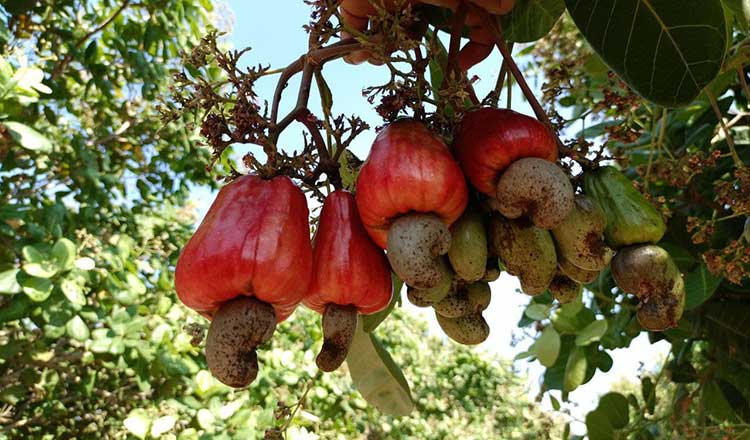
In terms of sectoral distribution, the industrial sector attracted the largest share of investment, receiving US$5.6 billion in approved capital. Infrastructure and other sectors followed with US$3.8 billion, while the agricultural and agro-industrial sector drew $436 million. Investment in the tourism sector amounted to $175 million, indicating a gradual recovery in tourism-related activities.
Provincially, Kampong Speu led the country in terms of the number of approved projects, with 142 projects registered during the year. It was followed closely by Svay Rieng Province with 139 projects, reflecting strong interest in border and industrial zones. Phnom Penh ranked third with 76 projects, while Takeo Province recorded 64 projects. Koh Kong and Preah Sihanouk provinces followed with 52 and 51 projects, respectively.
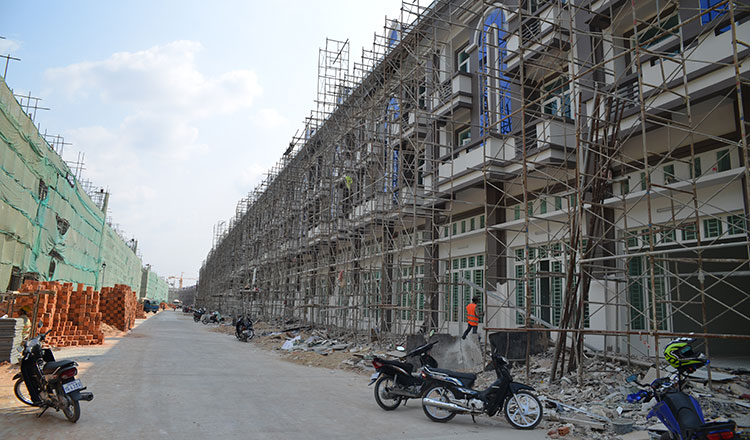
The CDC noted that the geographic spread of projects highlights growing investment beyond the capital, particularly in provinces with established industrial parks and improved infrastructure.
The council said it would continue to promote diversification and value-added investment to support sustainable and inclusive economic growth.
Speaking to Khmer Times, Lim Heng, Vice President of the Cambodian Chamber of Commerce (CCC), said the Kingdom’s investment laws were “functioning well”, noting that they apply equally to investors of all nationalities.
“Cambodia welcomes investment from all countries,” he said. “It is natural that Chinese investment features strongly, given the close friendship between the two nations and the sustained efforts by the Cambodian Chamber of Commerce, under the leadership of its President, Kith Meng, and the government led by Prime Minister Hun Manet to attract foreign capital.”
Heng highlighted what he described as Cambodia’s “diamond-clad friendship” with China, underpinned by the Cambodia-China Free Trade Agreement and the ASEAN-China Free Trade Agreement. These frameworks, he said, have positioned Cambodia as an attractive destination for Chinese investors, enabling companies based in the Kingdom to export efficiently to ASEAN and RCEP markets.
He added that Cambodia’s trade and investment reach extends well beyond China, pointing to existing free trade agreements with South Korea and the United Arab Emirates, as well as preferential access under the European Union’s Everything But Arms (EBA) scheme and Generalised System of Preferences (GSP) arrangements with Canada and the United Kingdom.
“More recently, Cambodia secured a reciprocal tariff rate of 19 percent with the United States, which is more favourable than the standard US rate,” Heng said. “This is expected to further stimulate investment interest, not only from China but also from other countries.”
Heng stressed that Cambodia’s investment promotion policy is not aimed at any single market. “We do not target specific countries when seeking to diversify investment sources. Our approach is to welcome all investors on an equal and non-discriminatory basis,” he said.
He also noted that regular dialogue between the government and the private sector, through public–private forums, remains central to maintaining a competitive and responsive investment environment.
Meanwhile, Lor Vichet, Vice President of the Cambodia Chinese Commerce Association (CCCA), told Khmer Times that Cambodia’s investor-friendly climate, coupled with strong government-backed incentives, continues to attract growing interest from Chinese companies, particularly those operating under full foreign ownership.
Vichet said Cambodia’s open trade and investment policies have been instrumental in boosting investor confidence and drawing new entrants from China. He pointed to the Kingdom’s expanding network of free trade agreements, including those with China, South Korea and the Regional Comprehensive Economic Partnership (RCEP), as a key factor enhancing Cambodia’s appeal as a regional trade hub.
“These agreements help companies streamline market access and export their products more efficiently,” he said, adding that they have reinforced Cambodia’s position as a strategic gateway for regional and international trade.
According to the latest figures from the General Department of Customs and Excise (GDCE), bilateral trade between Cambodia and China exceeded $17.6 billion in the first eleven months of 2025, marking a robust 28 percent increase compared with the same period last year. The data, however, also highlights an imbalance, with Cambodian exports to China declining by 6.4 percent year-on-year to $1.5 billion, while imports from China surged by 33.3 percent to $16.19 billion, widening the trade gap.
- 07:59 08/01/2026