Cambodia bolsters agricultural independence with new large-scale fertiliser plant
Cambodia bolsters agricultural independence with new large-scale fertiliser plant
A large-scale natural fertiliser factory with a capacity of about 100 tonnes per day is currently being built on a 6,500-square-metre site in Kampong Speu province and is set to commence trial operations in early July 2026.
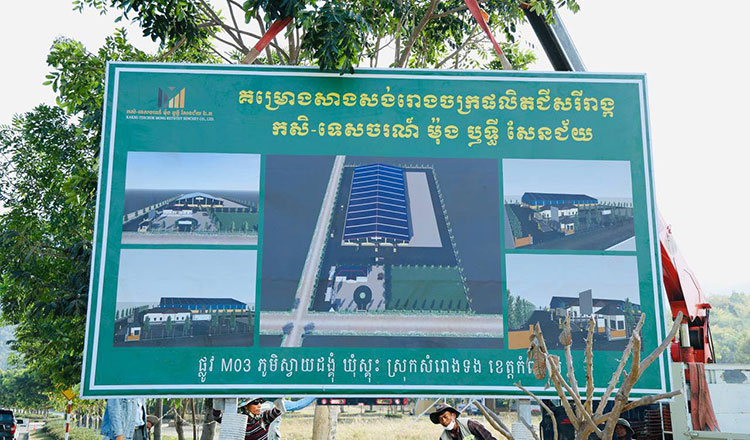
Mong Reththy, Chairman of Mong Reththy Group and also Chairman of the Senate’s Agriculture Commission, shared the information on Tuesday on his social media platform following a visit to the construction site.
Reththy said he led a technical team to inspect the construction of the natural fertiliser factory, located in Svay Dangkum village, Samrong Tong district, Kampong Speu province. The project began in early December 2025 and is expected to be completed and enter trial operations by early July 2026.
“This natural fertiliser factory has a production capacity of about 100 tonnes per day and will create employment for about 100 direct workers,” he wrote.
“We are making every effort to build this natural fertiliser factory to help reduce reliance on imported fertilisers and to produce high-quality fertiliser at affordable prices.”
Regarding fertiliser production, Prime Minister Hun Manet has identified agricultural fertiliser as a strategic priority for the Royal Government of Cambodia, aiming to increase domestic production rather than continuing to rely heavily on imports.
The Prime Minister made these remarks in June 2025 during the first joint congress of the National Assembly and the Senate, which discussed three key issues, including the social protection system, the informal economy, and agriculture.
According to Mr Hun Manet, the government, through the Ministry of Agriculture, Forestry and Fisheries (MAFF), is currently working with the private sector and experts to study the feasibility of local fertiliser production that ensures quality, sufficient supply, and affordable prices.
Fertiliser is not just a production input; it is a strategic issue that we cannot depend on others for indefinitely. If suppliers shut down or increase prices, we will encounter difficulties. Therefore, we must have the capability to produce fertiliser ourselves—whether natural or chemical—if not 100%, then at least 30% of our needs,” he said.
Mr Hun Manet added that ongoing discussions with the private sector and experts aim to turn this goal into a practical and sustainable reality.
- 07:52 15/01/2026