Cambodia unveils new fin strategy, targets 5% growth
Cambodia unveils new fin strategy, targets 5% growth
The Financial Sector Development Strategy 2025-2030 represents the Royal Government’s commitment to developing the financial sector to support sustainable economic development and improve citizens’ welfare.
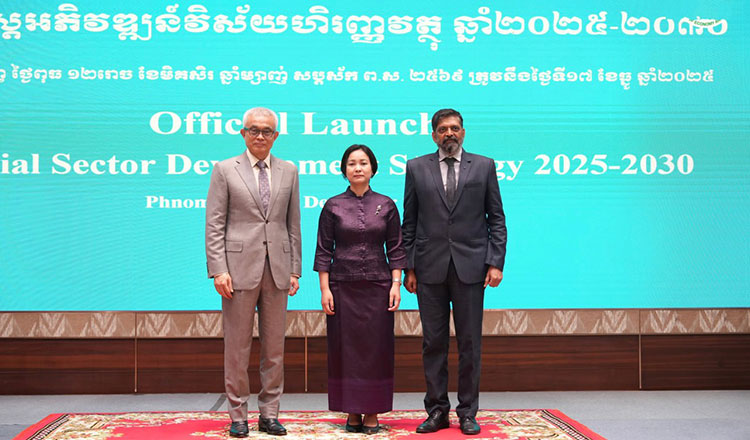
The National Bank of Cambodia (NBC) Wednesday launched the ‘Financial Sector Development Strategy 2025-2030’, a comprehensive roadmap jointly established via technical support from the Asian Development Bank (ADB), expecting to sustain economic growth at 5.0 percent next year despite US tariffs and border clashes with Thailand.
The launch ceremony was presided over by Aun Pornmoniroth, Deputy Prime Minister and Minister of Economy and Finance (MEF), in the presence of Chea Serey, Governor of NBC, and Vijay Kumar Akasam, ADB’s Country Operations Head for Cambodia, in Phnom Penh.
Addressing the event, Serey highlighted that the Financial Sector Development Strategy (FSDS) has been continuously updated since its initial launch in 2001, under the initiative of former NBC Governor Chea Chanto and the support of former Prime Minister Hun Sen, with technical assistance from ADB.
She noted that FSDS 2025-2030 represented the fourth update of the strategy, demonstrating the Royal Government’s commitment to developing the financial sector to support sustainable economic development and improve citizens’ welfare.
“The strategy implemented so far has strengthened the foundation of a stable, diversified, modern and integrated financial system,” the NBC Governor said.
Serey stressed that while the global situation is changing rapidly with high uncertainty, allowing financial technology to provide unprecedented opportunities, it has also brought new vulnerabilities.
The NBC Governor emphasised that the Covid-19 crisis and its lingering effects have disrupted global supply chains, slowed economic growth and pushed some citizens into poverty.
She went on to add that rising geopolitical tensions, trade wars and armed conflicts have further disrupted supply chains, international trade and investor confidence, making the global economic situation more uncertain.
“With the vision of transforming Cambodia into an upper-middle-income country, the financial system must be capable and dynamic to support more interconnected economic activity, deeper integration and higher productivity, Serey added.
In his open remarks, Pornmoniroth said that the FSDS serves as a long-term roadmap for financial sector development, which has been implemented over the past 25 years, starting with the ‘Financial Sector Development Vision and Plan 2001-2010’.
He explained that the successful preparation of the FSDS 2025-2030 is closely linked to the achievements made in earlier phases, incorporating necessary inputs and measures from relevant ministries and institutions in response to the rapidly changing and unpredictable financial and socio-economic landscape, both regionally and globally.
“In this regard, I would also like to underline that the FSDS 2025-2030 has been prepared thoroughly and comprehensively with a high sense of responsibility by the Financial Sector Development Steering Committee.”
“As a result, the strategy was submitted to the Economic and Financial Policy Committee (EFPC), a policy-making mechanism of the Royal Government, before receiving the approval of Prime Minister Hun Manet,” he added.
Pornmoniroth noted that the Kingdom’s economy has recovered rapidly and remains on a strong growth path following the global Covid-19 crisis, despite continuing challenges and high uncertainties in the regional and global context.
“Despite the imposed tariffs and invasion on national sovereignty and territorial integrity, the economy is expected to achieve growth of around 5.2 percent this year and 5.0 percent in 2026,” the Deputy Prime Minister noted.
The ADB’s Country Operations Head congratulated the official launch of FSDS 2025-2030, describing it as a landmark initiative that will shape the future of Cambodia’s financial sector.
Vijay Akasam said, “Today’s event is not just a ceremonial milestone, but a demonstration of our shared commitment to building an inclusive, innovative and sustainable financial system for Cambodia.”
“The new strategy provides a comprehensive roadmap, building on past achievements while introducing forward-looking reforms to address emerging challenges and opportunities,” he added.
Akasam explained that the strategy is anchored on six interconnected pillars. The first focused on expanding access to finance for individuals and businesses, particularly micro, small and medium enterprises (MSMEs) and underserved groups.
The second pillar aimed to maintain financial sector stability through robust regulation and risk management, while the third focused on strengthening financial market infrastructure and deepening capital markets, including the development of local currency bond markets and greater product diversity.
The fourth prioritised harnessing technology to drive digital transformation and financial innovation, followed by the fifth, promoting sustainable finance by integrating the Environmental, Social and Governance (ESG) standards, and mobilising green capital.
The final pillar aimed at advancing financial inclusion and strengthening consumer protection, Akasam added.
- 08:57 19/12/2025