What should be done to fix falling crop prices amid border closure?
What should be done to fix falling crop prices amid border closure?
There is no denying that the sharp decline in paddy prices has angered farmers across the Kingdom. The downturn has deepened economic pressure on households and fuelled demands for stronger government intervention. This has been further compounded by the border closure with Thailand since June, as blocked routes along with volatile trading conditions reduced market access, igniting strong public outrage towards the Ministry of Agriculture, Forestry, and Fisheries (MAFF). The fact is, while MAFF cannot control market prices or international trade dynamics, it did implement support measures, including requesting financial institutions to delay repayments and recommending that the government provide funds to stabilise agricultural prices during periods of volatility. The Royal Government released an additional $40 million to stabilise rice prices for the harvest season in late 2025 and early 2026 through the Agriculture & Rural Development Bank, a capital loan to partner rice mill factories to purchase paddy from farmers. Khmer Times talks to experts to suggest means to fix the problem
Cambodia’s agricultural sector has experienced sharp price drops since the border closure with Thailand in late June, fueling strong public outrage toward the Ministry of Agriculture, Forestry, and Fisheries (MAFF), although questions remain about whether such blame is fully justified.
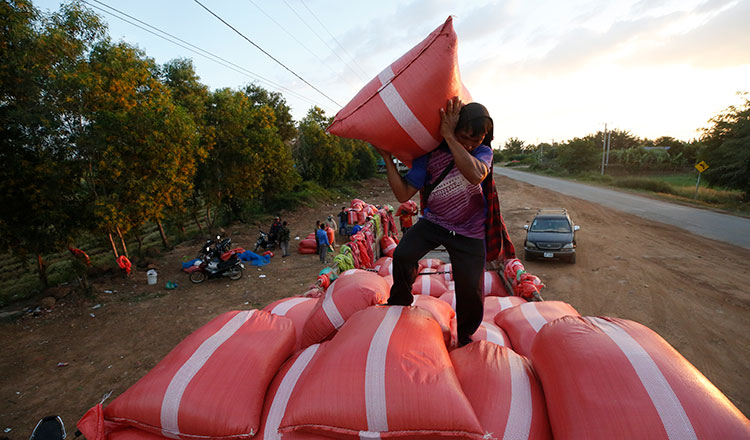
The border restriction produced immediate effects on farmers nationwide, as blocked routes and volatile trading conditions reduced market access. Local reports show paddy prices holding between 600 and 650 riels per kilogram, while cassava has fallen below 250 riels.
Farmers relying almost entirely on these crops have been hit especially hard, with losses generating widespread public concern and frustration. The downturn has deepened economic pressure on households and fueled demands for stronger government intervention across the agricultural and trade sectors.
In response to reduced trade with Thailand, Cambodia sought to expand agricultural exports to Vietnam as an alternative market. However, official trade data suggests the strategy has delivered limited short-term relief, raising concerns over market diversification and the effectiveness of regional export mechanisms.
According to the General Department of Customs and Excise (GDCE), exports to Vietnam rose only 0.4 percent to $3.39 billion in the first eleven months of this year, while imports dropped 1.4 percent to $3.73 billion, bringing total bilateral trade to $7.13 billion.
Meanwhile, the trade with Thailand contracted sharply as exports fell 13.8 percent to $679 million, while imports declined 12.7 percent to $2.73 billion, resulting in total bilateral trade of $3.41 billion due to months of border conflict between the neighbouring Kingdoms.
These figures highlighted the dual challenge: limited export growth to Vietnam and significant trade losses with Thailand. The increased reliance on one market has not offset the disruptions in another, exposing structural vulnerabilities in the agricultural trade landscape.
Such international shocks remained beyond the immediate control of the Royal Government and related institutions as a whole. However, public frustration often targets MAFF, reflecting misunderstanding about the ministry’s responsibilities, especially during externally driven agricultural crises.
Cambodia, a predominantly agricultural country, depends heavily on raw commodities such as rice, cassava, rubber and cashew nuts. These products support rural livelihoods, export earnings and food security, meaning price declines create ripple effects across markets, transportation networks and processing industries.
As prices fell, public criticism increasingly focused on MAFF, with some citizens urging Dith Tina, Minister of MAFF, to step down for allegedly failing to protect farmers’ interests. The criticism overlooks the ministry’s actual mandate and the broader institutional responsibilities involved.
MAFF’s core duties include improving productivity, promoting sustainable techniques and providing technical support. It is not responsible for market access, international trade negotiations or global price trends. It fell under separate economic and diplomatic agencies within the government structure.
The Ministry of Commerce (MoC) handles market expansion and trade promotion, while the Ministry of Industry, Science, Technology and Innovation (MISTI) oversees product innovation and processing. These institutions shaped the export growth and value-added potential more directly than MAFF.
The Ministry of Water Resources and Meteorology (MOWRAM) ensures irrigation and water supply to reduce production costs. Meanwhile, the Ministry of Public Works and Transport (MPWT) and the Ministry of Rural Development (MRD) manage road networks and logistics crucial for moving goods efficiently to markets.
Together, these ministries influenced agricultural competitiveness through infrastructure, innovation and trade facilitation. Their combined performance significantly affects farmers’ ability to reach buyers, secure fair prices and withstand external shocks such as border tensions or global market fluctuations.
In early November, Tina responded to public criticism, even accepting the blame if it made citizens feel relieved. He explained that MAFF had worked to maintain reasonable paddy prices during harvest season and supported farmers wherever possible.
“If blaming me makes you feel relieved, please do it. However, please turn the compassion on farmers into action by helping solve the rice price challenge,” the MAFF Minister stated.
He encouraged citizens to use their voices constructively, focusing on improving farmer welfare rather than targeting agricultural officials or specific government bodies.
The Minister urged collective action, suggesting rice mill factories purchase at fair prices, fertiliser sellers delay debt collections, landowners’ lower rents, and consumers support mills that buy from farmers, noting that shared responsibility is essential to addressing price challenges effectively.
Despite these explanations, many public responses reflected limited awareness of inter-ministerial roles as citizens continued to hold Tina personally accountable, saying that who else they should blame since he is the MAFF Minister.
While MAFF cannot control market prices or international trade dynamics, it has implemented support measures, including requesting financial institutions to delay repayments and recommending that the government provide funds to stabilise agricultural prices during periods of volatility.
MAFF has also advanced long-term initiatives such as promoting sustainable practices, providing technical support, distributing high-quality seeds and improving access to modern farming technologies. These efforts enhance productivity, reduce costs and build resilience against external shocks.
A week later, the Royal Government released an additional fund of $40 million to intervene to stabilise rice prices for the harvest season in late 2025 and early 2026 through the Agriculture & Rural Development Bank (ARDB), a capital loan to partner rice mill factories to purchase paddy from farmers.
Prime Minister Hun Manet acknowledged that falling prices stem largely from external factors, including border tensions. To strengthen trade and mitigate impacts, he inaugurated the Meun Chey-Tan Nam international border gate in Prey Veng province on December 8.
The new border gate is expected to improve trade with Vietnam and support the government’s goal of raising bilateral trade to $20 billion in the coming years. It also contributes to reducing dependency on Thailand by diversifying Cambodia’s export routes and regional partners.
The Royal Government continues to emphasise inter-ministerial coordination in addressing agricultural challenges. Strengthening cooperation among economic, infrastructure and trade ministries remains essential to building a more stable and competitive agricultural sector nationwide.
Looking forward, the Meun Chey-Tan Nam border gate could significantly stabilise export flows and support rural livelihoods. Diversifying trade routes and expanding access to Vietnam may reduce future risks tied to reliance on any single neighbouring market.
At the same time, ongoing productivity improvements by MAFF will help maintain the agricultural competitiveness. Combining enhanced trade access with stronger domestic production could provide farmers with greater security and long-term economic opportunities.
Although public perception has focused heavily on MAFF, experts emphasised that agricultural challenges require coordinated solutions. Effective responses depend on multisector cooperation, infrastructure investment and diversified trade strategies rather than blame directed at a single ministry.
Border tensions with Thailand and limited export gains to Vietnam reveal structural weaknesses in Cambodia’s agricultural economy. The government initiatives, including MAFF programs and new trade infrastructure, outlined a clear path toward recovery and greater resilience.
By recognising shared institutional responsibilities and supporting targeted measures that enhance productivity and market access, the Royal Government aimed to protect farmers, strengthen its agricultural sector and secure more stable export revenues in the years ahead.
During the launch of the Climate Adaptive Irrigation and Sustainable Agriculture for Resilience (CAISAR) Project, Thor Chetha, Minister of MOWRAM, told the Khmer Times that the project, if successfully implemented, would help lower farmers’ production costs, thereby boosting their competitiveness in the market.
He said price pressures from international markets are largely beyond domestic control. “When prices rise in the international market, our prices also increase, and when they fall, we are affected as well. What is most important is that we focus on reducing production costs for farmers,” he said.
Chetha went on to explain that expanding irrigation systems nationwide would allow farmers easier and more reliable access to water for crop irrigation and daily use, particularly during the dry season.
The Minister noted, “Improved irrigation infrastructure would also reduce farmers’ reliance on gasoline-powered water pumps, helping to lower fuel expenses.”
“When water is accessible at a lower cost, overall production costs can be reduced,” Chetha said, noting that this would strengthen the competitiveness of domestic agricultural products in both local and regional markets.
He emphasised that investment in climate-adaptive irrigation is a key component of improving agricultural resilience and supporting farmers over the long term. “By improving water management and reducing input costs, we can help farmers better adapt to climate challenges while improving productivity and market competitiveness,” he added.
Speaking to Khmer Times, Seun Sam, a policy analyst at the Royal Academy of Cambodia (RAC), said the decline in rice prices is a long-standing structural issue that has occurred over many years and involves multiple government institutions, not just MAFF.
He explained that the situation has worsened following recent border tensions, particularly affecting farmers in border provinces such as Battambang, Banteay Meanchey and Preah Vihear, who have traditionally relied on exporting raw agricultural products to Thailand.
“Disruptions to cross-border trade have limited market access and reduced farmgate prices,” he noted.
Sam continued that MOWRAM also plays an important role, as it is responsible for ensuring adequate water supply for farming activities, especially during the dry season when water scarcity becomes more pronounced.
He said addressing rice price challenges requires coordinated policy responses from other ministries, including MoC and MRD. He pointed out that rice prices are influenced by several interconnected factors such as fertiliser costs, transportation expenses and fuel prices, rather than international market conditions alone.
Sam said, “These cost pressures affect farmers’ profitability and competitiveness,” adding that some neighbouring countries have adopted measures to manage similar challenges, which could provide useful lessons for Cambodia.
He emphasised that resolving recurring rice price issues should be viewed as a shared responsibility among MAFF, MoC, MRD and MOWRAM. According to Saun, closer coordination could help produce more consistent and effective policies to support farmers.
Sam also highlighted the need for practical, long-term solutions, noting that restrictions on dry-season farming due to water shortages underline the importance of better planning and resource management.
He welcomed recent initiatives by private companies to purchase rice directly from farmers, describing them as a positive contribution. “Greater cooperation between relevant ministries and the private sector could help improve stability and sustainability in rice production and other crops,” he said.
Sebastian George, Chairman and CEO of the MV Group Cambodia, a company that invests in the Kingdom’s agriculture, told Khmer Times that external factors play a major role in the current decline in agricultural prices, and border closures have restricted export flows, causing oversupply in domestic markets and reducing farmgate prices.
He said that regional market volatility, particularly in Thailand and Vietnam, has further pressured Cambodian commodities by lowering comparative export prices. Global freight costs, currency fluctuations, and weakened demand from key buyers — especially China — also limit purchasing capacity.
“Because Cambodia’s agriculture is heavily export-dependent, these external disruptions have a much stronger effect on prices than domestic policy alone. Thus, the recent decline reflects broader regional economic shifts rather than internal mismanagement,” George noted.
When asked about whether public criticism of MAFF is warranted, or are other ministries and structural trade issues are more responsible, he said that the public criticism of MAFF overlooks the multi-ministerial nature of agricultural price stability.
“While MAFF oversees production and extension services, market access, logistics, and industrial processing fall under MoC, MISTI, MOWRAM and MPWT,” he said.
George explained that price instability is driven by export barriers, limited value-added processing, high transport costs, and weak cross-border trade coordination — areas beyond MAFF’s direct authority.
“Therefore, attributing the crisis solely to MAFF is inaccurate. Structural trade constraints and inter-ministerial coordination challenges are more responsible,” he said.
When further asked about the immediate and long-term strategies that could stabilise farmgate prices as Cambodia faces renewed border tension, he said that in the short term, the government can stabilise prices by opening temporary purchase schemes, negotiating emergency export corridors, and expanding storage and drying facilities to reduce farmers’ urgency to sell cheaply.
The Chairman of MV Group explained that strengthening real-time market information and reducing transport bottlenecks would also ease price pressure.
“Long-term strategies include expanding processing industries for rice and cassava, diversifying export markets, improving irrigation systems, and enhancing cross-border trade agreements to reduce dependence on single routes.”
“Promoting contract farming and farmer cooperatives can further secure stable pricing. A coordinated multi-ministry approach is essential to protect rural livelihoods during repeated border disruptions,” he added.
- 09:41 15/12/2025