Northwestern coffee sector moves towards sustainable production
Northwestern coffee sector moves towards sustainable production
The EUDR will apply from December 30 this year, to medium and large operators, and from June 30 next year, to most micro and small operators.
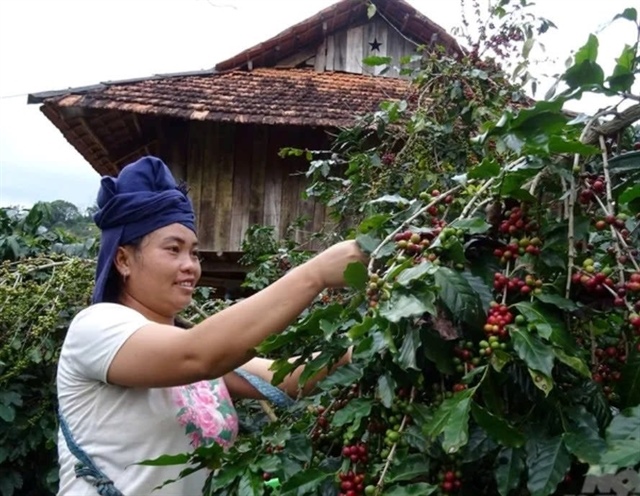
Sơn La is emerging as one of Việt Nam’s leading Arabica-producing regions. — Photo thitruongtaichinhtiente.vn |
The northwestern coffee-growing region is facing growing pressure to shift towards more sustainable production as the European Union (EU) tightens deforestation requirements and climate change creates new challenges for farmers.
The transition is not only about meeting export requirements, but also about improving coffee quality, developing suitable growing areas and creating greater value for farmers.
The issues were discussed at a workshop on promoting EUDR-compliant coffee production in Việt Nam on Tuesday.
The EU is one of Việt Nam’s largest coffee markets, accounting for around 40 per cent of the country’s coffee exports. Under the EU Deforestation Regulation (EUDR), operators must be able to identify where coffee was produced, provide the geolocation of production plots and demonstrate that the coffee was not produced on land subject to deforestation after December 31, 2020.
The EUDR will apply from December 30 this year, to medium and large operators, and from June 30 next year, to most micro and small operators.
The northwest, particularly Sơn La Province, has emerged as an important Arabica coffee-growing area. Sơn La currently has nearly 40,000 hectares of coffee, while in neighbouring Điện Biên Province, more than 10,000 hectares of coffee were newly planted this year alone.
The rapid expansion has created opportunities to raise incomes, particularly among ethnic minority households. However, much of the region’s coffee has been planted only in recent years and is still grown using traditional methods, with heavy reliance on rainfall.
The region’s mountainous terrain also limits productivity and increases the risk of soil erosion and degradation.
Speaking at the workshop, Nguyễn Mạnh Sơn of the Institute of Strategy and Policy on Agriculture and Environment said the northwest needs production models suited to its specific natural conditions.
In Sơn La, farmers are experimenting with intercropping, shade trees and modern irrigation systems. CARE is supporting several of these initiatives, including sprinkler irrigation in Mường Chanh Commune.
According to Dr Nguyễn Thế Mạnh of CARE, water-saving irrigation can help Arabica farmers regulate flowering, reduce labour requirements and improve yields. Combined with ground cover and organic fertilisers, it can also help retain soil moisture and improve soil health.
However, high investment costs and limited access to water remain barriers to wider adoption.
The experience of Hà Văn Thảo’s family in Mường Chanh shows the potential. After receiving CARE support to install drip and sprinkler irrigation in 2024, the family compared yields between irrigated and non-irrigated plots and later expanded the system across its coffee-growing area.
At Bích Thao Coffee Cooperative, director Nguyễn Xuân Thao said farming practices from Việt Nam’s Central Highlands cannot simply be applied to Sơn La because Arabica production there differs from Robusta production in terms of varieties, climate, soil and flowering conditions.
The cooperative has introduced new varieties for replanting since 2017, focusing on climate resilience and disease resistance. However, improving quality remains a major challenge, with high-quality and specialty coffee accounting for less than 1 per cent of production, according to the cooperative.
Data needed
Alongside farming practices, the region needs better data on coffee-growing areas.
Most coffee is produced by smallholder farmers, making it difficult to collect and standardise information. Sơn La also lacks a comprehensive assessment of weather, ecological and soil conditions to identify areas best suited to high-quality Arabica production.
Mạnh said government agencies, research institutions, businesses and other stakeholders should work together to build a comprehensive and standardised database of Sơn La’s coffee-growing areas. This would provide a scientific basis for planning coffee-growing zones, guiding production and assessing the development potential of different areas.
Alongside data on natural conditions, the EUDR requires information on production areas to be consistent and verifiable. Given the fragmented nature of coffee production, digitising farm data, helping farmers keep production records and strengthening links among farmers, cooperatives and buyers would help organise supply areas more efficiently while reducing compliance costs.
- 17:32 07/10/2026