Petrovietnam accelerates smart factory drive with AI, IoT
Petrovietnam accelerates smart factory drive with AI, IoT
Petrovietnam is accelerating its smart factory drive, deploying AI, IoT, digital twins and other technologies to improve industrial efficiency, strengthen operational reliability and cut emissions.
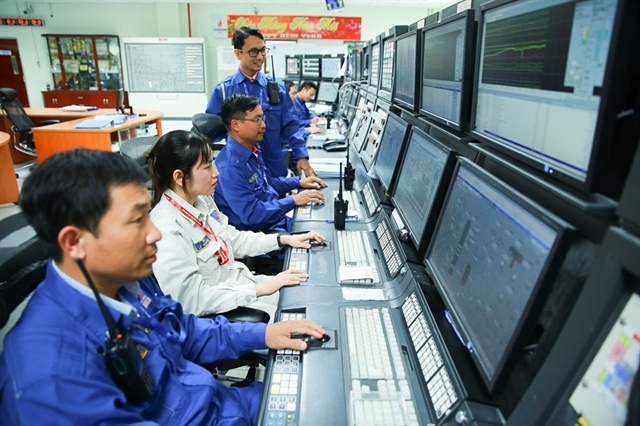
Engineers inside the control room of the Dung Quất oil refinery. — VNA/VNS Photo |
The Vietnam National Industry–Energy Group (Petrovietnam) is accelerating the development of smart factories, using artificial intelligence (AI), the Internet of Things (IoT) and digital twins to improve operational efficiency, strengthen competitiveness and reduce emissions.
The move is part of the group’s implementation of Politburo Resolution No 57-NQ/TW on breakthroughs in science and technology, innovation and national digital transformation.
Several Petrovietnam member companies are now integrating digital technologies into production and management, moving towards data-driven and increasingly automated industrial operations.
Cà Mau Fertilizer leads the way
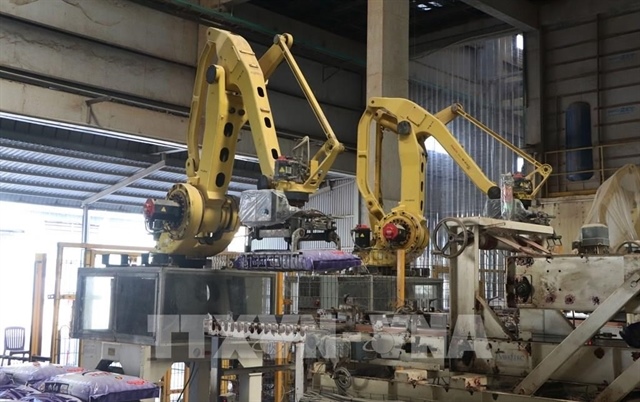
The Cà Mau fertiliser plant, operated by PetroVietnam Ca Mau Fertilizer Corporation (PVCFC), has become Petrovietnam’s first smart factory after integrating AI, IoT and big data into its operations.
A unified data platform allows managers to monitor key operating indicators in real time and access historical information remotely via mobile devices, helping them make faster decisions.
According to Nguyễn Duy Hải, former director of the Cà Mau plant, AI-based failure prediction has helped reduce unplanned downtime by 15-20 per cent, while energy and raw material consumption has fallen by 3-5 per cent.
The system also enables real-time monitoring of CO₂ emissions and has shortened decision-making cycles from several hours to just a few minutes.
PVCFC aims to complete the second phase of its smart factory programme in 2026, moving towards more autonomous operations powered by AI. The plan includes a smart warehouse and a digital twin that can simulate operating scenarios before they are implemented at the physical plant.
Engineers inside the control room of the Dung Quất oil refinery. — VNA/VNS Photo |
Digital twin completed at Phú Mỹ Fertilizer
At the Phú Mỹ fertiliser plant, PetroVietnam Fertilizer and Chemicals Corporation (PVFCCo – Phú Mỹ), in cooperation with FPT, has completed a digital twin project.
The platform connects the plant’s physical space, assets, technical documents and operational data in a unified digital environment, supporting operations, maintenance, safety and staff training.
PVFCCo said the project marks a shift from developing a digital solution to preparing it for practical use at the plant. The platform can later be expanded to support project management, infrastructure documentation, employee training and other smart management applications.
Dung Quất refinery goes digital
At the Dung Quất oil refinery, Binh Son Refining and Petrochemical JSC (BSR) is developing a smart refinery model based on real-time data and AI.
BSR General Director Nguyễn Việt Thắng said the company plans to deploy technologies including advanced process control and real-time optimisation (APC/RTO), AI-based energy and crude-oil optimisation, predictive maintenance, and drones and robots for inspection.
Digital twins are also being developed for key production units, alongside an Integrated Operations Centre (IOC) to consolidate operational information.
BSR has already established a unified data platform that enables managers to track indicators such as profit margins, energy efficiency, carbon intensity, operational reliability and supply-chain performance in real time.
A pilot digital twin for the refinery’s Residue Fluid Catalytic Cracking (RFCC) unit was scheduled for completion in June 2027. Experts estimate it could generate additional value of US$4.5-9.1 million annually through operational optimisation.
The technology could also allow the refinery to switch more flexibly between production modes, increasing petrol, propylene or diesel output in response to market demand.
BSR aims by 2030 to shift from a human-driven operating model towards semi-autonomous operations, with machines handling optimisation while people focus on supervision.
As operational data and knowledge are accumulated and connected on a common platform, the digital twin is expected to become an important foundation for improving efficiency and advancing the plant towards a data-driven smart factory.
The experience of Petrovietnam’s member companies highlights a broader shift in the energy and industrial sectors: digitalisation is moving beyond individual applications towards integrated systems that can support faster decisions, more efficient production and greater environmental performance.
- 11:07 08/09/2026