Vietnam maps out renewable energy hubs to build green supply chains
Vietnam maps out renewable energy hubs to build green supply chains
Vietnam is exploring inter-regional renewable energy hubs that could link clean power with manufacturing, ports and logistics, turning its expanding green capacity into a broader domestic industrial ecosystem.
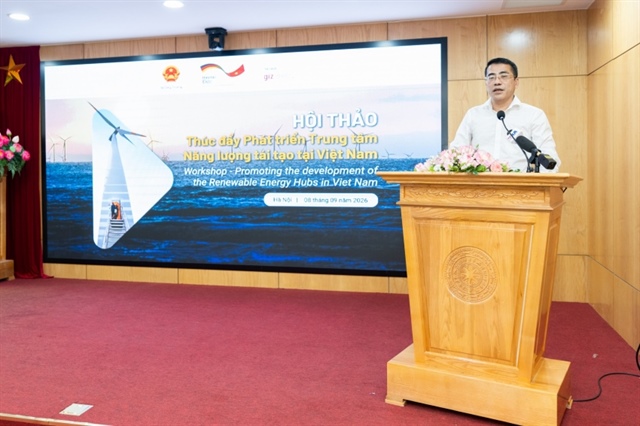
Tang The Hung, deputy director general of EAV. Photo: GIZ |
The Electricity Authority of Vietnam (EAV) and German Development Agency (GIZ) discussed the model with businesses and international experts at a workshop on renewable energy hubs in Hanoi on September 8.
Tang The Hung, deputy director general of EAV, said Vietnam's energy transition requires renewable energy development to go beyond expanding generation capacity.
“As Vietnam accelerates the energy transition towards its net-zero emissions target by 2050, renewable energy development needs to be closely linked with industry, infrastructure, supply chains, science and technology, and human resources,” Hung said.
This broader approach is reflected in the revised Power Development Plan VIII, which envisages two inter-regional renewable energy industry and service hubs by 2030. The hubs are intended to connect renewable power generation with supporting industries and promote greater localisation across the value chain.
The scale of future renewable capacity provides the economic rationale for such hubs. Under the planning scenario, onshore and nearshore wind capacity could reach 84.7–91.4GW by 2050, while offshore wind could expand to 113.5–139.1GW. Solar capacity, including utility-scale and rooftop systems, could reach around 293.1–295.6GW.
For policymakers, the question is increasingly how that expansion can generate industrial value beyond the electricity produced.
EAV envisages an integrated model connecting clean power generation with mechanical fabrication, port logistics, operations and maintenance (O&M), green industrial parks and workforce training. Such integration could allow renewable energy investment to support a broader domestic manufacturing and services base.

Christiana Hageneder, director of GIZ’s Energy Support Programme. Photo: GIZ |
Christiana Hageneder, director of GIZ's Energy Support Programme, said GIZ and its Vietnamese partners are conducting research to provide a stronger evidence base for policymaking, including assessments of existing capabilities, infrastructure gaps, and the legal and financial requirements for developing renewable energy hubs.
“Renewable energy hubs can help Vietnam strengthen its domestic industrial capabilities, create added value from the energy transition, and improve Vietnamese companies' participation in regional and global renewable energy supply chains,” she said.
Turning the concept into physical hubs, however, will require substantial investment, particularly in infrastructure for offshore wind.
Components such as towers, foundations and turbines can weigh up to 2,500 tonnes. Ports serving the industry would therefore require deep navigation channels, high load-bearing capacity, extensive assembly areas and access for specialised vessels.
Estimates presented at the workshop suggest port yards and quays would need to withstand loads of 15–25 tonnes per square metre, while around 30 hectares of assembly space could be required for every GW of offshore wind capacity. Basic port infrastructure investment could reach around $1.16 billion per 100 hectares, making public-private partnerships and long-term support mechanisms potentially important.
Two broad industrial-port clusters have been proposed. A southern cluster spanning Vung Tau, Binh Thuan, and Ninh Thuan could leverage existing oil and gas infrastructure, deepwater ports, and offshore engineering experience for component fabrication and O&M services.
A northern cluster around Haiphong and Quang Ninh, meanwhile, could draw on its steel and mechanical engineering industries and established port infrastructure to develop large supporting-industry complexes.
Vietnam also has a head start from its oil and gas and marine industries. The Vietnam Petroleum Institute pointed to existing capabilities in steel fabrication, offshore structures, ports, logistics, and technical personnel as a foundation from which a domestic offshore wind ecosystem could develop.
Yet attracting manufacturers will require more than industrial capabilities. Experts at the workshop stressed the importance of a stable project pipeline lasting 10–25 years to give equipment manufacturers confidence to invest. They also highlighted direct power purchase agreements, concentrated renewable energy zones, and a phased localisation policy as mechanisms that could support domestic production without imposing unrealistic requirements too early.
International experience suggests there is no single blueprint. Germany's Cuxhaven demonstrates the role of sustained investment in ports, industrial land, and logistics, while Yangjiang and Shantou in China integrate manufacturing, research and development, testing, training, and port operations. Britain's Grimsby and Humber illustrate the long-term economic contribution of offshore wind O&M, while Esbjerg in Denmark demonstrates how existing oil and gas infrastructure and capabilities can be repurposed for offshore wind.
|
Photo: GIZ |
For Vietnam, developing renewable energy hubs will therefore be less about replicating any one overseas model than connecting its own renewable resources with existing industrial strengths. With two hubs targeted by 2030, decisions on infrastructure, investment, localisation and the project pipeline will determine how much of the coming renewable energy value chain can ultimately be built at home.
- 12:05 09/09/2026