Việt Nam seeks suitable model for renewable energy hubs
Việt Nam seeks suitable model for renewable energy hubs
An initial study of the renewable energy hub model completed in July 2025 proposed an integrated ecosystem combining renewable energy generation with manufacturing, infrastructure and supporting services, research and innovation and workforce training.
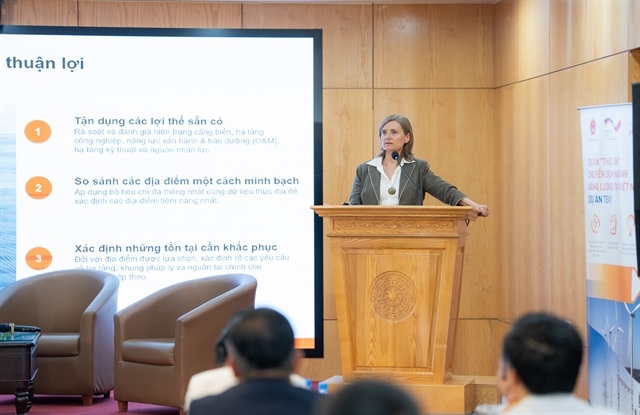
Director of GIZ's Energy Support Programme Christiana Hageneder delivered a speech at the workshop. — Photo courtesy of GIZ |
Việt Nam is studying models for developing renewable energy hubs that go beyond power generation to create integrated ecosystems involving industry, infrastructure, research and innovation, supply chains and workforce development.
The issue was discussed at a workshop on promoting the development of renewable energy hubs in Việt Nam, which was held in Hà Nội on Tuesday by the Electricity Authority of Việt Nam (EAV) under the Ministry of Industry and Trade in cooperation with the Deutsche Gesellschaft für Internationale Zusammenarbeit (GIZ).
The event was organised under the Promoting the Transition of the Energy Sector in Việt Nam project commissioned by the German government.
Speaking at the workshop, EAV Deputy Director General Tăng Thế Hùng said that as Việt Nam accelerates its energy transition towards the goal of achieving net zero emissions by 2050, renewable energy development is increasingly linked with the coordinated development of industry, infrastructure, science and technology, supply chains and personnel.
The revised Power Development Plan VIII identifies the development of inter-regional renewable energy industrial and service centres in areas with significant renewable energy potential as a way to link renewable energy development with industrial development and the localisation of value chains.
“Research into and the gradual development of renewable energy hubs are thus important for harnessing Việt Nam’s renewable energy potential, promoting industrial development and contributing to the country’s energy transition,” Hùng said.
An initial study of the renewable energy hub model completed in July 2025 proposed an integrated ecosystem combining renewable energy generation with manufacturing, infrastructure and supporting services, research and innovation, and workforce training.
Further studies are now being conducted to assess the conditions and potential for developing the model, with an early focus on central and southern Việt Nam.
No one-size-fits-all model
The workshop brought together domestic and international experts, businesses, investors and other stakeholders to discuss practical issues involved in developing renewable energy hubs.
Key topics included criteria for selecting locations and models, port and logistics infrastructure, governance and investment mechanisms, supply chain development and localisation, operations and maintenance, research and innovation and workforce development.
Representatives of the Vietnam Petroleum Institute under Petrovietnam said Việt Nam already possesses a number of capabilities that could provide a foundation for deeper participation in the offshore wind value chain.
These include steel structure fabrication, offshore engineering, ports, logistics and a technically skilled workforce.
However, further development of currently missing capabilities and the identification of areas with strong advantages will be necessary to establish a domestic offshore wind ecosystem, the representative said.
International experiences shared at the workshop demonstrated that there is no single renewable energy hub model that can be applied universally.
In Cuxhaven, Germany, the development of a similar hub has been supported by long-term and coordinated investment in ports, industrial land and dedicated logistics infrastructure.
The examples of Yangjiang and Shantou in China illustrate how large industrial clusters can integrate manufacturing, research and development, testing and certification, operations and maintenance, ports and workforce training.
Meanwhile, experience from Grimsby and Humber in the UK highlights the long-term economic value of operations and maintenance activities, particularly through job creation, skills development and contributions to local economies.
In Esbjerg, Denmark, existing port and industrial capabilities, including those developed through the oil and gas sector, have been transformed to support offshore wind. This example also underscores the importance of a long-term vision and close coordination between public authorities, port operators and businesses.
These international cases can offer lessons rather than ready-made templates for Việt Nam.
Participants at the workshop said the country should selectively adapt successful elements to domestic conditions, particularly by building on existing capabilities in offshore oil and gas, manufacturing, ports and technical services.
Turning energy transition into industrial opportunity
Director of GIZ's Energy Support Programme Christiana Hageneder said GIZ is working with the EAV on a study designed to provide a stronger and more comparable evidence base for future decision-making.
The study is expected to assess existing capabilities and conditions, infrastructure gaps and the legal and financial requirements needed to implement renewable energy hubs.
According to Hageneder, renewable energy hubs could help Việt Nam strengthen its domestic industrial base, generate long-term value from the energy transition and improve the competitiveness and position of Vietnamese companies in regional renewable energy supply chains.
The discussions at the workshop indicated that renewable energy hubs should not be viewed simply as a means of adding clean power generation capacity.
Instead, they could serve as platforms for expanding industrial development by connecting renewable energy resources with ports, manufacturing, logistics, technical services, research and training.
Such an approach could enable the energy transition to deliver wider economic benefits, including stronger domestic manufacturing capacity, more developed supply chains, new employment opportunities and improved worker skills.
The workshop's findings will contribute practical inputs to ongoing studies, helping identify opportunities, challenges and the conditions needed in terms of location, infrastructure, development models, supply chains, personnel and investment mobilisation.
- 10:44 09/09/2026