Vietnamese exporters pivot to ease pressure from US tariffs
Vietnamese exporters pivot to ease pressure from US tariffs
Pressure from the new US tariff policy is prompting Vietnamese exporters to reassess their strategies. Rather than pursuing volume-driven growth, many are shifting towards higher-value orders, tighter cost control, greater productivity and a more balanced allocation of markets to reduce reliance on a single destination.
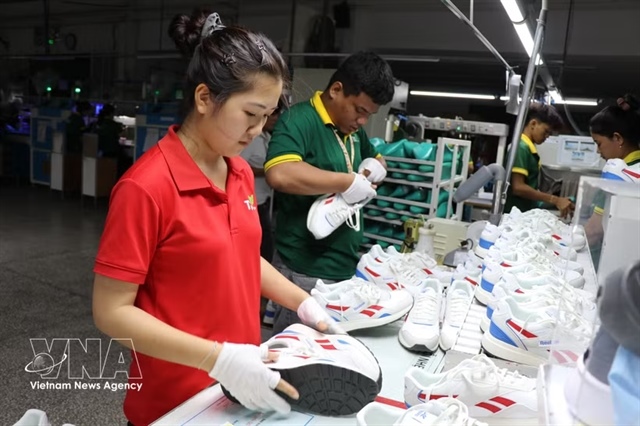
Workers produce leather shoes for export at Lefaso Tra Vinh Investment and Production Joint Stock Company in Trà Cú Commune, Vĩnh Long Province. — VNA/VNS Photo |
The US’s new tariff rates are testing the adaptability of Vietnamese exporters, requiring businesses to look beyond pricing and market adjustments and invest in technology, product quality, branding and compliance to sustain long-term competitiveness.
Improving quality, expanding markets
Pressure from the new US tariff policy is prompting Vietnamese exporters to reassess their strategies. Rather than pursuing volume-driven growth, many are shifting towards higher-value orders, tighter cost control, greater productivity and a more balanced allocation of markets to reduce reliance on a single destination.
Business results in the second quarter of this year at a number of exporters illustrate this shift. TNG Investment and Trading JSC, for example, posted 22 per cent growth in after-tax profit, the highest quarterly level on record. In the first six months, revenue rose 20.5 per cent.
The company attributed growth to expanded production, a greater focus on high-value-added orders and faster export deliveries. It has also accelerated digitalisation and automation to raise productivity, reduce costs and speed up shipments as the new US tariff policy took effect in the third quarter of this year.
Sao Ta Foods JSC (FMC) has adopted a different approach, accepting slower or declining revenue growth to protect margins and restructure its market mix. Shifting orders from the US towards the EU and Japan forms part of its strategy to spread risks amid uncertainty over US tariffs and trade remedies.
Timber and forestry product exports exceeded US$10 billion in the first seven months, up around 5 per cent. However, successive US trade policies and tariffs have made businesses more cautious and highlighted the need for stronger risk management and proactive market strategies.
Ngô Sỹ Hoài, vice chairman and secretary general of the Vietnam Timber and Forest Products Association (VIFORES), said many firms were expanding exports to China, Japan and the EU. Exports to China rose 46 per cent, those to Japan more than 20 per cent, while the EU also recorded positive growth. Expanding these markets is viewed as a means of reducing dependence on the US and limiting exposure to policy changes.
A test of competitiveness
In the short term, the US’s additional 12.5 per cent tariff is putting pressure on selling prices and profit margins. In the longer term, however, it could test Vietnamese businesses’ ability to adapt. Those capable of upgrading technology, improving quality, developing brands, securing raw materials and diversifying markets will have greater scope to remain competitive.
The challenge extends beyond tariffs. To establish a sustainable presence in the US, Vietnamese businesses must address issues ranging from market research and legal requirements to sales channels, cash-flow management and product development.
According to Trần Lịch, director of the Vietnam Impact Startup Incubator and Accelerator (VISIA), around 85 per cent of surveyed businesses are not yet genuinely prepared for the US market. Their major weaknesses lie less in production capacity than in their ability to access and operate in the market.
Specifically, 77.3 per cent identified market research and understanding US consumers as major challenges, while 76 per cent cited difficulties in developing marketing strategies and sales channels. Legal and compliance requirements were cited by 58.7 per cent; 56 per cent faced working-capital and cash-flow issues; and 53.3 per cent identified branding, design and market-appropriate R&D as weaknesses.
“Having a good product is not enough to enter the US market," Lich stressed, saying businesses need a comprehensive roadmap covering market research, legal requirements, go-to-market strategy, R&D, capital, logistics, distribution and sales.
Compliance also requires early preparation. Requirements imposed by US regulators such as the FDA, CPSC and USDA, along with intellectual property protection, should be addressed during product and market preparation rather than after orders are secured.
Early preparation can reduce order-disruption risks, shorten negotiations by three to 12 months and limit cash-flow risks. VISIA and Ready2US have developed the 2026 US Market Readiness Assessment Framework to help businesses assess their preparedness before investing in and expanding into the market.
Experts argue that Vietnamese businesses ultimately need to move beyond the mindset of simply “having goods to sell” and build sustainable competitive capabilities. The US should therefore be viewed not merely as a market for Vietnamese products but also as a test of quality, transparency, management capacity and the ability to meet increasingly demanding international standards.
- 17:16 08/09/2026