Kingdom’s fuel prices drop below regional peers’ despite import reliance
Kingdom’s fuel prices drop below regional peers’ despite import reliance
The new pricing structure places Cambodia among the more competitively priced fuel markets in the region. Based on current estimates, domestic fuel prices are now lower than those of several ASEAN neighbours.
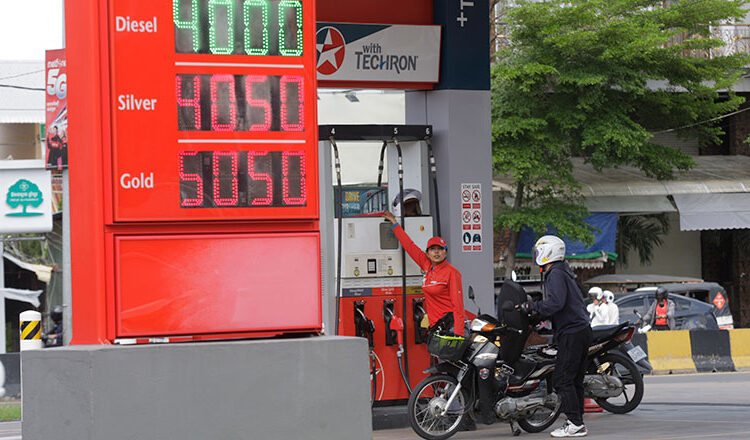
Cambodia’s retail fuel prices have fallen below those in several regional countries despite its reliance on imported petroleum products, reflecting the Royal Government’s timely and effective fiscal policies in mitigating the impact of Middle East conflict-driven volatility.
The development comes after the Ministry of Commerce (MoC) issued a statement yesterday adjusting retail fuel prices nationwide. Under the new pricing structure, petrol is set at 4,050 riels ($1.02) per litre, while diesel is priced at 4,000 riels ($1.00) per litre.
Petrol station operators across the country were instructed to implement the new retail prices by 1:00 pm the same day, ensuring the revised rates were applied uniformly nationwide and providing citizens with immediate relief at the pump stations.
Compared to the previous adjustment announced on June 23, petrol prices have declined by 300 riels, down from 4,350 riels per litre. Diesel prices also fell by 250 riels from earlier levels, reflecting continued downward pressure in international oil markets and domestic policy measures designed to cushion consumers from external price shocks.
The latest adjustment places Cambodia among the more competitively priced fuel markets in the region. Based on current estimates, domestic fuel prices are now lower than several ASEAN neighbours, including Thailand at $1.14 per litre, Myanmar at $1.20, Laos at $1.10, and Singapore at $3.30 per litre, where prices remain significantly higher due to heavy taxation structures, regulatory frameworks and vehicle ownership policies.
Cambodia’s pricing structure remains particularly sensitive to international oil market movements due to its reliance on imported petroleum products. However, the combination of global price easing and domestic fiscal interventions has helped stabilise retail fuel costs in recent months, preventing sharper increases during periods of geopolitical uncertainty.
Until further notice, Cambodia’s fuel pricing trend indicated both external market dynamics and internal policy responses. While current conditions support lower retail prices, analysts caution that continued volatility in global crude oil markets could still influence future adjustments depending on supply security, demand shifts, and shipping stability in major trade routes.
Speaking to Khmer Times, Chea Chandara, President of the Logistics Supply Chain and Brokers Business Association in Cambodia (LOSCBA), said that the continued fuel price decline reflects the Royal Government’s tax waiver policy used to subsidise retail fuel costs over recent months.
Chandara noted that the subsidy measures have resulted in estimated annual fiscal losses between $50 million and $60 million. “However, the policy has helped stabilise domestic fuel prices and shield consumers from sharp fluctuations in international oil markets,” he said.
The LOSCBA President added that since the Middle East conflict erupted, Cambodia has diversified its fuel supply chains by working with multiple partner countries. “This strategy has improved supply security and helped maintain market stability despite ongoing geopolitical uncertainty.”
Chey Tech, a socio-economic and geopolitical analyst, told Khmer Times that fuel prices are easing as the United States and Iran have agreed to return to the negotiation table on Tuesday in Doha, Qatar.
Tech noted that the move has helped calm market fears over potential disruptions in global oil supply routes, particularly through the Strait of Hormuz.
He noted that shipping traffic in the strategic waterway is gradually recovering, which has contributed to a decline in global oil prices after months of volatility. “The improved flow of maritime transport has reduced the risk premium previously embedded in crude oil prices,” he added.
Tech further highlighted that this global trend, combined with the Royal Government’s continued subsidy measures, including tax exemptions on fuel imports over recent months, has helped keep Cambodia’s domestic fuel prices below those of many ASEAN countries.
It may be noted that the Royal Government has continued to implement a series of fiscal measures to cushion consumers from global fuel price volatility. These included a subsidy of 6.5 cents per litre to help improve people’s livelihoods, alongside an additional one-cent reduction when international petroleum prices exceed $90 per barrel, and diesel prices surpass $100 per barrel.
Customs duties on fuel imports also remain at zero. In response to sustained increases in international fuel prices, transportation and insurance costs, Prime Minister Hun Manet further approved reductions in additional taxes, special taxes and value-added tax on petrol and diesel, with the government absorbing part of the tax burden to help stabilise domestic pump prices.
- 08:18 01/07/2026