Financing key challenge for green industrial park transition
Financing key challenge for green industrial park transition
Designing effective financing mechanisms, rather than securing access to technology, has become the biggest challenge in accelerating the green transition of Vietnam's industrial parks.
According to Pham Binh An, deputy director of the Ho Chi Minh City Institute for Development Studies (HIDS), industrial parks (IPs) and clusters will continue to be key drivers of Vietnam's industrial transformation. He made the remarks at a consultation conference on transition models and financing mechanisms for emission reduction projects, jointly organised by the Climateworks Centre and the HIDS on July 10.
"Ho Chi Minh City is currently facing a dual challenge. On the one hand, it must maintain its role as the country's leading economic growth engine. On the other, it must accelerate the green transition and reduce carbon emissions in line with Vietnam's commitment to achieve net-zero emissions by 2050," An said.
An noted that the green transition is no longer a matter of choice but a business imperative, particularly as the European Union's Carbon Border Adjustment Mechanism is set to take full effect for carbon-intensive sectors from January 1 this year. This will pose significant challenges for businesses as global supply chains become increasingly stringent in their carbon requirements. At the same time, however, it also creates new opportunities for companies to access green finance and sustainable investment capital,” An said.
Phat Pumchawsaun, Southeast Asia lead at the Climateworks Centre, said Vietnam's ambitious economic growth targets will drive substantial investment demand in infrastructure, construction, and manufacturing, leading to rising demand for steel, cement, electricity, and industrial infrastructure.
“This presents a critical opportunity to ensure that the next wave of investment builds a more competitive and lower-carbon industrial base from the beginning stages,” Pumchawsaun said.
He noted that government policies on public procurement, technical standards, carbon pricing, green finance, and emissions data will play a pivotal role in translating policy ambitions into tangible investment flows.
Figures from Ho Chi Minh City People’s Committee released that following the administrative boundary expansion, the city now has 66 IPs and plans to increase that number to 105, covering a total area of approximately 50,000 hectares to 2050.
While this expansion provides significant room for industrial development, it also presents a major challenge in advancing the green transformation of IPs and the city's industrial sector as a whole.
According to figures released at the conference by the HIDS, the green transition of IPs has achieved encouraging initial results. A number of enterprises have improved energy efficiency, strengthened emissions' management, and adopted cleaner production technologies.
A notable example is the pilot programme to transform Hiep Phuoc Industrial Park into an eco-industrial park, implemented with support from United Nations Industrial Development Organisation. The initiative has helped participating businesses reduce nearly 23,000 tonnes of CO₂ emissions annually while saving approximately VND66 billion ($2.5 billion) in production costs each year.
However, the institute noted that the adoption of renewable energy, water reuse, solid waste recycling, and international environmental management standards remains limited. Industrial symbiosis and circular economy models are still at an early stage of development and have yet to become mainstream practices across Vietnam's IPs.
In addition, Vietnam's industrial park system still has a substantial pipeline of undeveloped land designated for industrial use, providing a strategic opportunity to develop eco-industrial parks, smart IPs, and low-carbon industrial zones from the outset.
Under Ho Chi Minh City's Green Transition Plan for 2026–2035, with a vision to 2050, the city aims to have around 20 per cent of its IPs operating under the eco-industrial park model by 2030, increasing to 30 per cent by 2035.
The plan also targets the installation of rooftop solar power systems across all IPs and industrial clusters, with at least 20 per cent of electricity demand supplied by renewable energy. Additional targets include wider adoption of clean technologies, increased waste recycling and water reuse, and broader implementation of internationally recognised environmental management standards.
At the conference, the Climateworks Centre used two illustrative case studies based on publicly available information including the Saigon Hi-Tech Park (SHTP) and the VSIP Binh Duong cluster (VSIP I, II and III), to examine how different governance and investment models could support financing for emissions reduction projects at the industrial park and cluster levels.
Climateworks' analysis found that the financing gap for decarbonisation projects in Vietnam remains largely structural.
Although funding sources and low-carbon technologies are becoming increasingly available, many projects continue to face difficulties in accessing credit due to their relatively small scale, fragmented investment demand, long payback periods, high transaction costs, and the absence of effective risk-sharing mechanisms.
Against this backdrop, IPs and industrial clusters are viewed as the most appropriate level for aggregating investment demand, sharing infrastructure, and improving the bankability of emissions reduction projects, thereby strengthening their ability to attract long-term financing.
Vietnam Industrial Property Forum (VIPF) 2026
The sixth Vietnam Industrial Property Forum, jointly organised by Vietnam Investment Review and the Vietnam Industrial Real Estate Association under the patronage of the Ministry of Finance, will take place on August 26, at The Reverie Saigon in Ho Chi Minh City.
The forum will examine the latest shifts in global investment flows and supply chains, identify Vietnam's opportunities to attract next-generation investment, and discuss emerging trends in the development of green, smart IPs integrated with logistics, data centres, and high-tech manufacturing. The programme will also address new requirements related to environmental, social, and governance, green transition, infrastructure development, competitiveness, and institutional reforms needed to capture the next wave of strategic investment.
As part of the forum, the organising committee will present the VIPF Green Future Awards to recognise pioneering enterprises, IPs, and localities that have demonstrated noteworthy achievements in advancing eco-industrial, green, smart, and sustainable industrial real estate.
For more information about the forum and the awards programme, please visit https://vipf.vir.com.vn
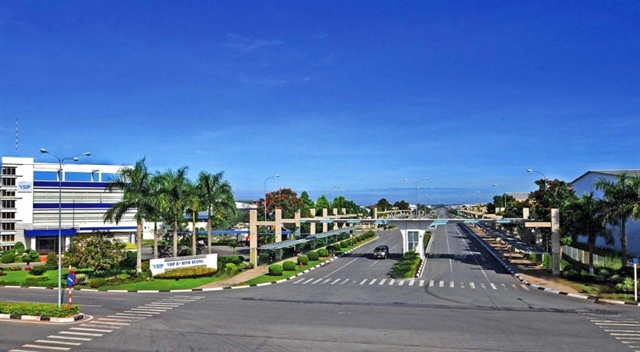
Photo: Le Toan |
- 09:32 13/07/2026