Digital-first financial centres can leapfrog legacy systems
Digital-first financial centres can leapfrog legacy systems
Vietnam has a rare opportunity to leapfrog legacy systems by building digital-first international financial centres designed for the future of finance, experts said at a forum in Danang.
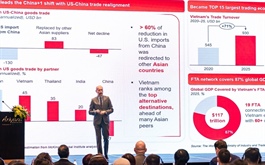
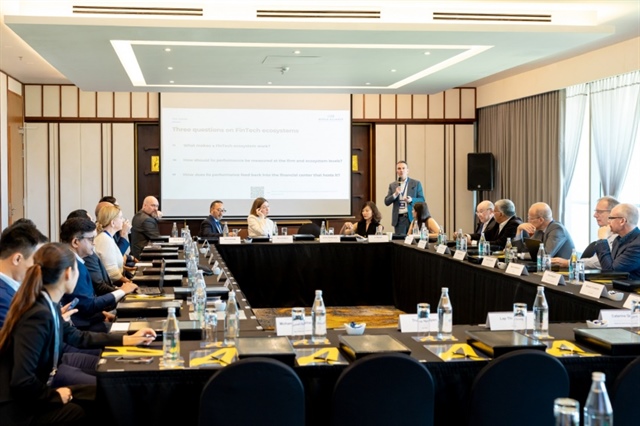
The vision for Vietnam's International Financial Centres (VIFCs) took centre stage at the Vietnam Financial Forum 2026, held in Danang on July 9-10, where policymakers, global financial experts, and industry leaders explored how the country can build competitive financial hubs in an increasingly digital world.
Rather than competing directly with established centres such as Singapore, Hong Kong, or London, speakers agreed that Vietnam has a rare opportunity to leapfrog traditional development models by designing financial infrastructure for the next generation of capital markets.
Richard McClellan, CEO of VIFC Ho Chi Minh City, said Vietnam's greatest advantage lies in building an entirely new financial centre at a time when AI is reshaping global finance.
"Embarking on a brand-new international financial centre is a radical and ambitious effort. We have the unique advantage of building at a time when AI's impact on fintech is fully acknowledged, allowing us to leapfrog older institutions and design digital market infrastructure purpose-built for the next decade," he said.
McClellan added that Vietnam should resist pursuing too many initiatives at once.
"Our immediate priority is to resist the temptation of focusing on too many small projects and instead concentrate limited resources on unblocking global capital flows through targeted infrastructure funds and corporate bonds. This will ensure our foundation is strong enough to support the fintech ecosystem that will eventually follow," he said.
Richard McClellan, CEO of VIFC Ho Chi Minh City. Photo: VFF 2026 |
Building on that vision, Danang is positioning itself to complement rather than compete with Ho Chi Minh City's financial ambitions.
Kevin Iwanaga, director of strategy and engagement at VIFC Danang, said the city aims to establish itself as Vietnam's technology-driven financial innovation hub.
"While Ho Chi Minh City stands firmly as the traditional Wall Street of Vietnam where major banks and deep capital reside, Danang is intentionally positioning itself as the country's Silicon Valley, fostering a tech-native culture of digital nomads and blockchain developers who prioritise a casual, innovation-first lifestyle over the rigid suit-and-tie formality of eastern financial capitals," Iwanaga said.
He said Danang's strategy will focus on tokenising real-world assets and infrastructure projects to unlock new funding channels.
"We are embracing a strategy focused on improved technology twists, specifically targeting the tokenisation of real-world assets and infrastructure projects to finance everything from local energy grids to nature-based carbon credit solutions. By building an internationally compatible framework that feels familiar to those used to English common law, we aim to help local authorities package investment opportunities into transparent, bankable products that global investors can easily evaluate through modern digital data rooms," Iwanaga said.
|
While different cities may pursue different specialisations, experts stressed that enabling regulations will ultimately determine whether innovation can flourish.
Jochen Biedermann, managing director of the World Alliance of International Financial Centres (WAIFC), argued that fintech should no longer be viewed as a separate industry but as the foundation of modern financial services.
"Fintech is no longer a peripheral add-on but has fundamentally become the very substance of modern financial services. Digital identity, instant payments and the availability of AI talent are among the essential building blocks of a successful financial ecosystem, but equally important is a regulatory environment that allows entrepreneurs to innovate without prohibitive barriers while enabling new technologies to be tested safely," said Biedermann.
He added that well-designed regulatory sandboxes will play an essential role in helping emerging financial centres commercialise innovation without compromising cyber resilience.
The discussion also highlighted the importance of clearly defining the complementary roles of Vietnam's two future international financial centres.
Ly Nguyen, co-hosted by Tony Blair Institute and IFC Advisory in collaboration with VIFC Ho Chi Minh City, VIFC Danang and WAIFC, said Vietnam's strategy should leverage the comparative strengths of both cities rather than duplicate functions.
"In our strategic journey to build a world-class financial ecosystem in Vietnam, we are consciously differentiating the roles of our major cities by positioning Ho Chi Minh City as the powerhouse for mobilising massive quality capital through infrastructure funds and corporate bonds, while simultaneously establishing Danang as a specialised hub for fintech innovation and the frontier of digital asset development," Nguyen said.

Ly Nguyen, co-hosted by Tony Blair Institute and IFC Advisory in collaboration with VIFC Ho Chi Minh City, VIFC Danang and WAIFC. Photo: VFF 2026 |
She noted that bridging traditional finance with emerging digital technologies will require both legal innovation and integrated digital infrastructure.
"By rolling out the Fintech Regulatory Sandbox in the coming months, we aim to provide the necessary legal foundation for pilot cases in real-world asset tokenisation and on-chain financing, thereby transforming Vietnam's manufacturing prowess into a transparent and highly attractive destination for international capital flows," she added.
The importance of developing niche strengths rather than competing head-on with established financial centres was also underscored by international experience.
Yuna Kim, head of international relations at Busan Finance Centre, shared how Busan successfully differentiated itself from Seoul by building a financial ecosystem centred on maritime industries.
"Busan has strategically developed a maritime financial capital by leveraging our local heavy industries and shipyard expertise to create a specialised, niche market that complements Seoul rather than competing directly with it. As Korea's only designated blockchain regulation-free zone, we have been able to experiment with blockchain technology and security token offerings to facilitate investment in large-scale shipping assets and support the green transition," Kim said.
She added that integrating AI, blockchain and fintech into traditional industries has enabled Busan to revitalise its maritime economy while strengthening its position as a specialised international financial centre.
"By layering AI and fintech innovations onto our traditional industrial foundation, we enable shipping companies to better respond to international environmental standards through advanced data applications. Our experience demonstrates that digital technology, when integrated with the real economy, can revive traditional industries while creating a more resilient and future-ready financial ecosystem," she added.
Across the two-day forum, a common message emerged that Vietnam's opportunity lies not in replicating existing global financial centres, but in creating a new generation of digital-first financial ecosystems built around innovation, regulatory flexibility and international connectivity. If successfully executed, the country's twin financial centres in Ho Chi Minh City and Danang could become complementary gateways linking global capital with Vietnam's next phase of economic growth.
- 09:00 11/07/2026