Cambodia sharpens MSME strategy to achieve 2050 high-income goal
Cambodia sharpens MSME strategy to achieve 2050 high-income goal
Ongoing initiatives will help MSMEs access laboratory services more quickly and reliably while strengthening competitiveness through improved standards and quality.

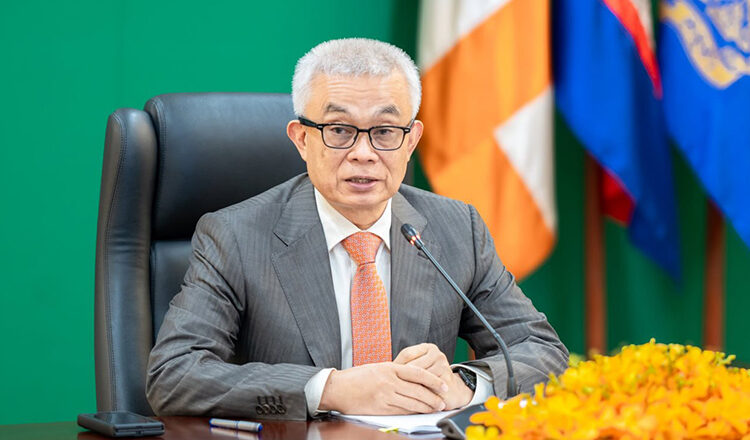
The Ministry of Economy and Finance (MEF) held discussions on the ‘Draft National Strategy on the Development of Micro, Small and Medium Enterprises (MSMEs) 2026–2030,’ aimed at supporting Cambodia’s long-term vision of becoming a high-income country by 2050 and ensuring readiness for graduation from Least Developed Country (LDC) status in 2029.
The meeting took place on Monday under the chairmanship of Deputy Prime Minister and Minister of Economy and Finance Aun Pornmoniroth, who also heads the Economic and Financial Policy Committee, at the ministry.
Participants included Minister of Rural Development Chhay Rithisen, Minister of Industry, Science, Technology and Innovation Hem Vanndy, Minister of Women’s Affairs Ing Kantha Phavi, Minister of Commerce Cham Nimul and Cambodia Chamber of Commerce Vice-President Tan Monivann, along with relevant officials, development partners and members of the Economic and Financial Policy Committee.
Building on efforts under the previous government to promote MSMEs development, the Royal Government under Prime Minister Hun Manet has continued prioritising solutions to challenges facing MSMEs. This effort aligns with the Pentagonal Strategy – Phase 1, which emphasises MSMEs promotion and informal economy development to strengthen participation in economic growth and support Cambodia’s goal of achieving high-income status by 2050 while preparing for LDC graduation in 2029, according to a statement by the Cambodia Chamber of Commerce.
It added that the strategy envisions strengthening and expanding Cambodia’s MSMEs sector into a solid foundation and key driver of national economic growth, supporting a successful transition from LDC status by the end of 2029.
The strategy seeks to improve the capability and resilience of MSMEs so they become a stronger pillar of the national economy, contributing to prosperity and social progress.
“To achieve these objectives, the strategy sets out three key priorities including (1) build a strong and sustainable foundation for MSME development, (2) enhance production capacity to meet domestic demand and strengthen export capability, and (3) deepen MSME integration into domestic, regional and global value chains,” read the statement.
The strategy applies to formally registered MSMEs across all sectors, including agriculture, industry, services and trade.
Meanwhile, informal economic activities and businesses that have not yet been legally registered will continue to receive support under the National Policy and Strategy for Informal Economy Development 2023–2028.
Speaking at an earlier consultation workshop, Vanndy said MSMEs are important sources of employment and innovation and can help Cambodian products expand into regional and international markets. However, they require stronger national support mechanisms to improve productivity and competitiveness.
He noted that ongoing initiatives would help MSMEs access laboratory services more quickly and reliably while strengthening competitiveness through improved standards and quality.
Keo Mom, President of the Chamber of Professional and Micro Enterprises of Cambodia (CPMEC), told Khmer Times yesterday that the government has increasingly focused on supporting SMEs, especially through the development of the national strategy, which she said could address many of the sector’s key challenges.
She highlighted access to finance as a critical factor for SMEs seeking to strengthen and expand production chains, noting that the government has provided low-interest loans and financing options without collateral requirements.
“On technology, CPMEC has organised training programmes to help members adopt digital tools for business management and sales, supported by the Skills Development Fund (SDF). CPMEC is also developing the Khmer SME Hub marketplace to gather and distribute Cambodian-made products more widely in domestic and international markets,” she added.
“Regarding Cambodia’s planned graduation from LDC status in 2029, Mom added that capacity-building programmes for MSMEs—including financial management, business management and safe production practices—are helping local producers prepare for expansion and remain competitive, particularly during periods of regional uncertainty, including tensions between Cambodia and Thailand.
Chey Tech, socio-economic researcher, told Khmer Times yesterday that the private sector remains the key engine driving Cambodia’s economic growth, with around 98 percent of businesses classified as small and medium-sized enterprises (SMEs).
He noted that SMEs contribute approximately 58 percent of Cambodia’s total GDP and provide employment for around 70 percent of the country’s workforce. “SMEs play a critical role in generating jobs, expanding production and sustaining Cambodia’s economic growth,” Tech said.
“The government’s policy is to continue supporting SMEs in Cambodia through capacity building, stronger policy support, incentive mechanisms, and ensuring lower production costs to improve competitiveness and promote Cambodia’s exports,” he added.
According to the 2022 Economic Census by the Ministry of Planning (MoP), Cambodia had 753,670 economic establishments nationwide, providing around three million jobs.
In addition, the workforce supported by micro, small and medium enterprises (MSMEs)—including enterprises, self-employed business operators and workers in the informal economy—accounts for more than six million people nationwide.
- 08:09 24/06/2026