Private banks accelerate in equity
Private banks accelerate in equity
Accumulating equity capital through retaining profits to distribute stock dividends is becoming the dominant trend.
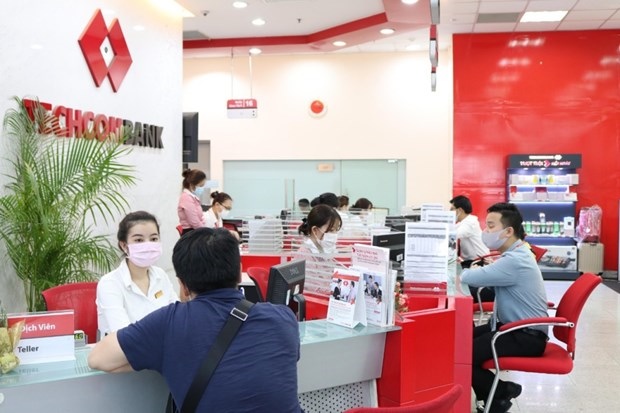
Transactions at Techcombank. The bank's equity reached US$7 billion in the first quarter of 2026. — VNA/VNS Photo |
There has been a significant change in equity growth of banks, with private banks accelerating strongly and narrowing the gap with State-owned giants.
In the first quarter of 2026, the financial statements of banks showed that a strong rise was seen in the equity of leading private banks. Private Techcombank and VPBank are currently becoming real contenders, capable of challenging the position of State-owned banks, including VietinBank, Vietcombank and BIDV. Vietcombank reported an equity of VNĐ234.03 trillion by the end of the first quarter and BIDV followed with VNĐ190.62 trillion.
With equity capital reaching approximately VNĐ186.7 trillion (US$7 billion) and VNĐ186.6 trillion respectively by the end of the first quarter, the equity of Techcombank and VPBank was just VNĐ2 trillion lower than that of VietinBank (VNĐ188.69 trillion).
MB also continued to maintain stable performance with VNĐ149.75 trillion in equity, a 5 per cent increase. Notably, MB plans to increase its charter capital to a record high of over VNĐ100 trillion in 2026, demonstrating ambitions for market dominance in the retail sector.
It is the result of the private banks’ sustained strategy of accumulating internal strength, with the private banks prioritising retaining profits to increase capital instead of paying cash dividends.
Accumulating equity capital through retaining profits is becoming the dominant trend. This helps banks both satisfy shareholders and retain the available capital for reinvestment in strategic areas.
According to experts, equity capital is considered one of the important indicators reflecting a bank's financial capacity. A large capital base gives banks more room to expand credit, invest in technology, enhance risk resilience, and meet increasingly stringent capital adequacy standards.
The larger the equity capital, the higher the capital adequacy ratio (CAR), giving banks more confidence in the face of bad debt shocks and interest rate fluctuations. In the context of increasingly stringent Basel III international banking requirements, increasing equity capital is no longer an option but a mandatory requirement for survival.
VIS Rating experts say the prioritisation of equity consolidation by large private banks not only improves their capital adequacy ratio (CAR) but also creates significant room for credit expansion as the real estate market and public investment are recovering strongly.
Experts from the Vietcombank Securities Company (VCBS) said that 2026 is a pivotal period. Banks with substantial equity capital will have an absolute advantage in reducing capital costs and boosting non-interest business segments such as insurance, digital banking, and fund management.
Sharing the same view, financial experts from WiGroup noted that strong equity capital is a measure of investor and customer confidence. A bank with a solid capital base will easily raise resources from the international market at a lower cost, while also having sufficient resources to invest in technology infrastructure – the decisive factor in the digital banking era.
However, experts believe that this race is predicted to become even more fierce in the coming quarters, especially as banks begin to implement the massive capital increase plans approved at their annual general meetings. In this ‘game’ worth trillions of Vietnamese đồng, whoever has a more solid capital base will have the opportunity to dominate the top in the new economic development cycle.
- 09:55 15/05/2026