Govt beefs up framework for key economic sectors
Govt beefs up framework for key economic sectors
Monitoring and evaluation reports on Pentagonal Strategy goals should not only present implementation progress by ministries but also reflect existing challenges, shortcomings, and areas requiring improvement, Vissoth says.
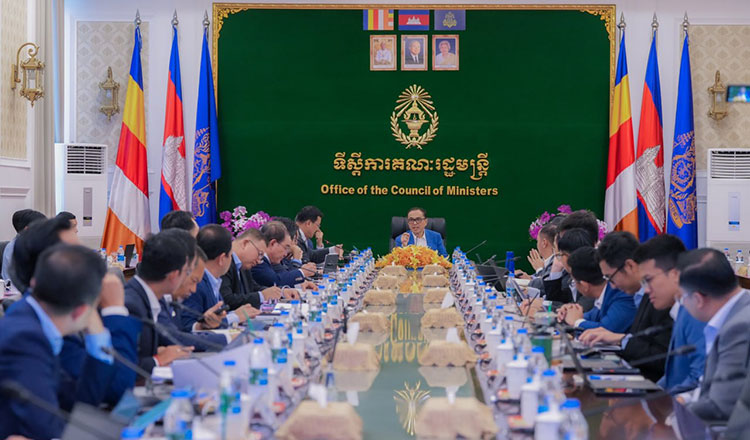
An inter-ministerial meeting to review preparations for the 2025 monitoring and evaluation report on Phase One of the Royal Government’s Pentagonal Strategy, was held on Friday, with discussions focused on strengthening performance, monitoring, improving accountability, and setting clearer targets for key economic sectors.
The meeting was presided over by Permanent Deputy Prime Minister Vongsey Vissoth, with attendance of Chhieng Yanara, Senior Minister in charge of Special Missions and Second Vice-Chairman of the Council for the Development of Cambodia, Minister of Agriculture, Forestry and Fisheries Dith Tina, Planning Minister Bin Trachhey, along with representatives from various relevant ministries.
Discussions mainly centred on setting baselines, targets, and institutional responsibilities for implementing key performance indicators related to agriculture, small and medium-sized enterprises, the business environment, and competitiveness.
Vissoth, who is also Minister in charge of OCM, stressed that monitoring and evaluation reports on the Pentagonal Strategy should not only present implementation progress by ministries and institutions but also reflect existing challenges, shortcomings, and areas requiring improvement.
He said the reports should serve as a foundation for adjusting policy directions and enhancing implementation effectiveness.
Drawing on more than two years of implementation experience, he noted that monitoring and evaluation still face several challenges, including working procedures, technical gaps, data issues, institutional capacity, human resources, and coordination among relevant ministries and institutions.
“Therefore, monitoring and evaluation should not merely be seen as a tool for measuring achievements, but should become a mechanism for guiding, reminding, and driving implementation in order to achieve the Royal Government’s policy objectives,” he said.
Vissoth also emphasised that progress in achieving several key performance indicators has been slow due to a number of challenges, including the technical capacity of lead and participating ministries and institutions, limited inter-ministerial coordination, the lack of comprehensive and timely data and information systems, as well as difficulties related to data collection, verification, and sharing among relevant institutions.
“These challenges require continued strengthening of institutional capacity, improvement of coordination mechanisms, and development of more effective data and information systems to support more efficient and accurate policy implementation,” he said.
Regarding key performance indicators related to agriculture, small and medium-sized enterprises (SMEs), as well as the business environment and competitiveness, the meeting reviewed and discussed the establishment of baselines, targets, definitions, data recording, collection, verification, and the validity of data usage, which still face several challenges and require further technical review.
- 14:46 11/05/2026