Businesses shift from expansion to efficiency
Businesses shift from expansion to efficiency
From small- and medium-sized to global franchises, companies are scaling back and restructuring operations amid intensifying competition and rising operating costs.

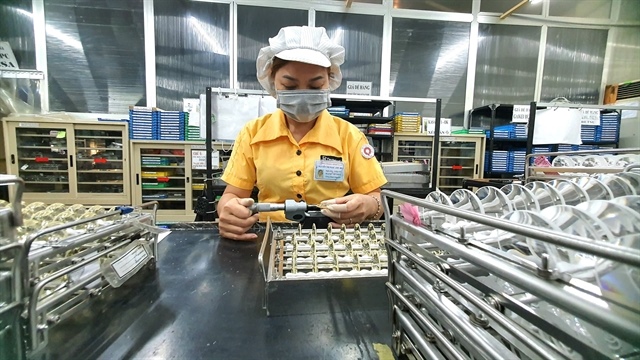
Businesses scale back amid tougher competition. Photo: Le Toan |
In April, Burger King officially shut down all of its Hanoi outlets after more than a decade in the market, while Chinese beverage chain Mixue Group began reducing store numbers in Vietnam following years of aggressive expansion across Southeast Asia.
The moves reflect a broader shift in Vietnam’s retail and food-and-beverage landscape, where both domestic businesses and international franchise chains are scaling back expansion plans amid slowing consumer demand, rising operating costs, and intensifying competition.
According to Dr. Le Duy Binh, director of Economica Vietnam, the franchise model operates under a natural market selection mechanism, where businesses with sufficient operational capacity continue to grow while weaker operators gradually exit the market.
“Those with enough capability stay in the game, while those that cannot adapt will withdraw,” Binh said. He added that store closures do not necessarily mean a brand is leaving Vietnam, but rather reflect a natural filtering process aimed at improving the quality and efficiency of the remaining outlets.
Burger King, which entered Vietnam in 2012 through a franchise partnership operated by Imex Pan Pacific Group, has repeatedly downsized its network over recent years. The closure of outlets in Giang Vo, Trung Hoa, and Xuan Dieu leaves the brand present mainly in Ho Chi Minh City and airport locations.
Meanwhile, Mixue is also entering a new phase of restructuring after several years of rapid growth.
According to its 2025 annual report, Mixue’s international store network fell by around 428 outlets last year, despite the company continuing to expand into new markets such as the United States and Kazakhstan. The decline was concentrated mainly in mature Southeast Asian markets, including Vietnam and Indonesia, where the company started closing underperforming outlets as part of a broader restructuring strategy.
The shift marks a notable change for one of the region’s fastest-growing franchise chains. Rather than prioritising outlet numbers, Mixue is increasingly focusing on operational efficiency and store productivity.
The company has accelerated the transition from smaller kiosks to larger-format stores featuring upgraded layouts and improved customer experience. According to the report, new stores launched in Vietnam and Indonesia during the second half of 2025 generated average revenues around 1.7 times higher than previous formats, while revenues at existing stores rose nearly 18 per cent on-year.
The adjustments underline how Vietnam’s consumer market is becoming increasingly competitive after several years of rapid post-pandemic expansion.
According to the National Statistics Office under the Ministry of Finance, around 108,900 enterprises exited the market during the first four months of 2026, averaging more than 27,000 business withdrawals per month.
Among them, 72,200 enterprises temporarily suspended operations, reflecting what economists described as a “defensive contraction” strategy aimed at preserving capital and minimising losses while waiting for stronger recovery signals.
At the same time, the growing number of enterprises moving from temporary suspension to full dissolution suggests that the resilience of many businesses has weakened considerably after several years of economic uncertainty.
According to the Vietnam Chamber of Commerce and Industry, small- and medium-sized enterprises (SMEs) account for more than 97 per cent of all enterprises nationwide, though most remain micro-sized firms with limited financial capacity and relatively weak resistance to market volatility.
VCCI surveys show that many businesses continue relying heavily on short-term cash flows while lacking sufficient financial reserves and long-term risk management strategies. As revenues decline or operating costs increase, liquidity pressures emerge quickly.
Meanwhile, the accelerating pace of digital transformation is creating additional burdens for smaller businesses. Many enterprises have invested heavily in technology upgrades without achieving corresponding improvements in productivity or competitiveness.
Despite the growing number of business closures and restructuring activities, analysts noted that the broader economic picture remains more balanced than headline figures may initially suggest.
During the first four months of the year, more than 119,400 enterprises were newly established or resumed operations, exceeding the number of market exits. Many newly established firms are concentrated in high-growth sectors such as e-commerce, digital services, green economy projects, and technology-enabled platforms.
Assoc. Prof. Ngo Tri Long described the recent rise in business withdrawals as part of a necessary market filtering process.
According to Long, many enterprises established during periods of loose credit and abundant liquidity lacked strong governance foundations or genuine competitive advantages. As market conditions tighten and capital becomes more expensive, weaker businesses are inevitably forced out.
“This is a harsh but necessary selection process of the market economy,” Long said. “The economy needs a stronger layer of enterprises with greater resilience and operational capacity.”
- 10:14 15/05/2026