Vietnamese investors building more structured portfolios
Vietnamese investors building more structured portfolios
Vietnamese investors are building more structured portfolios, placing greater emphasis on resilience, holding higher expectations for trust, and increasingly taking a multi-generational investment perspective.
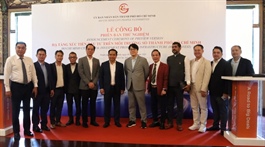
The Vietnam Financial Health & Investment Confidence Report 2026, issued by Thien Viet Securities (TVS) on July 10 in Ho Chi Minh City, noted that amid ongoing market volatility and rising living costs continuing to affect financial decisions worldwide, financial resilience is becoming an important measure alongside asset size.
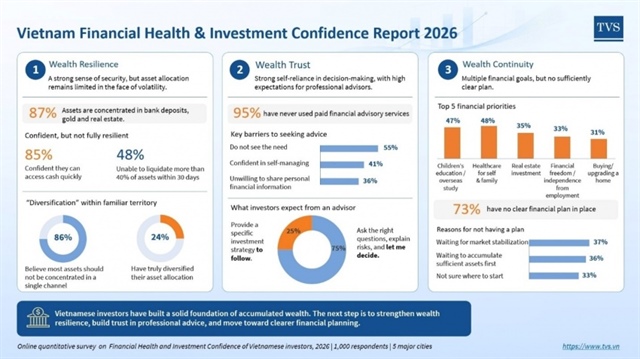
In Vietnam, the TVS survey indicates that investors are actively participating in multiple investment channels, with 55 per cent holding 2 to 3 investment channels and 39 per cent holding 4 to 5 channels. However, in terms of actual allocation, bank deposits, gold, and real estate still account for 87 per cent of the total asset portfolio of surveyed individual investors.
This concentration becomes more pronounced among investors with larger asset bases. As accumulated wealth increases, the proportion of real estate in the portfolio rises from 29 per cent among those with VND500 million ($19,250) to under VND1 billion ($38,500), to 46 per cent among those with VND2 billion ($77,000) or more.
By contrast, the combined allocation to modern financial channels such as equities, bonds, fund certificates, and foreign currency remains low, not exceeding 10 per cent across any asset group.
The survey also highlights a gap between awareness and action in portfolio diversification. While 86 per cent of respondents agree that most assets should not be concentrated in a single channel, 76 per cent still prioritise real estate or gold because they feel they understand these channels better. This suggests that the need for diversification is recognised, but actual allocation behaviour remains strongly shaped by familiar assets.
The survey also points to an underlying need for guidance in wealth management, yet the use of paid financial advisory services remains very limited, with 95 per cent of respondents saying they have never used such services.
The main barrier is not cost, but the perceived practical value of professional advisory services: 55 per cent say they have not seen the need, 41 per cent are confident in managing their assets independently, and 36 per cent are unwilling to share personal financial information.
Nevertheless, investors’ trust in financial institutions has not disappeared. Rather, it is shifting towards higher expectations for transparency and advisory quality. Among those who have used or are using paid financial advisory services, 75 per cent expect advisors to ask the right questions, clarify goals, explain risks, and support investors in making their own decisions. Only 25 per cent prefer to be given a specific investment strategy to follow.
Tran Vinh Quang, CEO of Thien Viet Asset Management, said that as investors become increasingly proactive in managing their wealth, the role of financial institutions is no longer limited to providing products or investment recommendations.
“It is about building a transparent, data-driven advisory process tailored to each client’s goals. Trust is built when investors can clearly see the practical value of professional advice: helping them understand risks, validate decisions, and maintain long-term financial discipline,” Quang said.
The report also highlights a gap between the desire to accumulate assets and the proactive development of long-term financial plans. Only 27 per cent of surveyed investors say they have a clear long-term financial plan for themselves and their families. The remaining 73 per cent have either not started, have not defined their goals, or do not yet have a specific roadmap.
Investors’ financial priorities also reflect the central role of family in asset-related decisions. When asked to select their most important long-term financial goals, healthcare for self and family and children’s education or overseas study ranked as the top two priorities, at 48 per cent and 47 per cent respectively. These were followed by real estate investment (35 per cent), financial freedom or independence from employment (33 per cent), and buying or upgrading a home (31 per cent).
As multiple long-term goals coexist, having a clear plan becomes essential for investors to allocate resources more effectively across different stages of wealth accumulation.
Notably, wealth transfer is still not viewed as a financial goal requiring proactive planning. Although real estate and ancestral/family assets play an important role in the wealth-accumulation mindset of many Vietnamese families, only 8 per cent of respondents included wealth transfer among their top financial goals.
This reveals a gap between the desire to pass assets on to the next generation and the preparation of a concrete plan to preserve, allocate, and transfer wealth effectively.
Le Pham Minh Duc, senior director of Investment Banking at TVS, noted that globally, wealth management is moving beyond the pursuit of returns alone towards risk management, asset preservation, and preparation for long-term goals.
“Vietnamese investors are following the same direction, while retaining distinct characteristics as portfolios remain concentrated in traditional channels. From our perspective, this report provides practical data to help investors assess their wealth not only by accumulated size, but also by resilience, risk allocation, and preparedness for their families’ long-term goals,” Duc said.
|
- 17:32 10/07/2026