Politburo issues conclusion on ensuring fuel supply and price stability
Politburo issues conclusion on ensuring fuel supply and price stability
The document follows a review of fuel price developments linked to conflicts in the Middle East and other regions.
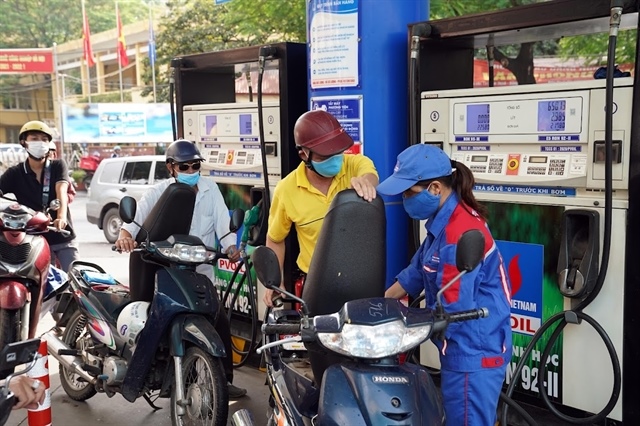
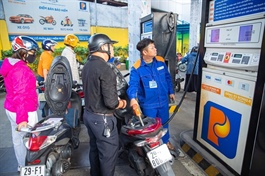
People fill up their motorbikes at a fuel station in Hà Nội. — VNA/VNS Photo |
The Politburo of the Communist Party of Việt Nam has issued a conclusion outlining measures to ensure a steady fuel supply and stabilise prices amid global volatility.
Conclusion 14-KL/TW dated March 20 follows a review of fuel price developments linked to conflicts in the Middle East and other regions.
First, the Politburo assigned the Standing Board of the Government Party Committee to urgently direct relevant agencies to closely monitor and forecast the global fuel supply, demand and price movements to proactively develop effective response scenarios.
It also called for the prompt use of policy tools, including fiscal measures such as taxes, fees, expenditures and advance budget spending, monetary measures such as interest rate support, credit access and foreign currency needs, and price management and trade policies.
These measures should be combined with strengthened inspection and supervision, tighter enforcement of smuggling violations, stricter management of key traders and distributors, and firm handling of hoarding, profiteering and trade fraud.
The Politburo also encouraged energy-saving consumption to help ensure a stable supply and minimise the price volatility of fuels and raw materials in the domestic market, thus avoiding negative impacts on business operations, people’s livelihoods, macroeconomic stability and social order.
Relevant authorities are required to promptly report issues requiring higher-level direction and to accelerate the development of a long-term national strategy on the supply and reserves of raw materials and fuels.
Second, the Politburo assigned the Party Committees of the Ministries of Foreign Affairs, Industry and Trade, and Finance to direct relevant agencies to engage with international partners and create favourable conditions for domestic enterprises to procure raw materials and fuels, ensuring an adequate supply for production and business activities.
Third, the Politburo tasked the Central Commission for Information, Education and Mass Mobilisation with directing media agencies to provide appropriate information to help stabilise market sentiment.
The Politburo requested Party committees at central and local levels to lead and direct agencies, organisations, sectors and units under their authority to fully implement the Party’s guidelines on socio-economic development and national defence and security, promote unity to overcome challenges and remain steadfast in achieving double-digit economic growth this year and the following years, contributing to the successful implementation of Party resolutions at all levels.
Businesses step up fuel-saving efforts
As fuel prices fluctuate and logistics costs rise, many businesses are reassessing their energy strategies from the smallest operational steps.
The Đại biểu Nhân dân (People's Deputies) newspaper quoted Nguyễn Tiến Huy, secretary general of the Vietnam Business Council for Sustainable Development, as saying that energy is no longer just a standard input.
“It is becoming a decisive factor in competitiveness, self-reliance and a company’s position in the value chain,” he said.
This explains why more businesses are moving beyond short-term savings measures to optimise entire operational systems.
In manufacturing, many firms have invested in replacing energy-intensive equipment with more efficient technologies. Some have adopted energy management systems and automation to minimise waste at every stage.
In logistics, route optimisation, reduced empty loads and shipment consolidation are becoming common practices.
These changes not only help cut costs, but also enable businesses to meet increasingly stringent environmental standards in international markets.
Economist Đinh Trọng Thịnh noted that businesses had previously focused on saving energy to cope with short-term fluctuations, but it is now becoming part of their long-term development strategies.
Optimising energy use, combined with technological innovation, digital transformation and green production, reduces costs and enhances resilience to external shocks, he said.
- 05:17 24/03/2026