Đồng Tháp farmers expand goat herds as prices rise
Đồng Tháp farmers expand goat herds as prices rise
Farmers in coastal areas of Đồng Tháp Province are ramping up goat farming as live goat prices remain high, offering attractive profits and stable market demand.
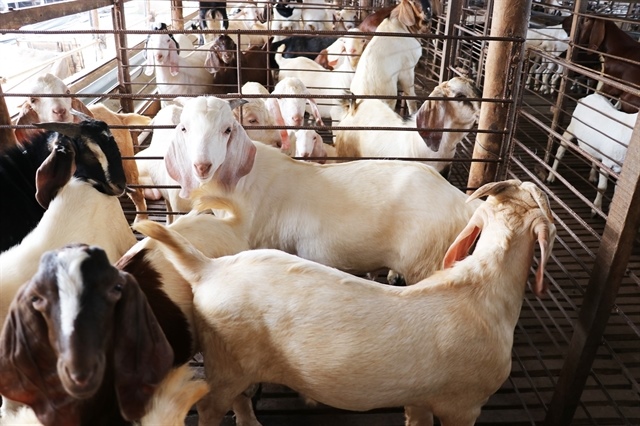
Biosecure, environmentally friendly goat fattening model in Tân Điền Commune, Đồng Tháp Province. — VNA/VNS Photo |
Farmers in coastal areas of Đồng Tháp Province are ramping up goat farming as live goat prices remain high, offering attractive profits and stable market demand.
Currently, traders are purchasing female goats at around VNĐ185,000-190,000 (US$7.3-7.5) per kilogramme, while meat goats fetch VNĐ165,000-170,000 (US$6.5-6.7) per kilogramme, which is VNĐ20,000 higher than last month.
Breeding bucks command even higher prices, ranging from VNĐ200,000 to VNĐ230,000 ($7.9-9.1) per kilogramme.
With a farming cycle of just 2.5 to 3 months, farmers can earn average profits of VNĐ1.2-1.5 million ($47-59) per goat after costs, making goat farming an increasingly attractive livelihood.
Goats are widely raised in eastern coastal communes thanks to their adaptability to dry conditions and resistance to disease.
Farmers can also take advantage of natural grasslands and agricultural by-products for feed, helping to reduce input costs.
In addition, goat meat remains popular in restaurants and eateries, ensuring stable market demand.
According to local statistics, the province now has a total goat population of over 160,000, concentrated in coastal communes such as Gò Công Đông, Tân Điền, Gia Thuận and Tân Phú Đông.
In Gia Thuận Commune, farmer Trần Bình Tân is raising more than 30 breeding goats and 25 young goats.
He said the current high prices for both meat and breeding goats have boosted farmers’ confidence, encouraging further investment in herd expansion.
Meanwhile, in Gò Công Đông Commune, Đoàn Văn Hồng operates one of the largest goat farms in the area, with a herd of over 150 goats.
His farm generates annual profits exceeding VNĐ200 million (approximately $7,900).
As a member of a local goat farming cooperative, Hồng has helped promote modern, clean production practices among farmers to meet market demand.
He noted that goat farming requires relatively low labour input, as feed sources such as leaves and grasses are readily available.
Goats typically mature within three to four months, while breeding females give birth once to twice per year, producing one to three offspring per litter with high survival rates.
Local authorities said the model has proven effective in improving incomes, particularly in coastal areas where freshwater shortages and saline intrusion pose challenges to traditional agriculture.
To ensure sustainable development, local agencies are strengthening technical support, promoting high-quality breeding, and expanding biosecure farming models that are resilient to climate change while protecting the environment.
The provincial agricultural sector has also implemented scientific research projects and models, including artificial insemination and breed improvement programmes.
In addition, biological bedding systems are being introduced to reduce environmental pollution and improve farming conditions.
Vaccination campaigns against foot-and-mouth disease have been carried out free of charge, alongside guidance on disease prevention measures such as proper housing, sanitation and feed processing.
These combined efforts are expected to support the continued growth of goat farming in Đồng Tháp, contributing to sustainable rural livelihoods.
- 09:27 19/03/2026