PM gives green light to advance from State budget for fuel price stabilisation fund
PM gives green light to advance from State budget for fuel price stabilisation fund
PM Chính said the top priority is to ensure no energy or fuel shortages, minimise macroeconomic impacts, and avoid disruptions to supply chains, production, business and consumption.
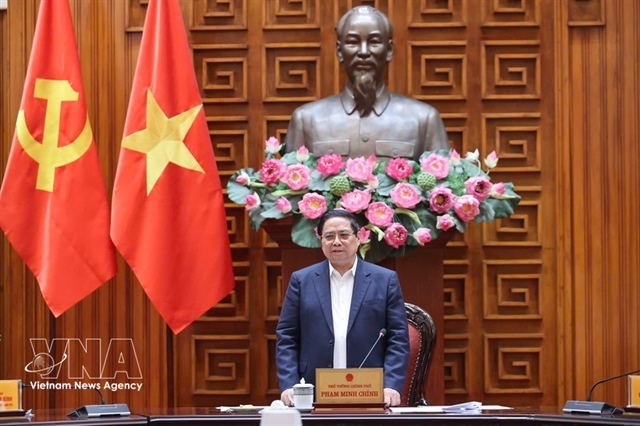
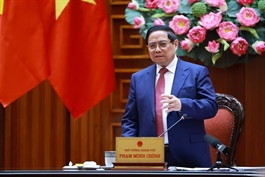
Prime Minister Phạm Minh Chính speaks at the meeting of standing members of the Government on funding sources to support fuel price stabilisation. — VNA/VNS Photo |
Prime Minister Phạm Minh Chính agreed in principle with proposals to advance funds from the State budget to the fuel price stabilisation fund while chairing a meeting of standing members of the Government on funding sources to support fuel price stabilisation on March 20.
According to reports and opinions presented at the meeting, amid developments in the Middle East and difficulties in the global oil market, the Government and the PM have recently held multiple meetings and issued urgent directives calling for timely, flexible and effective measures to ensure domestic energy security.
The Government leader has also conducted phone calls, sent official letters to leaders of various countries, and worked with foreign ambassadors in Việt Nam to seek support in safeguarding energy supplies.
Following the PM’s directives, ministries, sectors and relevant agencies have utilised the fuel price stabilisation fund and adjusted taxes on fuel products to help stabilise prices.
At the same time, major corporations and enterprises have stepped up the production and supply of fuel, coal, electricity and gas for the economy; promoted energy transition with new products gradually replacing fossil fuels; encouraged energy-saving practices; and strengthened inspections and enforcement against smuggling, hoarding, speculation and profiteering in the sector.
In his concluding remarks, PM Chính stressed that the top priority is to ensure no shortages of energy or fuel in any circumstances; minimise negative impacts from the energy crisis on macroeconomic management; and prevent disruptions to supply chains, production, business activities and people’s consumption.
To achieve these goals, a number of policies have been implemented, including fuel price stabilisation measures in accordance with regulations. However, given the rapidly evolving and complex situation – with the possibility of a prolonged crisis – preparations must be made for scenarios in which the stabilisation fund may face shortages.
The PM agreed in principle with proposals to advance funds from the State budget (from increased revenue in 2025) to the fuel price stabilisation fund. Once the crisis subsides, the fund will be used to reimburse the State budget.
The Ministry of Finance was assigned to take the lead, in coordination with the Government Office and the Ministry of Industry and Trade, to urgently finalise a draft report and seek approval from competent authorities for implementation. The policy is expected to be applied until April 15, with possible extension depending on actual conditions and subsequent reporting.
PM Chính emphasised that policy management must closely monitor developments, respond promptly, and be grounded in data and real-world conditions, in line with Việt Nam’s socialist-oriented market economy. Measures should follow an appropriate roadmap, avoiding abrupt changes or shocks.
Fuel market management must ensure price stabilisation while also taking into account fuel prices in neighbouring countries – both to support people’s livelihoods and business activities and to prevent cross-border smuggling.
The Government leader assigned Deputy PM Hồ Đức Phớc to continue overseeing matters related to the budget, taxes, fees and charges, while Deputy PM Bùi Thanh Sơn will directly handle issues related to market management and stabilisation, and the Ministry of Industry and Trade’s State management scope. Matters beyond their authority will be reported to the PM for consideration.
- 16:04 20/03/2026