Resolutions forge revolution to expand opportunities
Resolutions forge revolution to expand opportunities
Pillar resolutions underpins a wider reform agenda that includes streamlining the state apparatus and strengthening foundations in infrastructure and human resources.
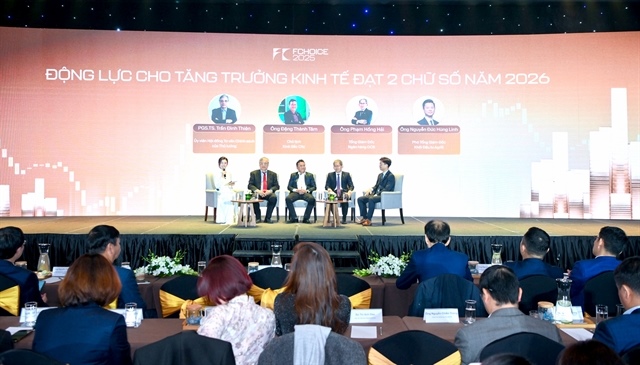
Experts discuss at the event. — Photo courtesy of the organiser |
A series of newly adopted pillar resolutions is laying the groundwork for what economists describe as a new development revolution in Việt Nam, one that broadens opportunity and strengthens freedom of choice for individuals and organisations as the country’s development space expands beyond traditional boundaries.
Speaking at the seminar Drivers of Double-Digit Growth and Investment Opportunities in 2026 held in Hà Nội on Tuesday, economist Võ Trí Thành said the current framework of resolutions was not yet complete and would soon be expanded with two more. So far, eight major resolutions had been issued, covering science and technology, international integration, law-making and enforcement, the private sector, energy, healthcare, education and the state economy.
According to Thành, this set of pillar resolutions underpins a wider reform agenda that includes streamlining the state apparatus and strengthening foundations in infrastructure and human resources. Việt Nam, he noted, still has substantial domestic resources, reflected in a high household savings rate. The central challenge is mobilising those resources effectively and building confidence so that capital flows into productive investment.
“This is a revolution about expanding opportunities and enhancing the capacity to choose, for every individual and every organisation,” Thành said. “Our development space is no longer confined to land and sea. It now extends to the digital space, outer space and even deep underground.”
Sharing the same assessment, Associate Professor Trần Đình Thiên said the most fundamental shift would lie in how policies are organised and implemented. Rather than issuing separate, fragmented resolutions that lack coordination, the current approach was systemic, designed to reshape the entire landscape instead of tackling bottlenecks one by one. This, he said, had narrowed the gap between policy intent and execution.
“The most important factor right now is the momentum of 2026,” Thiên said. “I believe that within the next 10 years, Việt Nam’s GDP could enter the world’s top 10.”
From an investor’s perspective, Đặng Thành Tâm, chairman of Kinh Bắc City Development Holding Corporation (KBC), said the change was already visible. Active in industrial real estate and working closely with foreign investors, he noted that the distance between words and action was closer than ever before.
Investment decisions, from approvals and site clearance to infrastructure development, were being implemented at unprecedented speed across ministries and localities. At the same time, Việt Nam’s recent diplomatic achievements, including comprehensive strategic partnerships with major powers, had strengthened the country’s position amid global uncertainty.
Opportunity amid global contrasts
The push for double-digit GDP growth is unfolding against a backdrop of sharp global contrasts.
The Fourth Industrial Revolution is rapidly expanding technological frontiers, forcing economies to restructure, according to Thành.
Never before have investment, trade and technology flows been so deeply intertwined. Rule-based globalisation and free trade now coexist uneasily with protectionism, rising technical barriers and great power competition.
In this context, Thành stressed that the challenge for countries would not be to exit major markets but to diversify in order to reduce risk.
For TTC AgriS, a leading sugar producer with exports accounting for around one-third of revenue, pressure is increasingly coming from green standards and traceability requirements. Deputy CEO Nguyễn Đức Hùng Linh said meeting ESG and traceability would demand strict compliance, long-term transformation and deep digital integration across the value chain.
European buyers, he said, might require full documentation within hours and in the future possibly within just one hour, or even direct access to enterprise data platforms.
“Vietnamese businesses are competing not only domestically but also with major global players such as Thailand and Brazil,” Linh said. “Beyond quality and price, ESG and traceability are becoming decisive competitive advantages.”
Tâm echoed the view that while Việt Nam’s foreign direct investment prospects remain strong, industrial real estate developers must stay proactive and flexible. When capital inflows from one market slow due to policy changes, firms need to pivot quickly to others to maintain momentum.
Alongside traditional advantages such as investment incentives and an attractive destination environment, KBC is placing greater emphasis on high-tech infrastructure.
“The share of high-tech investment in our industrial parks is among the highest in Việt Nam,” Tâm said, noting preparations to host AI data centres, which he described as critical smart infrastructure.
At the macro level, the question is no longer whether growth can recover but whether Việt Nam has built a sufficient foundation to enter a sustained cycle of double-digit growth from 2026 onwards.
Thiên said one of Việt Nam’s most significant changes, and once extraordinary, was now becoming the new normal: recognising the private sector as the core growth engine of the economy.
“Only by 2025 did we truly place the private sector in its rightful position, as the foundation and driving force of growth,” he said, pointing to Resolution 68 as a key catalyst.
Equally important, he added, would be the role of science and technology as both a goal and a tool, identified as a foundational productive force, alongside a more systematic and prioritised approach to infrastructure development.
Despite the optimism, experts agreed that execution remained the critical test. In banking, a sector central to funding growth, change was already underway. Phạm Hồng Hải, CEO of OCB, said banks were moving towards faster decision-making, clearer accountability and pilot-based implementation. Cash-flow-based lending, long common internationally but rare in Việt Nam, was widening access to capital for startups without traditional collateral, while green credit was emerging as a long-term business opportunity.
Tâm said Việt Nam’s diplomatic balance, young workforce and growing overseas labour presence added to its appeal. The decisive factor now, he stressed, would be the momentum of 2026.
“With a unified vision, strong execution and national determination,” he said, “Việt Nam has every chance to enter a new era of growth and to see its GDP rank among the world’s top 10 within the next decade.”
Experts discuss at the event. — Photo courtesy of the organiser |
FChoice 2025 honours early achievements in Việt Nam’s new growth era
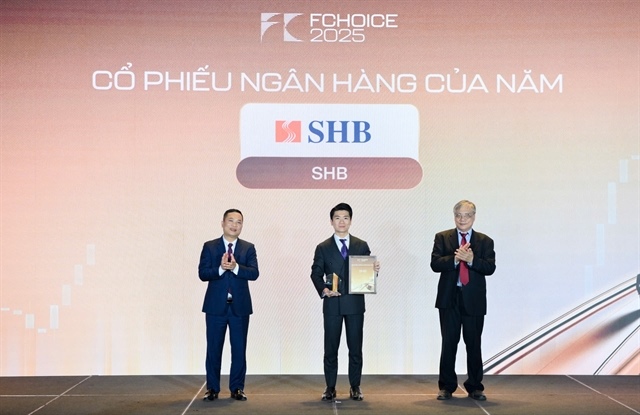
The FChoice 2025 awards ceremony was held at the event, bringing together leading economists, bankers and representatives of major enterprises from across the country.
Organised by CafeF, FChoice returned in 2025 with a refreshed format, continuing to recognise outstanding achievements that have delivered a tangible impact on the national economy, particularly in the financial and investment sectors. Beyond honouring exemplary organisations and initiatives, the event also served as a forum for policy dialogue and strategic discussion on Việt Nam’s macroeconomic outlook.
Launched in 2021, FChoice is an annual selection programme that tracks breakthrough developments shaping the economy. It has become a reference point for identifying emerging trends and assessing the effectiveness of policy and business responses in a rapidly changing environment.
The 2025 edition followed the theme Việt Nam’s Rise, featuring four main award groups: macroeconomic highlights; enterprises and entrepreneurs; notable products and projects; and audience-voted categories. The event reflected growing confidence in Việt Nam’s capacity to enter a new phase of growth, supported by institutional reform, private-sector dynamism and renewed investment momentum.
- 07:16 14/01/2026