Inflation forecast at 3.5 per cent, policy caution urged amid growth pressures
Inflation forecast at 3.5 per cent, policy caution urged amid growth pressures
Inflation in 2026 is forecast to edge up to 3.5 per cent, still below the National Assembly’s target, though double-digit growth and exchange rate pressures will demand cautious policies, experts said in Hà Nội on Monday.

A market in Tân Mỹ Ward, HCM City. 2026 inflation is expected at an average of 3.5 per cent. — VNA/VNS Photo Hương Giang |
Inflation in 2026 is expected to edge slightly higher than last year to an average of 3.5 per cent, still well below the National Assembly’s target, though mounting pressures from double-digit growth and exchange rate movements will require more cautious policy management, experts said at a forum in Hà Nội on Monday.
Speaking at the forum on market and price developments held by the Academy of Finance, Nguyễn Đức Độ, Deputy Director of the Ministry of Finance’s Institute of Economics and Finance, said inflation stood at 3.31 per cent in 2025, above the 2016–25 average of 3.09 per cent. However, this marked the 11th consecutive year that Việt Nam has kept inflation below 4 per cent, reflecting relatively stable price levels over the past decade, he said.
He pointed out that inflationary pressure in 2025 was driven mainly by strong credit growth of 17.65 per cent and a 3.92 per cent rise in the exchange rate, alongside a recovery in domestic consumption. Adjustments to the prices of some public services also contributed to higher consumer prices.
Độ also noted that a significant share of credit growth in 2025 flowed into asset markets, particularly real estate, pushing up asset prices without significantly affecting inflation.
Looking ahead to 2026, Độ said Việt Nam’s target of 10 per cent GDP growth would add pressure to prices, as rapid expansion requires a sharp increase in overall demand from both investment and consumption.
The exchange rate is also forecast to have a significant impact on the consumer price index this year, driven by higher imports as investment and consumption expand, while export growth may face headwinds from slower global economic growth.
Inflationary pressure from global commodity prices is expected to remain modest, Độ said.
Rising interest rates could also help restrain inflation, he added, noting that lending rates edged up in 2025 as credit growth outpaced deposit growth, a trend expected to continue into 2026.
Inflation is forecast to rise slightly in 2026 but not sharply, Độ said, projecting monthly CPI growth of around 0.3 per cent and an annual average of about 3.5 per cent.
However, he cautioned that prolonged high credit growth could cause monetary inflation pressures to build up over time.
Policy coordination
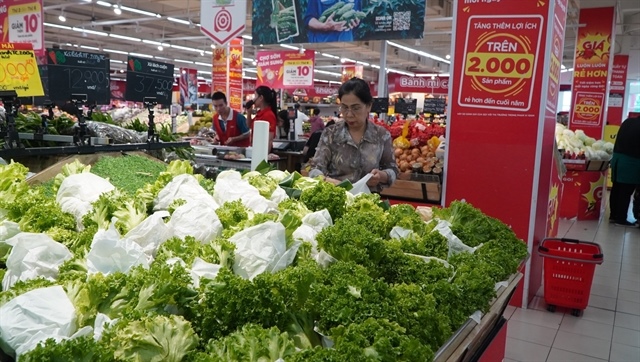
A market in Tân Mỹ Ward, HCM City. 2026 inflation is expected at an average of 3.5 per cent. — VNA/VNS Photo Hương Giang |
Achieving high GDP growth while keeping inflation within the 4–4.5 per cent target cap will require close coordination between fiscal and monetary policies, Độ said.
He pointed out that Việt Nam’s credit-to-GDP ratio reached 146 per cent in 2025, a relatively high level compared with economies at a similar stage of development, stressing that monetary policy should therefore prioritise macroeconomic stability, including inflation control, stable interest and exchange rates, control of bad debts and safeguarding the banking system.
Economist Cấn Văn Lực said digital transformation would be critical to achieving high growth alongside macroeconomic stability, particularly in the finance and banking sector. He noted that digitalisation can cut transaction costs, shorten payment times and improve transparency, thereby accelerating money circulation, which can generate higher value-added without creating excessive inflationary pressure.
Lê Quốc Phương, former Deputy Director of the Industry and Trade Information Centre, urged caution in policymaking, warning that expansionary fiscal and monetary policies aimed at supporting double-digit GDP growth in the 2026–30 period would create significant inflationary pressure.
Ngô Trí Long, an expert, said Việt Nam’s ambition to achieve GDP growth of at least 10 per cent in 2026 while keeping average CPI growth at around 4.5 per cent would require a risk-based, scenario-driven approach and close coordination between monetary, fiscal and price management policies.
He cited forecasts from international organisations that CPI would range from 3.4–3.8 per cent, or around 3.5–4 per cent, this year under the baseline scenario.
Long said a comprehensive set of measures is needed to achieve the inflation target, including ensuring transparent price roadmaps, policy coordination, reducing logistics and compliance costs and improving market monitoring and early warning systems.
Phạm Văn Bình, Deputy Head of the Ministry of Finance’s Price Management Department, said price management in 2026 will focus on ensuring effective inflation control while supporting production, business activity and daily life through appropriate roadmaps for price adjustments.
The National Assembly on November 13, 2025, adopted Resolution 244/2025/QH15 on the 2026 socio-economic development plan, setting the average CPI growth target at around 4.5 per cent.
- 14:37 13/01/2026