Cambodia’s economy will slow down to 4.3% in 2026 before rebounding to 5.1% in 2027, World Bank says
Cambodia’s economy will slow down to 4.3% in 2026 before rebounding to 5.1% in 2027, World Bank says
Ongoing reforms and infrastructure development will be key drivers of growth, contributing to broader economic stability and improving living standards across the country.
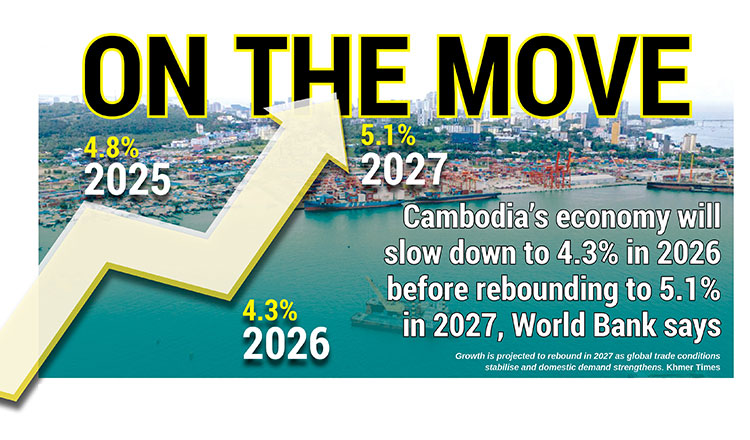
Cambodia’s economy is forecast to ease in 2026 before regaining momentum in 2027, the World Bank said in its Global Economic Prospects, January 2026. Real GDP growth was 4.8 percent last year, slowing to 4.3 percent current year, and then accelerating to 5.1 percent in 2027.
The moderation next year reflects a softer global environment, weaker trade growth, and lingering external uncertainties, which are expected to weigh on exports and investment.
Compared with the World Bank’s June 2025 projections, Cambodia’s 2025 growth outlook has been revised up by 0.8 percentage points, while the 2026 forecast has been trimmed by 0.2 percentage points, signalling a more cautious near-term outlook.
Growth is projected to rebound in 2027 as global trade conditions stabilise and domestic demand strengthens, supported by easing inflation, a gradual recovery in tourism, and continued investment in manufacturing and infrastructure.
The World Bank stressed that sustaining medium-term growth will depend on export diversification, productivity-enhancing reforms, and effective public investment management amid a more uncertain global economic environment.
The World Bank’s “Cambodia Economic Update: Coping with Shocks,” released in December 2025, also said Cambodia’s economy is expected to slow in 2026, with real GDP projected to expand by 4.3 percent, following an estimated 4.8 percent growth in 2025. The latest forecast marks an upward revision from earlier April 2025 projections of 4.0 percent in 2025 and 4.5 percent in 2026.
Besides, the report highlights that a softening property sector, border disruptions, and new trade restrictions are weighing on growth. A downturn in the property market has dampened domestic demand and construction activity, while tensions along borders have disrupted labour markets and tourism. The 2025 growth upgrade was largely driven by frontloaded exports of garments, textiles, and footwear (GTF) products.
“Cambodia is navigating a challenging period amid combined domestic and external shocks,” said Tania Meyer, World Bank Country Manager for Cambodia. “Strong buffers and targeted reforms can help the country withstand these economic pressures. Protecting vulnerable households, including returnees, remains essential. At the same time, improving the business environment, supporting informal enterprises and easing formalisation are critical to unlock growth, level the playing field, and create better-quality jobs.”
In the short term, the rapid return of migrant workers could strain job markets and social services. Over the longer term, investments in transport connectivity, including ports and highways, and improved trade logistics are expected to strengthen Cambodia’s capacity to meet rising domestic demand.
However, the World Bank cautioned that the country’s graduation from least developed country (LDC) status in 2029 could reduce access to concessional development assistance and narrow some preferential export markets, depending on transition arrangements and partner policies.
Meanwhile, the Ministry of Economy and Finance’s (MEF) Budget in Brief Fiscal Year 2026, released on Friday, forecast that Cambodia’s economy is projected to grow by 5 percent in 2026, following an estimated 5.2 per cent expansion in 2025.
The ministry said the country’s GDP in 2026 is expected to reach 217,063 billion riels, equivalent to approximately $53.79 billion, with GDP per capita rising to $3,020. The riel exchange rate is anticipated to remain stable at around 4,035 per US dollar, reflecting continued confidence in the national currency.
The current account deficit, including diversion, is projected at 3.1 percent of GDP, supported by a balanced trade position and an expected rebound in tourism revenue as regional travel recovers.
Meanwhile, inflation is forecasted to average 2.8 percent, underpinned by stable international commodity prices, especially fuel, and sustained domestic consumption and spending.
International reserves are set to reach $27.98 billion, enough to cover nearly eight months of imports, demonstrating Cambodia’s strong external position. The MEF highlighted that the medium-term fiscal framework and prudent monetary policies continue to provide resilience against global economic uncertainties, supporting sustainable growth, trade stability, and domestic investment.
The ministry also noted that ongoing reforms and infrastructure development will be key drivers of growth, contributing to broader economic stability and improving living standards across the country.
Cambodia faces external headwinds from slower global markets and uneven regional tourism recovery, according to economist Darin Duch. Speaking to Khmer Times, he highlighted the challenges and potential policy measures to safeguard the country’s economic stability.
“To start with, external conditions are creating pressures for Cambodia, with major global markets buying less and tourism recovering in a lopsided manner due to global slowdown and uncertainties,” Darin said.
He emphasised that short-term stability can be supported through Cambodia’s prudent fiscal and monetary policies. Targeted assistance to vulnerable households and small and medium-sized enterprises (SMEs), rapid disbursement of public investment—particularly in transport, irrigation, and digital infrastructure—and maintaining price stability can help stimulate aggregate demand.
Darin also stressed the importance of ensuring that credit continues to flow to productive sectors, while the financial sector improves risk-based supervision, promotes responsible lending, and strengthens capital buffers.
Looking further ahead, he called for structural reforms to diversify the economy, including supporting value-added manufacturing, green energy, modernising agriculture, and building digital skills. “These measures can help develop Cambodia’s economy sustainably, making it more resilient to global shocks,” he added.
- 13:00 20/01/2026